
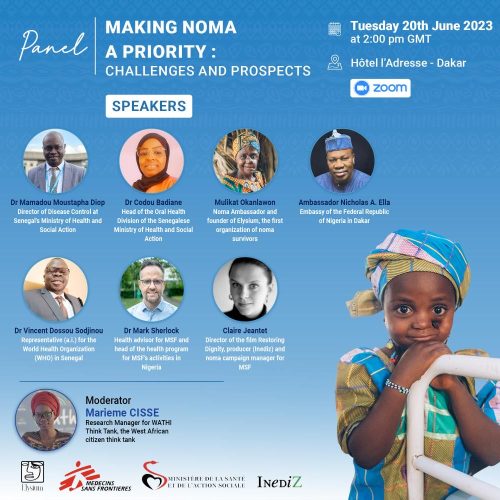

Nigeria’s Ambassador to Senegal, Ambassador Nicholas Ella, has made a case for the declaration of Noma disease as one of the Neglected Tropical Diseases (NTD) by the World Health Organisation (WHO).
Ambassador Ella also argued for more global stakeholders to engage in the campaigns and enlightenment at the grassroots level against the disease, which is a rapidly progressive and often fatal infection of the mouth and face, predominantly affecting children between the ages of two and six years in the least developed countries of the world, primarily in the “noma belt” of sub-Saharan Africa.
The Envoy launched the country’s advocacy at an awareness campaign mounted by global health governance actor – Médecins Sans Frontières (Doctors without Borders) – in Dakar, Senegal on June 20, 2023. He said at the occasion that “Having watched the video, ‘Restoring Dignity’ and listened to the panel of discussants, I believe we are all on the same wavelength to say that Noma destroys the dignity of the human body. This fatal disease is particularly prevalent among children in sub-Saharan Africa. This accounts for Nigeria’s interest in combating the causes of the disease.”
According to Ambassador Ella, there are no programs from WHO and no funding or collaboration with WHO at the moment concerning the disease even as Nigeria and African countries need more hands to combat the scourge.
Disclosing how Nigeria has treated more than 6,000 children at the Sokoto Noma Hospital, Ambassador Ella pointed out the difficulty for some persons to easily recognize Noma which takes only a short time to imperil the victims. The statistics, according to him, indicates that out of every 10 children affected, only one child makes it to the hospital.
He commended the efforts of Médecins Sans Frontières in the circumstance, particularly what he calls MSF’s giant initiative in sensitizing the public on the implications of this tropical disease and on measures for the eradication of the disease as well as for drawing support from organizations for the inclusion of Noma in WHO’s list of NTD.
The diplomat said in his remarks at the occasion that the Nigerian Ministry of Health has made considerable efforts to create awareness, to integrate Noma into its surveillance system and has equally added it to the school curriculum. The desire to see that this tropical disease is completely eradicated made Nigeria take the initiative to commemorate annual national Noma Day usually in November each year, said Ella.
The Nigerian Ministry of Health, he also said, has taken important strides at the Noma Hospital in Sokoto since 2014 towards creating awareness about the destructive effects of Noma, stressing that Nigeria has been committed to the WHO conditions for NTD warrant inclusion of the disease into its list.
As far as the Nigerian diplomat is concerned, both individuals and African governments are worried over this disease that is ravaging primarily children living in remote communities and the reality of such children having to live with the stigma and isolation that this compels them to because of the associated physical deformity.
He noted that poverty, lack of balanced nutrition, lack of access to good drinking water, cases of drinking from same source of water with animals and rejection of immunization could be factors contributing to the disease but also wants to see more research to support and determine the best treatment and control options. The diplomat equally called for a feasible public health strategy for the control and total eradication of this disease.