


 By Ihechinyere Chigemeri-Uwom
Umudike(Abia), Dec. 10, 2025
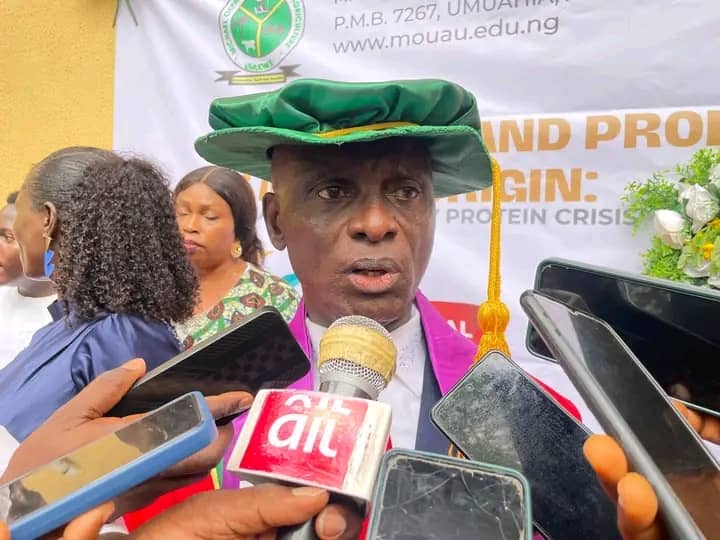
An Animal Geneticist, Prof. Uma Oke, on Wednesday urged the Federal Government to strengthen support for animal genetic improvement research programmes, emphasising their importance for national livestock development.
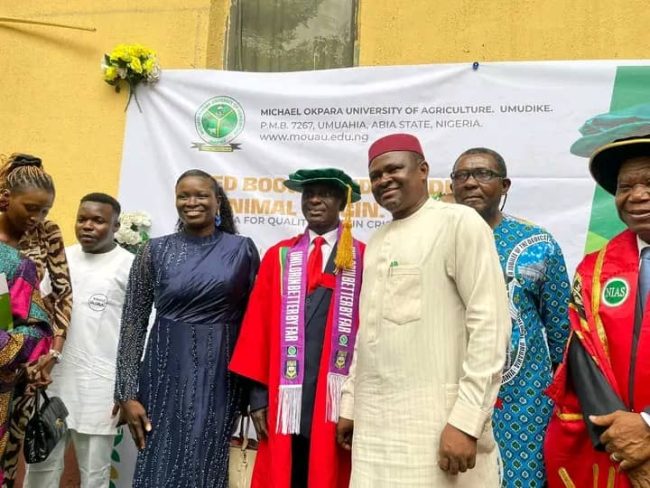
Oke, a Professor of Animal Genetics and Breeding, Micheal Okpara University of Agriculture, Umudike(MOUAU), said this while delivering the 66th Inaugural Lecture at the institution.
In his lecture titled “Seed Boogie and Products of Animal Origin: A Panacea for Quality Protein Crisis,” he emphasised that Nigeria had the potential to close its protein gap through better use of indigenous poultry strains.
Oke said that the findings of his study show that local and exotic poultry breeds hold “rich genetic material capable of transforming national protein production if properly developed”.
He explained that the application of core genetic principles, such as heterosis, breed complementarity and enhanced variability, could produce birds with faster growth, higher yield and stronger disease resistance.
According to him, results from the guinea fowl lavender–pearl combinations “clearly demonstrate the value of targeted crossbreeding in developing distinct and superior strains”.
The professor described indigenous chickens as “a reliable, affordable and nationally strategic source of quality protein,” and added that their improvement critical for food security and rural economic empowerment.
Oke called for stronger collaboration among researchers, farmers, policymakers and industry players to scale innovative protein production systems that match emerging breeding technologies.
He expressed concern that while more than 600 crop varieties have been registered since 1983, only three poultry strains; the Bununafha, Shika Brown and Nuela, had been officially recorded.
“The country must expand and formalise the registration of genetically improved poultry strains if it hopes to compete globally,” he said.
Oke stressed the need for increased financial support to breeders, noting that stabilising a new strain may take 7 to 20 years.
He said: “Developing a stable, distinct strain can take 7–20 years.
“Sustained government funding is essential for breeders to maintain long-term breeding cycles and achieve meaningful genetic advancement.”
He recommended restructuring the National Animal Production Research Institute (NAPRI) into species-specific research centres, with poultry and pig units located in the southern states where conditions favour their production.
Oke also urged improved funding and modern infrastructure for research facilities to fully exploit comparative advantages and accelerate genetic progress.
He called for more research centers nationwide, including the strengthening of the emerging hub at Umudike to conserve indigenous traits and drive innovation.
The professor further advised that institutions with available land should be supported to host species-based research facilities for poultry and pig development.
He also described improvement of animal genetic resources as “a national obligation essential to food security, sustainable development and economic growth”.
In his remark, the Vice Chancellor of MOUAU, Prof. Maduebibisi Iwe, expressed the university’s commitment to holding inaugural lectures and urged the university community to attend future inaugural lectures.
“From now till the next five years, many will be qualified to deliver these lectures and each time we announce, please find time to be here,” Iwe said.
He described the lecture as highly impactful, noting that it clarified the concept of “seed boogie” as it relates to animal mating and the production of offspring.
Iwe said that the lecturer highlighted the link between animal reproduction, sustainable breeding, and improved access to high-quality protein.
“Success in these areas should not be just an academic achievement, but a national imperative,” he noted.
The Vice Chancellor also commended the Federal Government for creating the Ministry of Livestock Development.
He expressed hope that the ministry, working with the Nigerian Institute of Animal Science, would address Nigeria’s protein and nutrition challenges.
In an interview with newsmen, the wife of the inaugural lecturer, Dr Ifeyinwa Uma-Kalu, disclosed that she plays an active role in supporting her husband’s literary work.
Uma-Kalu , who is also the Permanent Secretary of Ministry of Health, expressed gratitude to God for making the event a reality and being part of her husband’s intellectual journey.
She said: “I provide encouragement and sometimes serve as his sounding board.
“He presents his lectures to me several times, and I read parts, offering my contributions.”