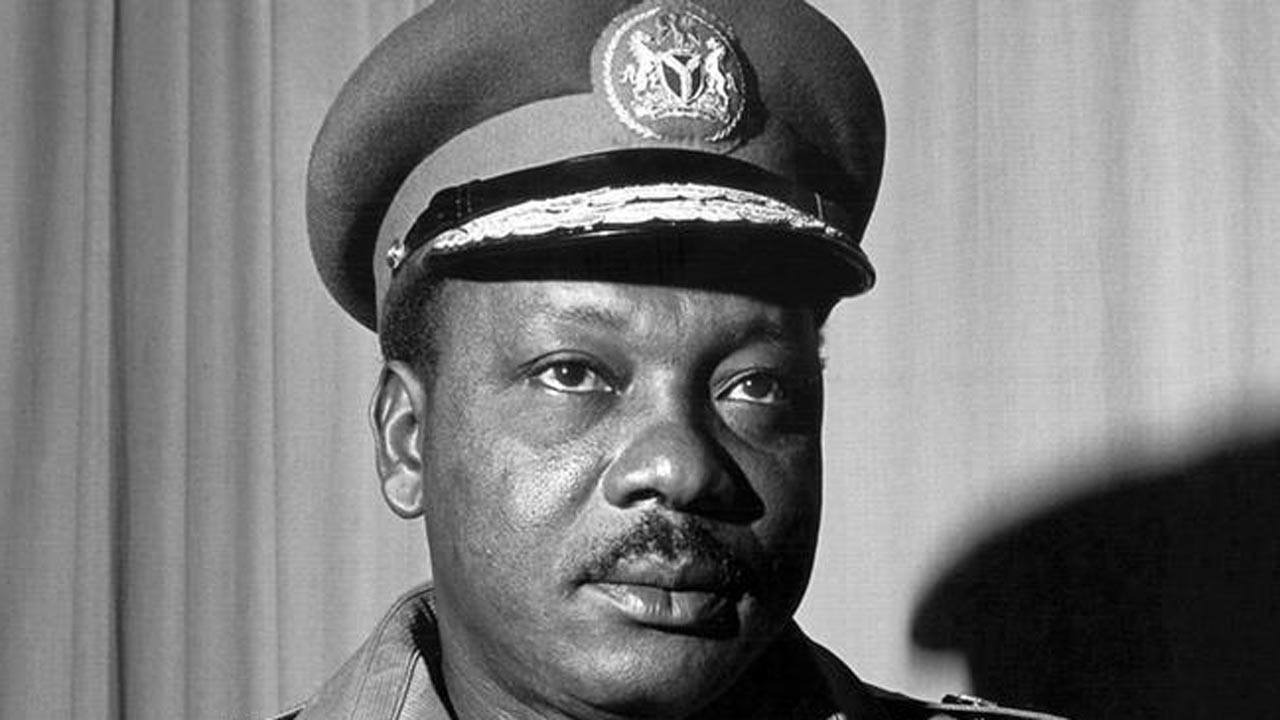
Since his gruesome murder by a mutinous segment of the Nigerian army, mostly northerners led by Major T.Y. Danjuma, Nigeria and Nigerians have been quite remiss and unfair to General J.T.U. Aguiyi-Ironsi, despite his selfless and noteworthy contributions to nation-building. For a man who gave his life to save Nigeria from anarchy, this utter disregard and ingratitude remains unfathomable. Love him or hate him, Gen Ironsi was an unwavering patriot and nationalist who loved Nigeria more than himself. His Army ADC, Sanni Bello (a Northerner), attested to the fact that at the time of the coup, Ironsi could have escaped but refused, to ensure that there was no anarchy and bloodshed thereby endangering his own life. Ironsi was reported to have said, “if he sacrificed his life and prevented bloodshed in Nigeria, it was better for him.” His Chaplain urged him to escape when mutineers were surrounding his building, he blatantly refused. It is noteworthy that Ironsi neither planned nor executed any coup against the Nigerian government. The January 15 coupists did not implicate him. Rather, as the General Officer Commanding (GOC) the Nigerian Army, a disorderly country was thrust upon him. With little to no preparation for this enormous political challenge, Ironsi rose to the occasion,despite the apparent danger to his life.
Yet, Nigerian elites and intelligentsia are fixated on Ironsi’s Decree No.34 of May 24th, 1966 promulgated to unify the country in a time of grave national uncertainties. His detractors have bought into the lop-sided narrative that this decree was the main reason for Ironsi’s overthrow and assassination. But we know better. Of course, given the prevailing ethnic tensions in the country at the time, not even a saint would have been acceptable to the vengeful North as long as the person was Igbo. Despite that it was the Supreme Military Council (SMC) that foisted Decree 34 and unitary government upon Nigeria, it made no difference to those who were determined to tie the idea exclusively to Gen Ironsi as evidence of his alleged agenda for Igbo domination. Indeed, a section of the country and its army officers believed that Gen Ironsi was part of the January 15 coup regardless that it was Ironsi who foiled the coup and forced the coupists led by Major Chukwuma Nzeogwu to surrender. Trumped up accusations and eventual murder of Ironsi were hardly surprising within the context of the political climate in Nigeria in 1966, when almost all anti-Igbo charges were ‘believable,’ even if ludicrous and laughable. In a sense, therefore, Gen Ironsi was doomed no matter what, simply because of who he was.
For a Head of State accused of promoting Igbo agenda and hegemony, the composition of his Supreme Military Council (SMC) is quite revealing. Apart from Ironsi, the only other Igbo out of the nine members of the SMC was Colonel Ojukwu who was there by virtue of being the Governor of Eastern Region. The rest were drawn from other parts of the country including Brig. Ogundipe (West); Lt Col Gowon (North), Lt Col Fajuyi (West); Lt Col Katsina (North); Lt Col Ejoor (Mid-West); and Lt Col Kurubo (Mid-West; Mr. Joseph Wey (North). Apparently, Ironsi was so detribalized that he entrusted his own safety to an Aid-de-Camp (ADC), Major Sani Bello, of northern extraction. Had Ironsi been truly a tribalist, he would have acted otherwise by assigning to an Igbo officer his personal security details. Furthermore, he would have assigned mostly senior Igbo officers to key military positions. He did neither because he was a nationalist who was consumed by his unwavering belief in ONE NIGERIA. Yet, he was accused of promoting Igbo agenda and domination. Commentators and scholars are yet to pay much attention to this patriot and national leader who still remains so misunderstood and maligned even in death.
Ironsi was the first Nigerian Military Head of State to be assassinated in a coup. The second was Maj.Gen Murtala Mohammed. Just look around the country – there are several national monuments, national buildings, and federal highways named after Murtala Mohammed in commemoration of his sacrifice to Nigeria. Murtala’s rule was as short as Ironsi’s but each came at a different phase in Nigerian history. While Ironsi emerged at a time of national crisis and anarchy, Mohammed came at time when the country was fairly stable under Gowon. Yet, each played their parts within the prevailing circumstances. Ironically, there are hardly any national memorial for Ironsi, no major national monument named after him, and Nigerian scholars have even ignored him despite his leadership and legacy. Maj-Gen Ironsi was first in everything in Nigerian army. He was the first Nigerian Army Major; first to enroll in army Staff College; first to append “M.V.O, Psc” to his name; first Lieutenant Colonel, (and therefore first to command a battalion); first Brigadier, first Major-General; first indigenous GOC of the Nigerian Army and its Supreme Commander; first military Head of State and Supreme Leader of Nigeria; and the first Force Commander of the United Nations Peace-keeping Mission in the Congo (the first African or Black Commander of any United Nations Peace-keeping mission). What a remarkable stature of a General; he was an enigma!
Despite his good intentions to forge national unity in the face of mounting tribal sentiments, Ironsi could not generate enough public interest and support to back his desire for a united Nigeria. What his detractors have consistently failed to appreciate is that Ironsi was murdered for his belief in a strong national unity that will trump ethnic politics. Strangely, while several parts of the country are today calling for a restructured country that allows for true federalism with devolution of power from the center, the North insists on concentration of power at the center, a form of unitary government for which Gen Ironsi was condemned and murdered in 1966. Indeed, realizing how they misunderstood and killed Ironsi for his concept of unitary government, the North should, as a matter of honour, erect monuments for Ironsi in their major cities because their current posture on centralization aligns more closely with those of Ironsi and SMC. Also, the federal government should, as a matter of respect, name some major national landmarks after General Ironsi. Indeed, Nigeria should apologize to Ironsi even posthumously.
In the light of the foregoing, no matter the prism with which one views Gen Ironsi and his actions, he was more of a hero than a villain who valued the unity of Nigeria so much. As the nation’s first military ruler, did Ironsi make mistakes while in office? Certainly. Did he score some positive points? Of course. Although he paid the ultimate price for Nigerian unity, why then should he be placed as a mere footnote in the Nigerian governance discourse? Today, his subordinates and professional colleagues who did less, are better memorialized. It is rather unfortunate that the country for which he died continues to be bedeviled by ethnic and religious bigotry, which coalesce to obliterate his legacies. As we labour to find a workable political arrangement for Nigeria today, may the soul of the Supreme Commander, first GOC of the Nigerian Army, and the first military Head of State, Maj Gen Johnson Thomas Umunnakwe Aguiyi Ironsi, continue to rest in peace! May we find a more perfect and peaceful union for Nigeria, and may other Nigerians begin to see the Igbo as full citizens and treat them with equity and brotherhood!
*Professor Nwauwa, PhD is of Bowling Green State University, Ohio USA