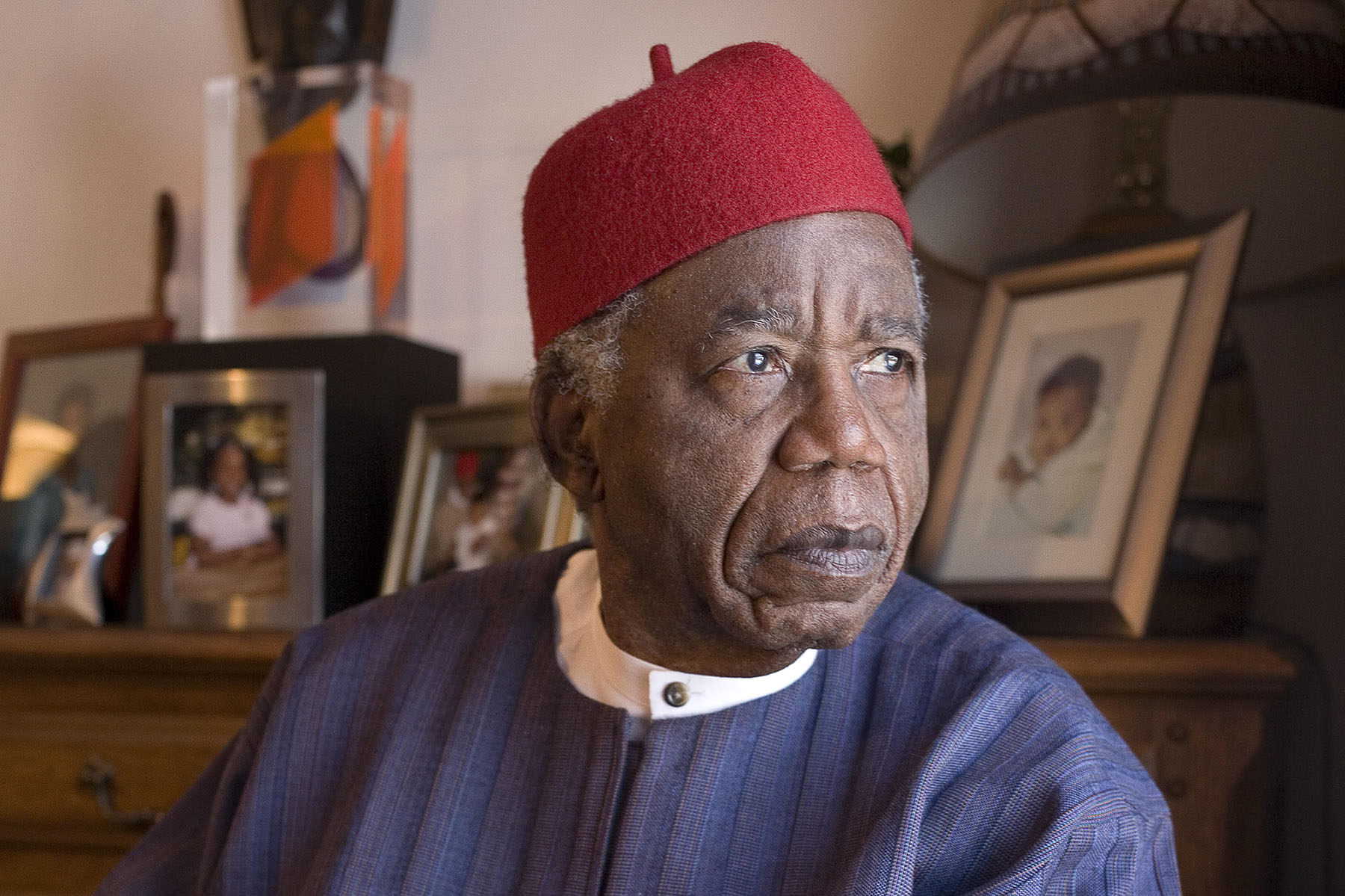
When Professor Chinua Achebe, the literary giant, legendary author, and activist from Ogidi, Anambra State, Nigeria, remarked that “until the lions have their own historians, the history of the hunt will always glorify the hunter,” it was clear to me what he meant. His remark was motivation and inspiration for me to aspire to join my African sisters and brothers to tell our own story and to refute the ethnocentric biases in the accounts of African experience hitherto written by most Western authors. To say that most European writers from the countries of our erstwhile colonizers were influenced in their writings about European encounter with Africa and Africans by ethnocentrism is to state the obvious. That’s exactly what Professor Achebe was alluding to by the story of the hunt glorifying the hunter.
For instance, Professor Peter Bauer, the Hungarian-born economist and British citizen argued vehemently, albeit incorrectly, that “while it is not true colonialism brought about poverty, there is some truth in the notion that poverty brought colonialism” in the Third World in general, and Africa in particular. Bauer argued further that foreign aid was responsible for creating the Third World and that without foreign aid there would be no Third World. I have to point out here that a person’s memory loss should not be mistaken for a record of actual events. History tells us that after World War II, the Third World emerged, adding itself to the old bi-polar worlds of capitalism and communism, or first world and second world, respectively.
It was during the decolonization process that the Bandung, Indonesia conference was held from April 17 through 24 in 1955 to facilitate a strategic meeting of new native leaders from Africa and Asia. The Non-Aligned Movement (NAM) and the Group of 77 (G-77), two independence movement organizations, emerged in 1961, and 1964, respectively. Both the NAM and G-77 played—and are still playing—the necessary roles of looking out for the interests of their member nations at the UN and as peacemakers in matters of conflict and tension between the United States and the Soviet Union, lest they plunge us into a World War III. Writing on what the Third World stood for in 1961, Julius Nyerere, the first Prime Minister of independent Tanzania, warned:
We give notice now that no one will be able to count on an automatic vote from us simply because we are their friends. Nor should any country which feels unfriendly toward us assume that we shall automatically vote on the opposite side to it. We shall not automatically condemn a policy because it is said to be a communist plot. Nor shall we necessarily oppose a policy because it is described by its opponent as an imperialist intrigue. We shall look at every issue in the light of whether we believe it supports the cause of freedom, of justice, and of peace in the world.
Equally impactful in the independence movement was the publication in the French Magazine L’Observateur of an article where the phrase “tiers monde,” French for Third World, was used for the first time on August 14, 1952. These were all events that gave unprecedented boost to the decolonization presses.
The author of this article, Alfred Sauvy, a French Economist and Demographer, used the phrase to describe the similarity between the Third Estate of France before the French Revolution of 1789 and the societies in Africa, Asia, and Latin America. Like the Third Estate, he wrote, “this Third World, ignored, exploited, scorned, wishes to stand up for itself.” The Third world wanted out from the shackles of colonialism in its quest for independence and self-determination. It was not a world waiting to choose which side to join because it chose to be itself. It is worth noting that the French use of “Third” is as in the fraction one-third sense, or one of three distinct worlds. Alfred Sauvy was saying that the region he referred to as the Third World, which included the continents of Africa, Asia, and Latin America, were people who were neither absolutely capitalists nor communists and were nonaligned and not identified with the political ideologies of the first and second worlds. He referred to the Third Estate as a distinct group of people other than the Second Estate, made of the nobility, and the First Estate, made up of the clergy. The Second and the First Estates were lording it over the Third Estate, just as the first and second worlds were lording it over the Third World. By likening the Third World to the Third Estate, Alfred Sauvy was saying that the Third World possessed a revolutionary potential, was neither aligned to America or Soviet Union, and like the Third Estate, would rise to demand freedom from European domination. That prediction came to fruition after World II when the colonies in Africa and Asia forcefully joined their Latin American counterparts as independent nations.
The phrase “Third World” was not meant as a derogatory but a forward-looking and hopeful term that described the agitation in the region as the people embarked on their relentless decolonization process. Its original meaning was not as a condition or as in good, better, and best. That being the case, the vision of the Third World, its needs, and its perspectives were different and were all incompatible with the idea that the world can be either democrats in the Western sense or socialists in the Soviet sense. Rossi wrote in 1963 that to the old alternative, the Third World added one of its own.
It is, therefore, incorrect to suggest that foreign aid created the Third World. As his reward for consistently disseminating this falsehood, Professor Bauer was made Lord Bauer, thanks to his friend the Late British Prime Minister Margaret Thatcher. In another account laced with ethnocentrism, Joseph Conrad wrote in his “Heart of Darkness” of his protagonist Marlow sailing up the Congo River in search of Kurtz the mysterious European Ivory trader. Conrad admitted European exploitation in Africa but felt no compunction using reprehensible nouns and adjectives to talk about native Africans. They were wantonly slaughtered and the fence around the residence of the enigmatic and reclusive Kurtz was adorned with the skulls of murdered native Africans. How ironic that they were called savages and not those who were killing them! I would, therefore, end here with the question about who the real savages were!
Anthony I. Akubue, St. Cloud, MN, Tuesday, December 10, 2024