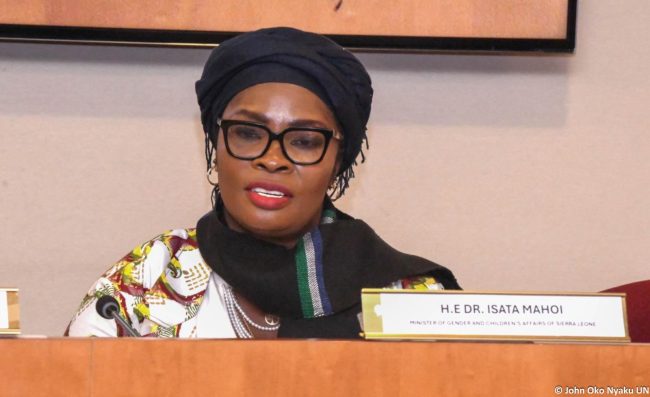
Being a statement by H.E Dr. Isata Mahoi, Minister of Gender and Children’s Affairs, Republic of Sierra Leone at the recently held ECOWAS Women, Peace and Security Response Initiatives in West Africa, a Side Event on the margins of the 69th Session of the Commission on the Status of Women, held in New York, United States.
Madam Chair, Excellencies, Distinguished Delegates,
- I am honored to participate in this ‘WPS Response Initiatives in West Africa’ event as part of our comprehensive review of progress made since Beijing 30 years ago.
- Gender forms an integral component of every aspect of our economic, political, and social lives in West Africa. Since the early days of our communities, women have been at the forefront of creating communities and upholding them through our pivotal roles in families, marketplaces, and community centres. We have a history of dynamic women establishing nations in our region, including in my country Sierra Leone – Queen Masareko and Paramount Chief Madame Yoko to name just two. This historical context gives me hope and a strong belief that we can achieve the objectives we have set for achieving the full, meaningful and safe participation of women and girls in society.
- As the first African country to co-chair the Security Council’s Informal Expert Group on Women, Peace and Security, and a Board Member of the Compact on WPS and Humanitarian Action as part of Generation Equality, Sierra Leone remains steadfast in our commitment to the full implementation of the Beijing Declaration and Platform for Action, the Maputo Protocol on Women’s Right’s and the ECOWAS Guidelines on Women, Peace and Security. Working collaboratively with our partners, including in ECOWAS and the Mano River Union, we have made significant progress in strengthening legislative and policy frameworks to promote gender equality and empower women and girls.
- Our commitment to gender mainstreaming is reflected in the integration of gender-responsive provisions across key sectoral legislations, including on employment, mineral development, public elections, political participation, land rights, and the prohibition of human trafficking, which we have developed in line with ECOWAS legal frameworks relating to women’s empowerment, good governance, and economic integration.
- The adoption of the Gender Equality and Women’s Empowerment (GEWE) Act of 2022 marked a transformative milestone in our journey toward gender equality. This landmark legislation has expanded women’s participation in political and public life, enhanced their access to economic resources, and promote equality in employment.
- Recognizing the urgent need to protect women and girls from gender-based violence, we have enacted robust legislation, including the Sexual Offences (Amendment) Act 2019, which imposes stricter penalties for sexual offences, and the Prohibition of Child Marriage Act 2024, which criminalizes all forms of marriage involving girls under 18 years of age.
- These measures, championed by His Excellency President Dr. Julius Maada Bio and Her Excellency First Lady Dr. Fatima Maada Jabbie Bio, reflect our leadership’s unwavering commitment to dismantling systemic barriers to gender equality.
Madam Chair,
- Women and girls in our region continue to be disproportionately affected by poverty and conflict, and gender gaps persist across all sectors. Violent conflict, terrorism and violent extremism, as well as climate change effects have differential and devastating consequences for women and girls. Addressing these serious violations has been made more difficult in light of growing backlash against women’s rights, including against the very language we use to communicate our identifies and issues, threatens to reverse hard-won gains. In that vein, Sierra Leone welcomes the recent historic adoption of the African Union Convention on Ending Violence Against Women and Girls during the 38th Ordinary Session of the AU.
- During our current tenure as a non-permanent member of the UN Security Council, we have spotlighted these challenges facing women and girls across the continent and in our sub-region in our deliberations on the numerous conflicts and thematic challenges we face. As IEG WPS co-chair, we have joined other WPS commitment holders in issuing statements on issues affecting the protection and promotion of women and girls’ fundamental human rights in conflict situations. Last year alone, the commitment holders delivered 11 such statements at security council stake-ins.
- Our region is an incubator of many of the best-known origin stories in the WPS journey, whether it is Liberian women barricading a hotel so that the parties would not leave without signing a peace agreement, or Sierra Leone’s contribution to international jurisprudence and gender justice. Three-quarters of ECOWAS countries have adopted a national action plan on women, peace and security, and many now have action plans and gender units in their armed forces. We therefore have an obligation to ensure that WPS agenda, a cornerstone of our collective commitment to gender equality and conflict prevention, is not compromised in the face of operational adjustments including in peacekeeping missions supervised by the UN or regional arrangements through the African Union or ECOWAS.
- Going forward, we must ensure that women are at the forefront of peacebuilding efforts. Their inclusion in peace processes is not merely a matter of equity; it is a necessity for sustainable peace. Evidence shows that peace agreements are more durable when women are involved in their negotiation and implementation. The protection of women and girls from violence, including sexual and gender-based violence, must be explicitly included in peacekeeping mandates and in peacebuilding and reconstruction strategies. Achieving these objectives requires political will, strategic will, continuous capacity building, resource allocation and a zero-tolerance policy towards perpetrators of such violence.
- In this regard, we welcome various initiatives by ECOWAS in partnership with regional and global development institutions, civil society and private sector, to improve gender equality, healthcare, and economic empowerment across the region. Training programs to build capacity of WPS focal points across the region on the global WPS framework including UN resolution 1325, have been pivotal in improving our national response to the issues affecting women in conflict and fragile contexts.
- In closing, Madam Chair, we call on States and non-state actors engaged in armed conflict to cease attacks on girls and women and allow lifesaving aid to reach the millions in need. We call for women’s voices to be heard, in boardrooms, in community centers, and in decision-making forums where policies affecting our lives and livelihoods are shaped.
- I thank you.