Grief, soul searching: Review of Ebidenyefa Tarila-Nikade’s When Tomorrow Beckons By Michael Chiedoziem Chukwudera


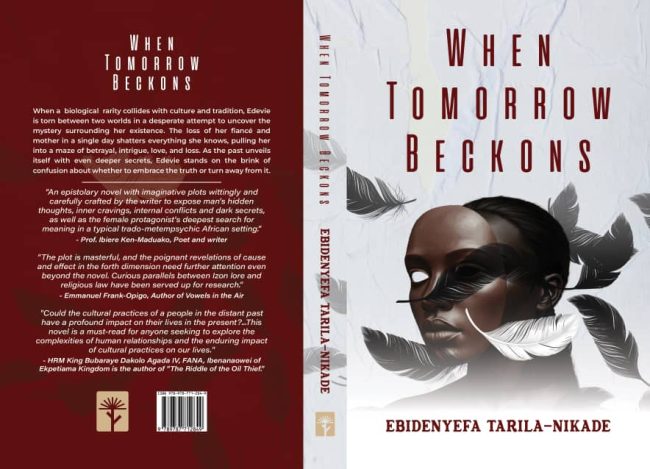
Ebidenyefa Tarila-Nikade’s When Tomorrow Beckons opens with the protagonist, Edevie, contemplating what appears to be between suicide and being on her dying bed. In the beginning of the novel, the reader never quite knows which of them it is for sure. She is writing at what is presumably the end of her life, to a friend known as Sele, to narrate how things came to their present state. And it begins with the tragic end of her love affair with the man she was to marry, who had just committed suicide. It is even sadder when we learn that the ill-fated relationship while it lasted was a very wonderful relationship, made more beautiful even by the whirlwind romance which accompanied it, before the tragic end which comes with its own unfolding and ungodly revelations.
Because the book begins on such a high note, the reader is compelled to wonder what the over 380 pages of the novel could possibly hold, and the great thing is, the protagonist’s voice compels the reader and with its urgency and piercing tone, draws you into the story. It is also noteworthy that this quality is perhaps possible because the novel is epistolary. The reader assumes the place of Sele, an intimate friend of the protagonist, who we only get to know through the intimacy with which the protagonist relays the story to her. Aside from very little, we know nothing about Sele, but the story tells us that they must be really close. The reader hence, reads the story like one written to them by a close friend. Nikade’s When Tomorrow Beckons brings to mind John Steinbeck’s advice to writers, “Your audience is one single reader. I have found that sometimes it helps to pick out one person – a real person you know, or an imagined person – and write to that one.”
Set in Bayelsa, the novel portrays a large or broad spectrum of Ijaw people and Ijaw culture, an underrepresented demography in literature in Nigeria. The psychology of the settings also proffers upon it, a unique language, a Nigerian brand of English. The type of English in which the novel is written brings a fresh dimension to the language, because of its unabashed employment of Nigerianism in the language.
The progression of the story is one in which the scare from one tragedy leads to another, and the protagonist immediately has a double edged tragedy in one instance on her hands. Afterwards, the protagonist, Edevie’s vulnerability leads her into a forbidden romance which for a while gives steam to the narrative. By the time she realises her quagmire, it’s already quite a battle to get out of it. And so the heart of the story in When Tomorrow Beckons is Edevie’s struggle to regain ownership of herself in the wake of her personal tragedy and the challenges and losses she encounters on the way, her close call with death, soul searching and ultimately her self-discovery. And the profundity of the narrative ultimately lies in the vulnerability in the story. Edevie writes to open up her heart to Sele, and the readers, as they read, come to bond like close friends to the protagonist. Some of the plot comes off as dramatic but very convincing because of the strong voice in which the story is written. She writes of her losses and her attendant grief so eloquently, and she writes of her relationship with the people in her life, from her father to Emeka, to Aisha, to Father Johnny, etc., and the paradoxes of roles they play in her life, so cleverly. The characters in the story are presented in such a way that they engage the reader’s judgements and as the story unfolded, it refutes sometimes, but often rewards the reader’s suspicions. For example, Emeka’s overzealous attitude in protecting Edevie, in the wake of Ofonime’s suicide left something amiss about his character. And sometimes, I felt Edevie tried to be too independent when she needed help, being selective of how she needed help rendered to her, only to find her suspicions materialise.
One can argue though that the novel had a lot of big grammar and could have been written in simpler English, but the grammar in which this book is written fits so much into the voice of the writer, to the voice of the protagonist, and since the story is told in a first-person narrative, it could as well be said that the protagonist in whose voice the story is told likes to speak big grammar.
Ebi Tarila-Nikade’s When Tomorrow Beckons is very expansive. But this is a consequence of the writer going all out to tell this particular story in the way that it brews inside of them, an obvious artistic choice. Edevie’s story opens the reader’s eyes to the fact that dealing with grief could as well be a spiritual path, and it delves into the native cosmology of how the protagonist’s life was charted. The answer to life’s numerous problems is often buried in layers of mystery, and sometimes, the answers leave us more shaken, even than our grief, but they open to us a path of redemption. Anyone interested in how a story is able to do this, should read Ebidenyefa Tarila-Nikade’s When Tomorrow Beckons.