
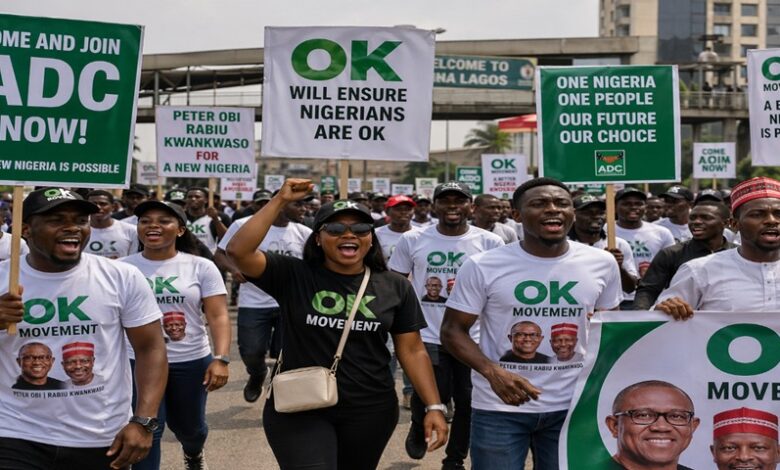
Nigeria’s political landscape is once again entering a season of recalibration, negotiations, and quiet realignments ahead of the 2027 general elections. Among the emerging signals is the growing conversation around the newly-formed OK Movement in the African Democratic Congress (ADC). If this development can be properly structured, it could reshape the contours of opposition politics and offer Nigerians a fresh electoral alternative. Yet, as with every promising political idea in Nigeria, potentiality alone is not enough. Strategy, discipline, inclusiveness, and realism must combine to determine whether the Movement is going to become a genuine force or just another fleeting experiment on will-alignment.
At the heart of the OK Movement is a possibility that has captured public imagination: the convergence of two strong political figures with distinct regional bases, in the persons of Peter Obi and Rabiu Kwankwaso. Their coming together, under a credible platform like ADC, raises an important question: can Nigeria’s opposition party finally overcome fragmentation and mount a serious challenge in 2027? The answer is yes, but only if they can meet certain critical conditions.
The first and perhaps most important requirement is clarity of purpose. Political movements in Nigeria often begin with enthusiasm but latter lose their sense of direction due to conflicting ambitions and a lack of ideological cohesion. Therefore, it is important that the OK Movement defines what it stands for beyond electoral victory. Nigerians are increasingly demanding substance: economic recovery, institutional reform, security, and governance accountability. If the Movement is to be taken seriously, it must articulate a clear, coherent vision that distinguishes it from both the ruling establishment and from the traditional opposition parties. Without this clarity, even the most attractive political alliance will struggle to inspire trust among the voters.
Unity of leadership is another important and critical factor. One of the recurring weaknesses of opposition coalitions in Nigeria is the inability to get state actors to subordinate their personal ambitions to party success. In their own rights, both Obi and Kwankwaso are influential figures with loyal supporters, and this is both a strength and a potential fault line. For the OK Movement to succeed, there must be a transparent and credible mechanism for deciding the presidential ticket that will be acceptable to all stakeholders. Whether that mechanism comes through primaries, consensus, or negotiated agreement, the process must be seen as credible and fair. Any perception of imposition or manipulation could fracture the Movement before it gains traction. This is where the question of inclusiveness and equity becomes not just a moral argument, but a strategic imperative.
Since Nigeria’s independence in 1960, the South East geopolitical zone has not produced even one Executive President. The North has produced eight Heads of State in all, and three Executive Presidents. The West has produced three Heads of State, all of which were Executive Presidents. The South-South has provided one Executive President and the South-East has provided one ceremonial President and no Executive President. This historical imbalance is more than a talking point: it is a deeply felt grievance among many Nigerians who see it as evidence of structural exclusion. Addressing this imbalance could serve as a powerful unifying message, signaling a commitment to fairness and national integration.
This means that positioning Peter Obi as the presidential candidate, therefore, will not merely be a matter of individual popularity; it will be about acknowledging a legitimate demand for inclusion. Such a decision would communicate to Nigerians and the world that the OK Movement is willing to break with entrenched patterns and embrace a more equitable distribution of power. It would also resonate with younger voters and urban populations who are increasingly driven by issues of justice, merit, and national cohesion.
However, this proposition must be approached with political sensitivity. Rabiu Kwankwaso is not a peripheral actor who can simply be asked to step aside. He represents a significant political movement with deep roots, particularly in Northern Nigeria. For inclusiveness to be meaningful, it must extend to all parties involved. This means that any arrangement that places Obi at the top of the ticket must also offer Kwankwaso and his supporters a compelling stake in the project, whether through the vice-presidential slot, strategic policy influence, or a clearly defined succession framework. If successfully negotiated, such an arrangement would send a powerful message, not only within Nigeria but to the international community, that Nigerian politics is capable of evolving beyond narrow regional calculations. It would demonstrate that equity and electability are not mutually exclusive, and that a coalition built on fairness can still be competitive.
Beyond leadership and ticket composition, the OK Movement must invest heavily in grassroots organization. Elections in Nigeria are not won solely on the strength of national figures, they are decided at the polling unit level. This requires a robust party structure, credible local leadership, and a well-coordinated campaign machinery. ADC, as a platform, must undergo rapid institutional strengthening. It needs to build its presence in all of the 36 states and the Federal Capital, recruit competent party officials, and establish functional ward and local government structures.
In addition, voter mobilization must go beyond traditional methods. The 2023 elections demonstrated the growing influence of young voters, digital engagement, and issue-based campaigning. The OK Movement should harness these dynamics by investing in data-driven strategies, leveraging social media effectively, and engaging civil society organizations. Digital enthusiasm must be matched with on-the-ground mobilization to ensure that support translates into actual votes.
Another crucial factor is coalition-building. No single movement, no matter how popular, can win a national election in isolation. The OK Movement must actively seek alliances with other political actors, regional groups, and interest blocs. This includes engaging leaders in the South-South, North-East, and North-Central regions, as well as influential stakeholders across religious and ethnic lines. Building a broad-based coalition will not only enhance electoral prospects but also strengthen the legitimacy of the Movement.
Policy credibility is equally essential. Nigerians are increasingly skeptical of political promises, having witnessed decades of unmet expectations. The OK Movement must therefore present a realistic and detailed policy agenda. This should include clear plans for economic stabilization, job creation, security reform, infrastructure development, and anti-corruption measures. More importantly, these policies must be communicated in a way that connects with the everyday experiences of citizens. At the same time, the Movement must prepare for the inevitable hurdles. One of the biggest challenges will be internal cohesion. Managing diverse interests within a coalition has never been easy, and disagreements are inevitable. What matters is the ability to resolve conflicts without undermining the overall project. This requires strong internal governance mechanisms and a culture of dialogue and compromise.
Another hurdle is the entrenched advantage of established parties. The ruling party, in particular, will not cede power easily. It has access to state resources, established networks, and significant influence. The OK Movement must be prepared to compete against this advantage by building resilience, ensuring transparency, and maintaining public trust.
Electoral integrity is another concern. Ensuring that votes count remains a critical issue in Nigeria. The Movement must invest in election monitoring, legal preparedness, and collaboration with civil society to safeguard the process. This includes training agents, deploying observers, and utilizing technology to track results. Public perception will also play a decisive role. The OK Movement must manage its narrative carefully, avoiding the pitfalls of misinformation and propaganda. It must consistently project a message of unity, competence, and hope. Any sign of internal discord or inconsistency could be exploited by opponents.
Above everything else, the Movement must address the issue of trust. Many Nigerians have become disillusioned with political alliances that promise change but deliver little. To overcome this skepticism, the OK Movement must demonstrate integrity in both words and actions. This will include transparency in funding, accountability in decision-making, and a commitment to ethical conduct. The role of ADC itself cannot be overstated. As the platform for the Movement, the party must rise to the occasion. It must enforce internal discipline, uphold democratic principles, and provide a level playing field for all aspirants. The party leadership must also engage proactively with stakeholders, ensuring that the Movement is inclusive and representative.
In consolidating its potential to win, ADC must also focus on long-term sustainability. This means building an institution that can outlast individual ambitions. Political parties in Nigeria often revolve around personalities, which weakens their stability. By strengthening its institutional framework, ADC can position itself as a credible alternative not just for 2027, but for future elections.
Ultimately, the success of the OK Movement will depend on its ability to balance idealism with pragmatism. The idea of inclusiveness, particularly in addressing the historical exclusion of the South East from the presidency, is both compelling and necessary. However, it must be integrated into a broader strategy that accounts for Nigeria’s complex political realities.
If the Movement can achieve unity, build a strong organizational structure, articulate a clear vision, and present a credible ticket that reflects both equity and electability, it stands a real chance of competing favourably in 2027. More than that, it could redefine the narrative of Nigerian politics, proving that collaboration, fairness, and strategic thinking can overcome entrenched divisions.
The road ahead is undoubtedly challenging, but it is not insurmountable. What is required is courage, the courage to make difficult compromises, to prioritize national interest over personal ambition, and to pursue a vision of Nigeria that is inclusive, just, and forward-looking. If the OK Movement can rise to this challenge, it may well become one of the most consequential political developments in Nigeria’s democratic journey.
Chief Sir Asinugo is a UK-based veteran journalist and author.


