By Ihechinyere Chigemeri-Uwom
Umuahia, May 7, 2026
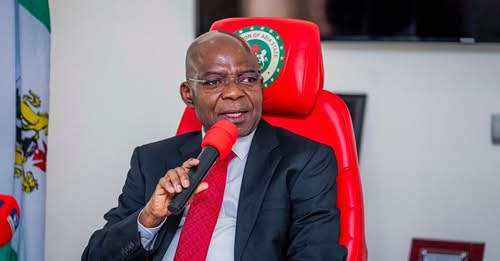
Gov. Alex Otti of Abia has said that his administration remains fully committed to efficient service delivery and institutional reforms as it approaches its third anniversary.
Otti said this on Thursday, when he inaugurated the boards of key government agencies and institutions at the Michael Okpara Auditorium, Umuahia.
The boards include the Rural Access Roads Agency, Abia State Roads Fund, Abia State Lottery Board and Abia State University Teaching Hospital (ABSUTH) Management Board.
Others are the Abia State Library Board and Governing Council of the Public-Private Partnership and Investment Promotion Office.
The governor said the inauguration of the leadership and members of the boards was intended to strengthen governance and improve service delivery.
He emphasised that his administration remained focused on governance and development, in spite of growing political activities ahead of future elections.
“We remain as committed, enthusiastic and energetic in pursuing our development objectives as we were on the day of inauguration.
“If anything has changed, it is that we are now even more determined to do more for our people,” he said.
Otti further said that although his administration had only achieved a fraction of its targets, significant and irreversible progress had been recorded in road infrastructure, public service delivery and security.
According to him, the government has restored public confidence by aligning governance with the expectations and needs of the people.
He said that his administration had also revived the “can-do spirit” of residents by creating an environment that encouraged productivity, innovation and growth.
Otti described the inauguration of the boards as part of his efforts to strengthen institutional leadership, accountability and efficiency in government operations.
He said that the agencies were strategic to the actualisation of the administration’s medium and long-term development goals.
The governor urged the appointees to deploy their experience, competence and professionalism in the discharge of their duties.
He, however, cautioned the board members against interfering in the day-to-day management of ministries, departments and agencies.
“The role of the boards is strictly policy formulation, strategic guidance and institutional oversight, while the day-to-day administration remains the responsibility of the management,” he said.
Otti also advised the management teams of the affected institutions to cooperate fully with the boards to ensure effective service delivery.
He assured the appointees of adequate welfare support to enable them to remain focused on their assignments.
The governor further commended the Abia State House of Assembly for its legislative support, especially in the passage of laws establishing some of the agencies and boards.
According to him, the cordial relationship among the different arms of government has contributed significantly to the successes recorded by the administration in the past three years.
“Abia shall indeed be great in our lifetime. We have the right quality of men and women to make that happen,” Otti said.
Responding on behalf of other appointees, Dr Ezinne Benjamin-Kalu, thanked the State Government for the confidence reposed in the board members.
Benjamin-Kalu, who is the Chairman, ABSUTH management board, described their appointments as a call to duty, sacrifice, accountability and results.
“We do not take this responsibility for granted because public service at this level is beyond ceremony; it is about delivering results and contributing meaningfully to the development of the state,” she said.
She said that the governor’s decision to inaugurate the boards reflected the administration’s commitment to strengthening healthcare delivery and improving institutional performance across sectors.
She urged members of the various boards to justify the confidence reposed in them by remaining committed to effective service delivery and institutional reforms.
She said: “Institutions, especially in the healthcare sector, must evolve to meet modern realities and international standards.
“In the healthcare sector, medical technology is advancing rapidly, research is becoming more sophisticated and public expectations continue to rise.
“Our teaching hospital must evolve to meet contemporary standards and deliver quality healthcare services to the people,” Benjamin-Kalu said.