
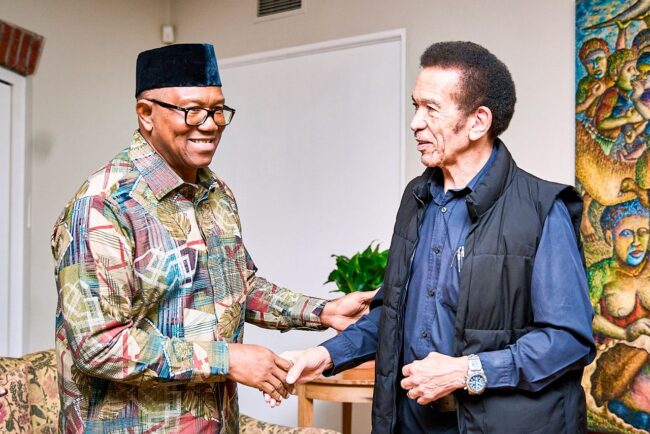
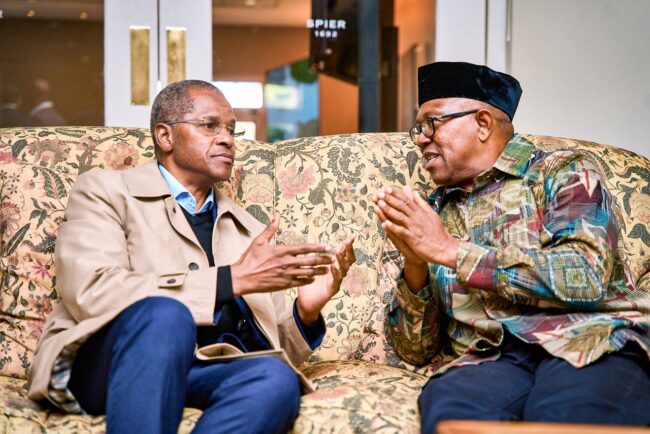
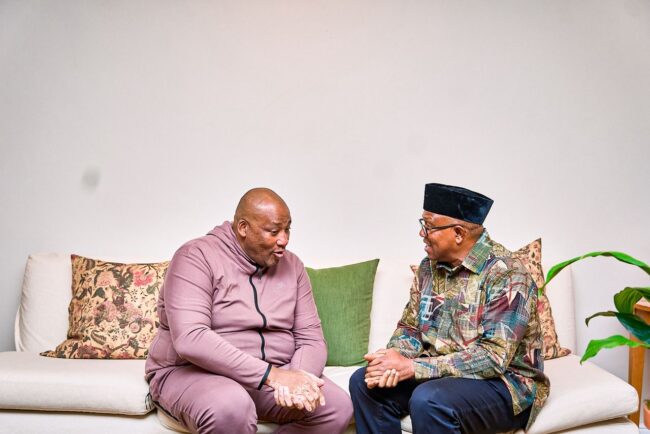
Mr. Peter Obi of the Nigeria Democratic Congress (NDC) as part of his engagements in Cape Town, South Africa, before leaving for Johannesburg, also in South Africa, met with two former African leaders, President Ian Khama of Botswana and President Thabo Mbeki of South Africa.
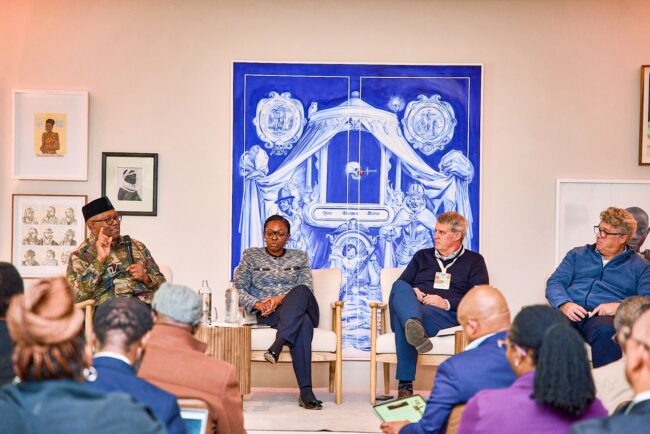
The former Governor of Anambra State, who was in Cape Town to attend the Spier Dialogue Event, where he delivered a guest speech on “Policies for Growth in Africa,” in X posts, said he used the opportunity of his meeting with the two highly respected leaders to appreciate them “for their positive comments on the recent immigration issues in the region and their continued advocacy for peace and unity among African nations.”
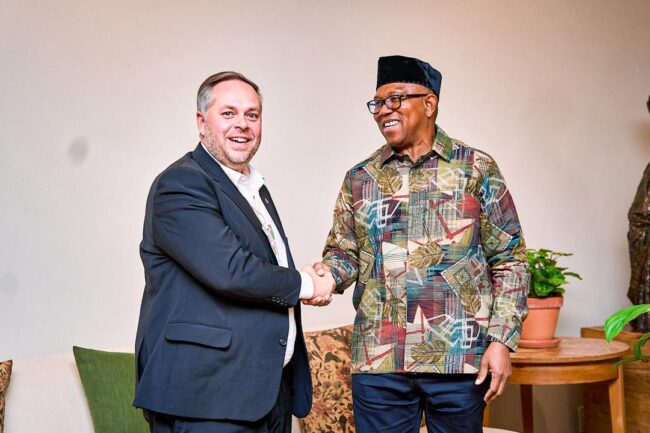
He had, while in Cape Town, also met with Mr. Leon Schreiber, the South African Minister of Home Affairs and a prominent figure in the Democratic Alliance; Mr. Velenkosini Hlabisa, the Minister of Cooperative Governance and Traditional Affairs and leader of the Inkatha Freedom Party (IFP); and Mr. Gayton McKenzie, the Minister of Sports, Arts and Culture and leader of the Patriotic Alliance (PA).
Mr. Obi, the presidential candidate of the Labour Party (LP) in the 2023 election, said his conversations with the three Ministers “were productive and candid, focusing on the current challenges that affect both countries—particularly those related to migration, economic strains, youth unemployment, security issues, and the rising tensions faced by African foreigners in South Africa.”
He said he used the opportunity of his speech at the Spier Dialogue to make the point that Africa has no reason remaining poor. “Our continent is blessed with enormous natural and human resources. Africa holds huge mineral reserves, possesses over 60% of the world’s uncultivated arable land, and has the youngest population globally. These are not liabilities; they are strategic assets for economic transformation.
“Yet, despite these enormous advantages, Africa continues to lag due to poor leadership, corruption, weak institutions, and the high cost of governance.
“Africa must now look ahead and move forward with decisive action. We must shift our focus from politics and endless election cycles to productivity, development, and nation-building. The future of Africa lies in investing aggressively in Human Development Index (HDI) indicators, especially education, healthcare, and lifting people out of poverty.
“Today, many African countries still record low life expectancy, high infant mortality, widespread unemployment, and growing poverty levels. Small and medium-scale businesses, which should be the engine of growth, are collapsing under harsh economic conditions, poor infrastructure, and policy inconsistency,” he said.
He also insisted that: “What Africa needs is competent leadership with the capacity, compassion, and commitment to prioritise production over consumption, and development over politics. If we invest in our people, strengthen institutions, reduce the cost of governance, combat corruption, and create an environment where businesses can thrive, we can build a more productive, secure, democratic, and prosperous Africa that works for all its people,” noting that “A New Africa is Possible.”