El Anatsui: Beyond bottle caps and glory By Professor Chris Uchenna Agbedo
....A review of El Anatsui: The Man, the Myth, the Legend at 80 and Counting (2026)


Preamble
“Beyond Bottle Caps and Glory: A Review of El Anatsui: The Man, the Myth, the Legend at 80 and Counting” is an attempt to read this remarkable festschrift not merely as a commemorative publication but as a cultural archive, an institutional memory and an enduring intellectual monument. Rather than reviewing individual essays sequentially, this presentation traces the volume’s larger architecture, interrogating how its diverse voices collectively construct the life, legacy and continuing significance of one of Africa’s greatest contemporary artists.
The review unfolds through ten interconnected movements. It begins with “Introduction: Beyond Biography into History,” where the extraordinary constellation of contributors and the volume’s intellectual ambition are situated. It proceeds to “Reading the Prefatory Materials: Setting the Compass of Memory,” examining how the Vice-Chancellor’s Note, the Foreword and the Editor’s Introduction establish the interpretive framework of the book. From there, it explores “Where Language Becomes Sculpture: Reading the Panegyrics for Ikedire,” demonstrating how poetry and indigenous praise traditions transform admiration into literary art. The discussion then moves to “From Monument to Man: Reading The Other Side of the Legend,” where the public icon is humanised through intimate recollections and personal testimonies.
The intellectual centre of the review is “The Intellectual Architecture of Greatness: Reading the Ideo-Aesthetics of the Master Artist,” which examines mentorship, the New Nsukka School, Anatsui’s artistic philosophy and the theoretical essays that elevate the volume from homage to scholarship. This is followed by “The Living Voice of History: Reading the Selected Interviews,” before assessing “The Monument and Its Many Strengths,” “Constructive Reservations,” and “Looking beyond the First Edition: Pathways for Future Enrichment.” The review culminates in “Beyond Bottle Caps and Glory,” and closes with “Parting Shot: The Grammar of Form,” where sculpture and linguistics converge as complementary grammars of meaning, memory and human imagination.
- Introduction
There are artists who produce masterpieces, and there are artists who themselves become masterpieces of history. The former create objects that invite admiration; the latter create legacies that command remembrance. Their lives transcend biography and become part of a people’s cultural memory. They reshape not only artistic practice but also the very language through which societies understand creativity, beauty and human possibility.
It is within this rare category that El Anatsui belongs. El Anatsui: The Man, the Myth, the Legend at 80 and Counting, a 411-page festschrift edited by Greg Mbajiorgu and Chikaogwu Kanu, is therefore much more than a birthday publication. It is an intellectual archive documenting the life, art, mentorship and global influence of one of Africa’s most celebrated contemporary artists. While the occasion is the celebration of Anatsui’s eighty-second birthday, the book itself reaches far beyond commemoration. It chronicles nearly five decades of artistic innovation, pedagogical excellence and cultural diplomacy rooted in the University of Nigeria, Nsukka, yet extending to the world’s foremost museums and galleries.
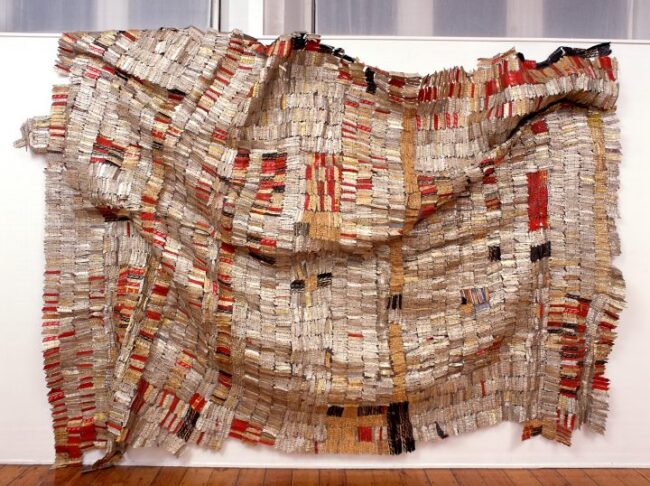
The title of my review, Beyond Bottle Caps and Glory, reflects this broader vision. El Anatsui’s transformation of discarded bottle caps into globally acclaimed artworks is already well known. His honours and international recognition are equally well documented. This volume, however, invites us to look beyond the celebrated sculptures to encounter the mentor behind the masterpieces, the neighbour behind the legend, the intellectual behind the icon, and the human being whose greatest artistic achievement may well be the countless lives he has shaped.
Perhaps the book’s first remarkable achievement lies not in what it says but in who says it. More than one hundred and twenty contributors drawn from art, literature, linguistics, history, philosophy, journalism, musicology and cultural studies across Africa, Europe and North America come together to bear witness to one extraordinary life. Particularly symbolic is the presence of eight distinguished octogenarian scholars whose contributions transform the volume into an intergenerational conversation on scholarship, creativity and legacy. Alongside them are serving and former Vice-Chancellors, former Deputy Vice-Chancellors, traditional rulers, internationally acclaimed artists and public intellectuals.
What emerges is not simply a festschrift but what may aptly be described as a republic of voices. Each contributor offers a fragment of memory, a personal encounter or an intellectual reflection. Together, they construct a panoramic portrait of an artist whose influence has transcended sculpture to shape institutions, disciplines and generations. Before the reader reaches the first chapter, one conclusion is already unmistakable: this volume is not merely documenting the life of El Anatsui; it is documenting the remarkable intellectual community his life has inspired.
2. Reading the Prefatory Materials: Setting the Compass of Memory
Every important book announces its intellectual destination before the first substantive chapter begins. Its prefatory materials are not ornamental preliminaries; they are interpretive signposts. They reveal the editors’ philosophy, define the institutional stakes and prepare the reader for the journey ahead. In El Anatsui: The Man, the Myth, the Legend at 80 and Counting, these opening texts function as a compass, gradually enlarging our understanding of the man being celebrated. They persuade us that El Anatsui is not merely an accomplished sculptor but an institutional memory, a cultural phenomenon and one of the University of Nigeria’s most distinguished global ambassadors.
The opening note by the Vice-Chancellor, Professor Simon U. Ortuanya, is much more than an official goodwill message. It is an act of institutional self-recognition. In celebrating El Anatsui, the University is celebrating one of its defining narratives. Through nearly five decades of teaching and artistic innovation in Nsukka, Anatsui transformed the University’s name into a globally recognised point of reference in contemporary art. His sculptures became cultural ambassadors, carrying the intellectual signature of the University of Nigeria into the world’s leading museums and galleries. The Vice-Chancellor’s note is therefore as much a celebration of institutional excellence as it is a tribute to an individual. That institutional affirmation is reinforced by the tribute of the immediate past Vice-Chancellor, Professor Charles Arizechukwu Igwe. The symbolic convergence of a serving and former Vice-Chancellor underscores the continuity of institutional memory. It reminds us that genuine academic traditions transcend administrations. El Anatsui’s legacy belongs not to one era of the University but to its enduring heritage.
The Foreword by Emeritus Professor P. O. Ngoddy performs another important function. It elevates the volume beyond commemoration into documentation. Rather than a birthday souvenir, the book emerges as an archival intervention, a deliberate effort to preserve artistic, intellectual and institutional memory for future generations. Finally, the Editor’s Introduction by Dr. Greg Mbajiorgu serves as both map and compass. Faced with over one hundred contributors from diverse disciplines and countries, he succeeds in harmonising remarkable diversity without suppressing individual voices. The result is a volume in which multiple perspectives converge around one luminous centre: El Anatsui, the artist, teacher, mentor, intellectual and humanist. Together, these prefatory materials perform a subtle but crucial rhetorical task. They shift our expectations from celebration to documentation, from tribute to testimony, and from a birthday book to a lasting archive of memory. In many respects, they constitute the unseen foundation upon which the entire volume securely rests.
3. Where Language Becomes Sculpture: Reading the Panegyrics for Ikedire
If the opening section constructs the public mythology of El Anatsui, the subsection “Panegyrics for Ikedire” accomplishes something even more remarkable: it transforms praise into art. Here, language ceases to be merely communicative and becomes creative. The contributors do not simply describe El Anatsui; they recreate him through metaphor, rhythm and poetic imagination. Their pens become chisels, and their words assume the texture of sculpture. One leaves these pages with the impression that literature has, for a moment, borrowed the vocabulary of the visual arts.
African societies have always recognised that extraordinary lives demand extraordinary language. From oríkì among the Yoruba to iboko and egwu otuto among the Igbo, praise poetry has long elevated memory into performance. The contributors stand within this rich tradition while refreshing it with contemporary literary sensibilities. The result is a remarkable gallery of poetic voices. The titles alone reveal the imaginative richness of the section. “Wizard with Lithe Fingers” transforms craftsmanship into enchantment, suggesting hands capable of coaxing wonder from discarded matter. “The Quiet Iroko Tree” captures Anatsui’s personality with admirable economy. The iroko symbolises strength, endurance and rootedness; its quietness reminds us that genuine greatness rarely announces itself with noise. Some of history’s tallest trees grow in silence.
Equally memorable is “Soul-Sculptor in the Den of Lions.” Here, the artist is presented not merely as one who shapes metal but as one who shapes consciousness. The “den of lions” evokes the trials and adversities through which originality must pass. Like every visionary, Anatsui transforms resistance into testimony. Then comes “Bottle Caps Glitter in the Sun,” perhaps the most evocative metaphor for his artistic philosophy. What others discard, he redeems. What others overlook, he illuminates. The title quietly captures the central lesson of his art: beauty often lies hidden within neglected things, awaiting the imagination capable of revealing it.
Among the intellectually richest contributions is the prose-poem “How Can This Continent Be Dark?” With a single rhetorical question, it overturns the colonial metaphor of Africa as the “Dark Continent.” How, it asks, can a continent that produces a creative mind like El Anatsui still be spoken of in the language of darkness? The artist’s life becomes the answer. Perhaps the greatest achievement of this subsection is that it reveals not only the man being celebrated but also the cultural imagination of those celebrating him. Every act of praise is also an act of self-disclosure. The recurring images of the elephant, iroko, sage, griot and guide illuminate African conceptions of greatness in which artistic excellence, humility, wisdom and communal responsibility remain inseparable. There is an even subtler accomplishment. Just as El Anatsui assembles discarded fragments into works of enduring beauty, these poets gather memories, metaphors, proverbs and rhythms and reorder them into literary art. Different materials, different media, but the same creative principle: transformation. In that sense, these writers are not merely writing about El Anatsui—they are practising, through language, the very aesthetic philosophy that defines his life’s work. By the close of this subsection, one realises that these are more than panegyrics. They are enduring acts of remembrance, proving that when language reaches its highest possibilities, it does not merely praise greatness—it preserves it.
4. From Monument to Man: Reading The Other Side of the Legend
Every enduring legend runs a peculiar risk: the brighter the public image becomes, the more easily the human being disappears behind it. Fame enlarges reputation while diminishing personality. The artist becomes an institution; the institution hardens into an icon; and the icon gradually eclipses the individual from whom it originated. It is precisely against this tendency that Section two—The Other Side of the Legend mounts one of the volume’s most compelling interventions. If the preceding section elevates El Anatsui into the symbolic altitude of cultural mythology, this section gently escorts him back to earth. It reminds us that before every legend stood a neighbour; before every icon lived a friend; before every international celebrity walked an ordinary human being whose greatness was rooted in the quiet rhythms of everyday life.
The transition is both deliberate and effective. Readers who have encountered the Elephant, the Iroko and the Colossus are now invited to meet the colleague who shared corridors, the traveller who journeyed across continents, the mentor who quietly transformed lives, and the friend whose humanity proved no less remarkable than his artistic genius. Essays such as The El I Know!, Celebrating Our Friend, This Colossus Named El and Reflections on El Anatsui: His Humanity, Creativity and Mentorship replace institutional distance with personal intimacy. These are not accounts of exhibitions, awards or auction records. They are narratives of encounters, conversations, encouragement and quiet acts of kindness. Again and again, contributors remember less what El Anatsui created than how he made people feel. Achievements impress the mind; humanity lingers in the heart.
The succeeding essays deepen this process of humanisation by revealing a man whose greatness expresses itself through simplicity rather than spectacle. We encounter the good neighbour, the generous friend, the sports enthusiast and the companionable colleague. Here, the stereotype of the inaccessible artistic genius quietly dissolves. El Anatsui emerges as a practitioner of quiet influence. He does not dominate rooms; he illuminates them. In an age captivated by performative celebrity, this portrait of understated greatness is both refreshing and profoundly instructive.
Perhaps, the greatest intellectual contribution of this section lies in its refusal to define El Anatsui solely by sculpture. He appears instead as historian, music enthusiast, chess coach, community builder, philosopher and public intellectual. To describe him only as a sculptor would be like describing a cathedral by its doorway. The entrance may be visible, but the vast architecture within remains unseen. These essays remind us that creativity is nourished not only in the studio but also in conversation, friendship, travel, play, reading and everyday human encounters. The artwork is produced in the studio; the artist is produced by life.
As a literary linguist, I found this section especially rewarding because it demonstrates that biography is never merely the chronology of events; it is the grammar of relationships. Lives derive their deepest meaning not simply from what individuals accomplish but from the human connections through which those accomplishments become possible. By the close of this section, the legend has not diminished; it has deepened. The icon has rediscovered his humanity. And perhaps that is the greatest compliment this remarkable collection pays to El Anatsui: it shows that the highest form of greatness is not the kind that places a person beyond human reach, but the kind that remains unmistakably human even after the world has declared it extraordinary.
5. The Intellectual Core of the Volume: Reading the Ideo-Aesthetics of the Master Artist
The intellectual centre of the volume lies in Section Three, where celebration gives way to sustained critical inquiry. If the earlier sections introduce El Anatsui as legend and restore him as man, this section explains why that legend endures. It shifts attention from personality to philosophy, from biography to aesthetics, from memory to method. Here the reader encounters not merely the celebrated sculptor but the thinker, teacher, innovator and movement-builder whose influence has profoundly reshaped African contemporary art. In many respects, this is where the festschrift most convincingly transcends homage and assumes the character of serious scholarship.
The opening essays on testimonies of mentees and colleagues illuminate what may well be El Anatsui’s most enduring artistic medium—not aluminium, wood or clay, but human potential. They reveal that great teachers are ultimately measured less by the works they personally create than by the creative lives they awaken in others. Across these reflective narratives, one encounters artists who did not simply learn techniques from El but discovered new ways of seeing, questioning and imagining. Whether in I Was Not a Fan of El, An Encounter with El That Changed My Practice, or My Journey with El, a common thread emerges: mentorship here is neither authoritarian nor prescriptive. El Anatsui appears not as a master who reproduces copies of himself but as a liberator who encourages each student to find an authentic artistic voice. His pedagogy privileges curiosity over conformity, experimentation over imitation and freedom over formula. The measure of his teaching, therefore, is not stylistic uniformity but creative diversity.
That philosophy naturally flows into the essays on the making of the New Nsukka School, arguably one of the most historically significant discussions in the collection. If the preceding testimonies celebrate individual transformation, these essays document the emergence of an artistic movement. They persuasively demonstrate that El Anatsui did far more than train successive generations of students; he fundamentally reconfigured artistic consciousness within the University of Nigeria and beyond. Under his influence, the Nsukka School matured into an internationally recognised centre of innovation, distinguished by its willingness to draw simultaneously from indigenous visual traditions and contemporary global artistic discourses. One is tempted to suggest that the New Nsukka School may ultimately constitute El Anatsui’s greatest sculpture—not fashioned from discarded metal but patiently shaped through generations of artists whose practices continue to bear the imprint of his liberating vision. It is a living artwork, still growing, still evolving, and still extending his influence far beyond the walls of his studio.
The essays devoted to El Anatsui’s legacy widen the horizon still further. They remind us that his achievement cannot be measured solely by exhibitions, honours or auction records. Long before environmental sustainability became fashionable academic vocabulary, El Anatsui was already practising an aesthetics of ecological redemption. His celebrated transformation of discarded bottle caps and other found materials into monumental works of beauty is shown to be far more than an exercise in formal experimentation. It is a profound philosophical statement about renewal, value and possibility. Waste becomes wealth; fragments become form; what society discards is reclaimed into significance. His sculptures quietly challenge modern cultures of excess by demonstrating that creativity often begins where consumption ends. In this respect, his art speaks simultaneously to environmental ethics, African material histories and the universal human capacity to remake broken worlds.
Perhaps, the richest intellectual rewards await the reader in the concluding subsection, Unveiling the Legend. Here the contributors move decisively beyond appreciation into rigorous theoretical engagement. Essays such as Alchemy of Memory and Matter, From Refuse to Renewal, Analysis of El Anatsui’s Metallic Sculpture, Transvangardist Visionary, and Rhythm of Life Forms reveal the astonishing interpretive fertility of his work. Through the lenses of postcolonial studies, memory studies, material culture, environmental humanities, philosophy and visual methodology, Anatsui’s sculptures emerge as texts that invite endless reading. Metal becomes memory; discarded objects become historical testimony; artistic form becomes philosophical argument. His works resist definitive interpretation because they inhabit the fertile intersection where history, ecology, aesthetics and identity continually converse.
For a literary linguist, this section carries particular fascination. One begins to recognise that El Anatsui’s sculptures operate much like language itself. Just as words derive meaning not in isolation but through their relationships with other words, the seemingly insignificant fragments that compose his sculptures acquire significance only through their placement within larger visual structures. Individual bottle caps resemble lexical items; the completed sculpture resembles discourse. Meaning is generated not by isolated units but by patterns of connection. In that sense, Anatsui may rightly be described as a grammarian of materials, constructing visual syntax from discarded objects just as the writer fashions enduring meaning from ordinary words.
By the end of this section, the reader understands why the volume commands lasting scholarly value. It no longer asks merely that we admire El Anatsui; it challenges us to think with him. His art is revealed not simply as visually compelling but as intellectually inexhaustible. This is where the festschrift rises decisively above commemorative literature. It becomes a serious contribution to African art history, cultural studies and interdisciplinary scholarship. If the earlier chapters preserve memory, this section generates knowledge. And in doing so, it ensures that El Anatsui’s legacy will continue to inspire not only artists and admirers, but also future generations of scholars who will return to his work, discovering in it ever new questions, new meanings and new possibilities.
6. The Living Voice of History: Reading the Selected Interviews
The volume concludes with Selected Interviews, a section whose significance extends far beyond editorial convention. If the preceding chapters interpret El Anatsui through scholarship, these conversations allow him to emerge through the immediacy of lived experience. Interviews occupy a unique space between history and memory, preserving not merely facts but the rhythms of speech, the spontaneity of recollection and the authenticity of personal testimony. They remind us that archives are built not only from documents but also from voices.
The interview with Dr. (Mrs.) Adaobi Onah offers an intimate portrait of the artist beyond the polished narratives of academic discourse. Here, memory unfolds naturally through conversation, revealing dimensions of character that formal criticism alone could scarcely capture. The conversational mode restores warmth, personality and human presence to a figure whose public reputation might otherwise overshadow the individual behind it. Equally valuable is the interview with His Royal Highness Igwe George Asadu, which relocates El Anatsui within the cultural landscape of Nsukka. It reminds readers that greatness is measured not only by international exhibitions and museum collections but also by the esteem of the community in which one has lived, worked and quietly transformed lives.
By ending with these conversations, the editors make an astute editorial choice. After hundreds of pages of tributes, literary celebrations and critical essays, the book returns to the oldest medium of preserving knowledge; i.e., the spoken word. These interviews become living archives, safeguarding voices before they recede into history. In doing so, they complete the volume’s remarkable journey: from celebration to documentation, from documentation to remembrance, and ultimately from remembrance to history itself.
7. The Monument and Its Many Strengths: Major Merits of the Volume
The greatness of this volume lies not only in the excellence of its individual essays but in the remarkable architecture that binds them into a coherent intellectual whole. It is at once a festschrift, an archive, a literary anthology and a scholarly compendium, and it succeeds admirably in each of these roles. Its first distinguishing merit is its monumental scope. More than one hundred and twenty contributors converge across its pages, representing an extraordinary community of scholars, artists, traditional rulers, administrators and public intellectuals. Particularly noteworthy is the remarkable constellation of eight octogenarian scholars whose contributions lend the book the authority of living history. Their presence transforms the volume into an intergenerational conversation on creativity, scholarship and legacy.
Equally impressive is its interdisciplinary breadth. Art history converses with literature, linguistics with visual aesthetics, philosophy with history, journalism with musicology, creating a rich intellectual mosaic that reflects the expansive reach of El Anatsui’s artistic imagination. The editors wisely allow multiple disciplines to illuminate the same subject without sacrificing coherence. The volume’s international reach further enhances its significance. Contributors from Africa, Europe and North America testify that Anatsui’s artistic journey, though rooted in Nsukka, belongs to the wider world. In celebrating one artist, the book simultaneously celebrates the global visibility of African creativity.
Another enduring strength is its preservation of institutional memory. Running through the essays is the evolving story of the University of Nigeria, Nsukka. The book therefore documents not only the life of an artist but also the intellectual culture that nurtured his remarkable career.
Perhaps its greatest contribution, however, is its archival value. Future scholars of African art, cultural history and contemporary aesthetics will repeatedly return to these pages as an indispensable documentary resource. What might have disappeared as scattered memories has here been preserved as enduring scholarship.
Finally, the volume achieves a rare balance between scholarship and sentiment. It engages both the intellect and the emotions, proving that rigorous analysis and heartfelt admiration need not be opposing impulses but complementary ways of honouring an extraordinary life. In that harmonious union lies one of the book’s most enduring triumphs.

8. Constructive Reservations: Where the Volume Could Have Reached Even Greater Heights
No work of this magnitude is beyond constructive criticism. Indeed, the finest tribute a reviewer can pay a serious publication is to engage it critically rather than reverentially. El Anatsui: The Man, the Myth, the Legend at 80 and Counting is an outstanding achievement whose few limitations arise largely from the commemorative nature of the festschrift itself. Its most noticeable limitation is the predominance of celebration over sustained critical interrogation. The essays are rich in admiration and gratitude, but readers seeking more robust debates on aspects of Anatsui’s artistic philosophy, evolving practice or the wider controversies surrounding contemporary African art may find the discourse somewhat uniformly laudatory. A small number of essays offering respectful critical engagement would have further strengthened the book’s scholarly authority.
The volume also exhibits some inevitable repetition. Given the sheer number of contributors, familiar anecdotes and recurring metaphors such as the elephant, the iroko and the mentor, appear across several essays. While understandable in a collective tribute, tighter editorial coordination might have encouraged greater thematic variety. Given that the subject is one of the world’s foremost visual artists, a richer visual archive would also have enhanced the volume. Additional colour reproductions of major works, landmark exhibitions and studio photographs would have complemented the textual brilliance with a more expansive visual experience.
Finally, a consolidated chronological biography tracing El Anatsui’s life, exhibitions, honours and major career milestones would make future editions even more valuable as reference works. These observations do not diminish the stature of the book. Rather, they point to possibilities for an already distinguished volume to become even more comprehensive and enduring. Such suggestions are, in themselves, a tribute to a work that has already secured an important place in the documentary heritage of African art and scholarship.
9. Looking Beyond the First Edition: Pathways for Future Enrichment
Every significant book not only records achievement but also opens new possibilities for future scholarship. This volume has already established itself as a major contribution to African art history and cultural documentation, yet its richness naturally invites further development. Foremost among these possibilities is the creation of a more expansive visual archive. As the subject is one of the world’s foremost visual artists, future editions would benefit from additional colour reproductions of major works, photographs of landmark exhibitions, studio practice and key moments in El Anatsui’s remarkable artistic journey. Such images would complement the essays by allowing readers to encounter directly the visual language they so eloquently interpret.
A consolidated chronological timeline of his life and career would also strengthen the book’s documentary value, enabling readers to follow the progression of his artistic development alongside his major exhibitions, honours and international recognition. Equally valuable would be a select bibliography of scholarship on El Anatsui and an appendix documenting his major exhibitions across the world, thereby transforming the volume into an even more indispensable research resource.
Finally, future editions might include a dedicated section of extended critical essays engaging contemporary debates in postcolonial aesthetics, environmental humanities, material culture and African modernism. Such additions would not diminish the commemorative spirit of the volume; rather, they would reinforce its standing as the definitive scholarly resource on El Anatsui. These suggestions are offered not as corrections but as invitations. The surest sign of an important book is that it leaves room for future generations to continue the conversation it has so brilliantly begun.
10. Beyond Bottle Caps and Glory
Every enduring work of art eventually transcends the material from which it is fashioned. Under the discipline of imagination, ordinary substances acquire extraordinary destinies. That truth has defined El Anatsui’s artistic career. He has shown the world that significance often lies hidden within what society discards, and that beauty is less a property of precious materials than an act of creative redemption. Curiously, the book under review embodies the same philosophy. El Anatsui: The Man, the Myth, the Legend at 80 and Counting is far more than a commemorative volume. It is a cultural archive, an intellectual monument and a repository of collective memory. Its pages preserve not only the story of an extraordinary artist but also the history of the University of Nigeria, the evolution of the Nsukka School and the global journey of modern African art. In gathering over one hundred and twenty contributors from different generations, disciplines and continents, the editors have transformed many distinct voices into one compelling narrative of creativity, mentorship and legacy.
The volume also performs an invaluable archival function. It preserves memories before they dissolve into history and safeguards testimonies that future scholars will regard as primary sources in reconstructing the intellectual history of African contemporary art. Its significance therefore extends far beyond the immediate occasion of celebration. Ultimately, however, the greatest achievement of this remarkable publication is not that it tells us who El Anatsui is. Rather, it demonstrates what one life, lived with disciplined imagination, intellectual generosity and creative courage, can make possible. It shows how an artist becomes an institution, how a teacher becomes a movement, and how a university becomes a global point of artistic reference.
That, in the final analysis, is the enduring triumph of this book. It takes us beyond bottle caps and beyond glory, beyond biography and beyond celebration, to a deeper understanding of how genius enters history, not simply through the works it creates, but through the lives it transforms, the traditions it reshapes and the possibilities it leaves behind for generations yet unborn.
Parting Shot: The Grammar of Form
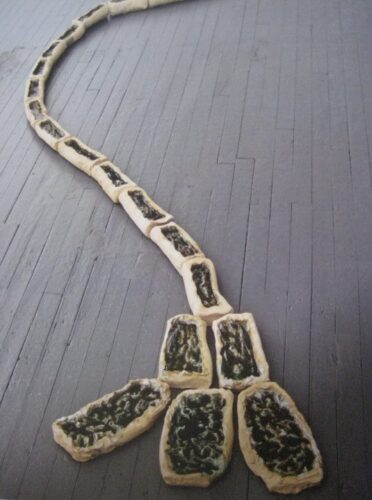
As I closed this remarkable volume, I found myself returning to a thought that has quietly accompanied this review. At first glance, sculpture and linguistics appear to inhabit different worlds. One shapes matter; the other studies language. Yet, beneath that apparent difference lies a profound affinity. Both are arts of meaning-making. The sculptor transforms material into significance; the linguist uncovers significance in discourse. One works with texture, the other with text. Both seek to rescue meaning from the ordinary. This perhaps explains why El Anatsui’s art has always spoken to me as a literary linguist. His bottle caps are never merely bottle caps. They become signs, symbols and silent narratives through which history, memory, commerce, identity and resilience are made visible. Every installation is a visual discourse awaiting interpretation. His sculptures are, in effect, texts without sentences.
By the same logic, language itself is a form of sculpture. Every metaphor chisels thought into shape; every sentence gives architecture to ideas. The sculptor and the linguist therefore share the same creative vocation: they gather fragments and organise them into meaning. The editors of this volume have unconsciously practised the same philosophy. By bringing together more than one hundred voices from different generations, disciplines and nations, they have transformed diversity into coherence. The book itself becomes an artistic creation, demonstrating that intellectual harmony need not require uniformity. That, ultimately, is the deepest lesson of both El Anatsui and this remarkable publication. Civilisation advances not only through those who shape objects of beauty, but also through those who shape meanings that endure. In that shared enterprise, the sculptor and the linguist discover that they have always been speaking the same language.

Permit me, therefore, to end where El Anatsui himself has taught us to begin, i.e., with the ordinary. He transformed discarded metal into enduring beauty. This remarkable volume transforms memory into history. Both remind us that greatness is not found in the material from which things are made, but in the imagination that gives them form. If art is memory made visible, then this book is memory made enduring. It deserves not merely to be read, but to be returned to, again and again, as future generations seek to understand not only the man called El Anatsui, but also the remarkable world of ideas, institutions and human relationships that his life made possible.
Agbedo, PhD, fnias, mnal is a Professor of Linguistics, University of Nigeria, Nsukka.


