
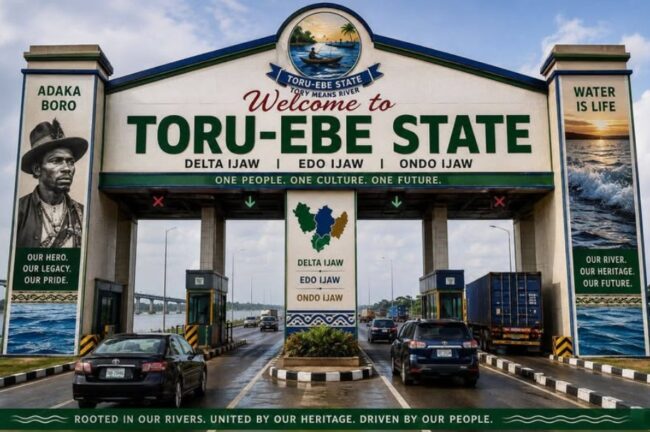
The image before us transcends the boundaries of a conventional architectural structure. It evokes memories of a historic gathering convened nearly three decades ago by Chief Joseph Oyakeme Agbegha, Chairman of the Toru-Ebe State Creation Movement, where distinguished sons and daughters of Toru-Ebe, traditional leaders, and eminent advocates converged around a shared vision of identity, equity, and self-determination. At that defining moment, I was entrusted with the responsibility of serving as the Coordinator of the Toru-Ebe State Creation Movement in the United States, while High Chief Christopher Youdeowei, Okosi-Ala and Traditional Prime Minister of the Kabowei community in the Niger Delta region, was appointed European Coordinator.
Those responsibilities were not ceremonial acknowledgments; they represented a solemn commitment to a historic aspiration. Decades later, I can affirm with unrelenting conviction that the vision remains alive, the cause remains legitimate, and the journey continues. This image therefore represents far more than a physical monument. It embodies historical consciousness, collective memory, and the enduring determination of a people to preserve their heritage and secure their rightful place within the Nigerian federation.
For millions of Toru-Ebe people across Nigeria, in the diaspora, and for all genuine advocates of the proposed Toru-Ebe State, this image conveys a profound message: a people united by ancestry, culture, history, and destiny cannot be permanently diminished by artificial boundaries. It affirms the enduring reality that the Delta Ijaw, Edo Ijaw, and Ondo Ijaw are not disconnected communities, but a unified cultural nationality bound together by ancestral lineage, language, traditions, collective experiences, and the riverine civilization that has shaped their existence across generations.
The inscription, “One People. One Culture. One Future,” is therefore not a symbolic expression devoid of substance. It represents a living historical reality forged through centuries of resilience, sacrifice, adaptation, and perseverance. It reflects the legitimate aspiration of an indigenous nationality determined to preserve its identity, advance sustainable development, and participate fully in the Nigerian project with dignity, recognition, and fairness. The pursuit of Toru-Ebe State is not an act of separation or exclusion; rather, it is a principled appeal for inclusion, equity, and a more balanced federation where every constituent community has the opportunity to contribute meaningfully to national progress.
It must be clearly understood that the demand for the creation of Toru-Ebe State is neither an emotional reaction nor a political convenience. It is a carefully considered proposition anchored in constitutional equity, historical continuity, administrative effectiveness, and distributive justice. It reflects the legitimate aspirations of an enduring ethnic nationality whose collective identity predates colonial boundaries and whose contributions to Nigeria’s economic survival and national development have remained significant and undeniable.
For generations, the Ijaw communities spread across Delta, Edo, and Ondo States have experienced administrative separation without cultural disintegration. Colonial and post-colonial boundaries may have divided governmental jurisdictions, but they have never erased the shared consciousness, traditions, and aspirations of the Toru-Ebe people. Their rivers continue to connect them. Their heritage continues to unite them. Their collective vision for a more equitable future continues to endure.
The creation of Toru-Ebe State, therefore, would not represent the invention of a new identity. It would constitute the constitutional recognition of an existing historical reality and the restoration of an ancient cultural community whose unity has survived decades of administrative fragmentation.
The strength of any federation depends upon its ability to correct imbalances, acknowledge legitimate grievances, and ensure that all communities experience a genuine sense of belonging. Throughout Nigeria’s constitutional history, the creation of states has served as a mechanism for expanding representation, bringing governance closer to the people, promoting development, and strengthening the federal character principle upon which the nation was founded.
The Toru-Ebe aspiration belongs within this established constitutional tradition.
Its creation would provide an opportunity for more responsive governance across the riverine communities, accelerate infrastructural transformation, strengthen environmental protection, promote maritime enterprise, enhance security along the coastal corridor, and unlock the immense possibilities of Nigeria’s Blue Economy. It would empower communities that have contributed substantially to the nation’s petroleum wealth while addressing the persistent developmental disparities that have characterized many resource-producing areas.
Justice cannot indefinitely demand sacrifice from communities that have patiently awaited fairness.
Nigeria’s unity cannot be sustained solely through constitutional declarations. It must be continuously strengthened through equitable representation, balanced federal arrangements, and visible demonstrations of fairness. A nation achieves enduring cohesion when every constituent community sees itself not as a peripheral observer, but as a valued stakeholder in the collective national enterprise.
The demand for Toru-Ebe State is not directed against any ethnic nationality, existing state, or regional interest. It is an invitation to further strengthen Nigeria’s federation by extending to the Toru-Ebe people the same constitutional opportunities that have enabled other communities to achieve greater representation, development, and inclusion.
The towering image of Isaac Adaka Boro on the gateway serves as a profound reminder that every generation inherits unfinished responsibilities. His historic vision was never anchored in hostility or division, but in dignity, justice, self-determination, and the equitable treatment of all peoples within the framework of national advancement. The flowing waters depicted alongside his image carry an equally powerful message: rivers do not divide civilizations; they connect destinies, cultures, and communities.
Water is life. Justice is nation-building. Equity is the foundation of peace.
The creation of Toru-Ebe State would symbolize a Nigeria confident enough to acknowledge historical realities, courageous enough to address longstanding imbalances, and visionary enough to strengthen national unity through fairness rather than exclusion.
The historical record further demonstrates that this aspiration is neither recent nor accidental. On 25 October 2007, a formal document titled “A Request for the Creation of Toru-Ebe State from the Present Delta, Edo, and Ondo States” was submitted to the administration of Alhaji Umaru Musa Yar’Adua, President of the Federal Republic of Nigeria from May 2007 until his death in May 2010. The request was presented on behalf of the proposed Toru-Ebe State by a distinguished assembly of Ijaw leaders, traditional authorities, professionals, and advocates who represented a broad spectrum of the community’s aspirations.
The signatories included Chief (Dr.) E. K. Clark (OFR), foremost Ijaw National Leader; Chief J. O. Oyakemeagbegha, Chairman of the Toru-Ebe State Creation Movement; Chief Joshua Fumudoh, former President of the Ijaw National Congress; Professor (Rev.) C. A. Dime, Pioneer President of the Ijaw National Congress; Brigadier General C. K. Emein (Rtd), former Military Administrator of Niger State; High Chief F. J. Williams, former INC National Secretary; Major Frederick Anesah (Director, State Security Service, Rtd); and numerous other respected leaders, including traditional leaders, retired military officers, legal practitioners, public servants, and members of the Toru-Ebe State Creation Movement. Among them were High Chief Joel M. Magi (JP), Chief (Barr.) R. E. O. Esite, Barrister Alexander I. Moro, Barrister Sam A. B. Ikporukpo, Brigadier General Broderick Demeyeibo, Chief (Barr.) V. B. Bamuza-Mutu, Lieutenant Colonel Edwin Agbegha (Rtd), Commander Maurice Biakpara (Rtd), Chief Benson Egbele, Chief Henry Pereotubo, Evangelist Nathaniel O. Ege (JP), Engineer Dennis Seikepagha, and Mr. Okokolo Carter (JP), General Secretary of the Toru-Ebe State Creation Movement.
That historic petition remains a significant milestone in the continuing pursuit of recognition, equity, and inclusive development. It provides undeniable evidence that the movement for Toru-Ebe State is not a recent initiative, but a sustained and carefully articulated aspiration rooted in history, justice, and the constitutional principles of equitable national development.
The time has come for Nigeria to complete another important chapter in its democratic evolution.
Let justice prevail over expediency. Let equity triumph over historical neglect. Let constitutional fairness rise above political hesitation.
Toru-Ebe State is not a narrowly defined geographical proposition. It is a constitutional imperative, a developmental necessity, and a national opportunity whose realization will contribute to a stronger, more united, and more prosperous Federal Republic of Nigeria.
Professor Gold, FCILG, FCECFI is the Amadabo of Ijaw Diaspora, author of Isaac Adaka Boro: The Unfinished Project and Recipient of the United States President’s Lifetime Achievement Award