
Beyond culture: Why creative industries are the economic future of Africa and the Caribbean By Keneea Linton-George, Kingston, Jamaica



August 4, 2025.
Africa and the Caribbean are two of the most creative and culturally rich regions on earth, exporting music, food, fashion, and art to the world. But while the world hungers for more, the fuel to drive this creativity remains underfunded, under-supported, and undervalued. At the 2025 AFRI-Caribbean Investment Forum, cultural industry leaders called for bold, structural investment to turn creativity into commerce, and vision into viable industries. And as a practitioner in one of the most promising yet under-leveraged industries, I left with more than inspiration, I left with a sense of urgency. The dialogue with cultural and creative leaders centered on the transformative potential of collaboration between the two regions, the conversation moved far beyond shared history, it pointed to a shared opportunity. The Caribbean is sitting on a goldmine and requires vision and courage at this pivotal time.
Globally, creative and cultural industries (CCIs) employ 29.5 million people, and in the UK, the CCIs are growing five times faster than the national economy. There is no reason this growth cannot be mirrored in the Caribbean, if we formulate the necessary systems and strategies. The industry faces a chronic lack of data, investment, and formal recognition. As Ambassador Arlando Romain bluntly stated: “The government needs to move beyond seeing the creative sector as soft power and reposition it as a co-economic pillar.”
Nordicity highlighted that “The British Council has referred to culture as ‘The Missing Pillar’ of sustainable development, deserving of recognition alongside the three pillars of development – social, economic, and environmental.” The 2021 Nordicity report on the Cultural and Creative Industries in Jamaica commissioned by the British Council revealed that “there is an urgent need to research and document the economic impact of CCIs in Jamaica.”
According to UNESCO, “Jamaica’s cultural and creative industries’ (CCIs) are estimated to contribute 5.2% of the country’s GDP, generating revenues of JMD $2.2 billion annually, and accounting for 3% of total employment.” These figures are believed to be understated as researchers at Nordicity stated that “The feedback from consultations during this mapping exercise suggested that these figures were low, particularly in light of the informal nature of many aspects of these industries. This informality is pervasive; however the economic impact is visible.” Accurate data is needed to change the value perception and bring about evidence-based decision-making that will give creatives the opportunity to operate on a leveled playing field.
Why is the creative industry undervalued? Ambassador Arlando K. Romain of Grenada said “First step in leveraging any opportunity is, recognizing the opportunity. We cannot measure culture with a tape measure. And neither should we measure the scope of the industry with the same metrics used to measure tourism or agriculture. Government support is crucial, but how do we secure the data we so urgently need to be seen as bankable? “A good banker smells where the money is; where the opportunity is,” said Mr. Temwa Gondwe of Afreximbank, referencing Prof. Benedict Oramah, the President and Chairman of the Board of Afreximbank. We now need to train our banks on how to value intangible assets in the cultural and creative industries.
Mr. Gondwe highlighted that $2Billion has now been allocated to creatives through the CANEX programme. Launched by Afreximbank, the Creative Africa Nexus (CANEX) initiative serves as a comprehensive platform offering trade finance, market access, export readiness, mentorship, and IP investment for creatives. Through programs such as the CANEX Fashion Mentorship, CANEX at Intra-African Trade Fair, and Creative Africa Exchange, the platform is enabling meaningful trade and cultural partnerships.
As a fashion designer, I am encouraged by the Afreximbank’s investment in creatives. But as a founding member of the Designers Guild in Jamaica, I am yet to see ground-breaking investment in the area that will bring about more tangible and lasting impact in the industry. The call from emerging designers in the industry remains for investment in skills training and manufacturing facilities. The Designers Guild in Jamaica was formed by and for designers in 2010 at the end of the three-year European Union funded programme that saw the establishment of the Jamaica Fashion and Apparel Cluster. Through this and other programmes we have seen significant spend on growing the fashion industry. What has become evident is that the bulk of the spending is usually in areas that bring about immediate results, positive or otherwise. It allows for quick assessments and immediate results reporting when designers are jetted to participate in international runway shows and trade shows but return with press and no sales. Recommendations are usually made to improve market readiness of designers and the cycle repeats.
I dare say, with the advent of social media, and the online marketplace, we do not need another runway show. What the industry desperately needs is focus on the not so glamourous areas of skills training and manufacturing infrastructure, the nitty-gritty engine that will keep the industry moving forward. Fashion shows are essentially just marketing, and you cannot justify the investment nor see returns in one season with designers who have talent but no buyers. Investment in our human resources and manufacturing infrastructure is the main strategy to guarantee long-term, tangible return on investment.
The potential for co-production, sourcing African textiles is immense. Africa produces 10% of the world’s cotton and with the move toward sustainable fabrics and the limited access to these fabrics in the Caribbean, Africa is the answer. Imagine a regional strategy that connects The University of Technology Jamaica’s fashion programme and Edna Manley College Of The Visual And Performing Arts with African universities through exchange programmes and co-funded design research labs on banana and pineapple fiber for example. This is not a dream, it is a blueprint for success. But vision without infrastructure is like sketching garments on napkins and tossing it aside.
The Caribbean is relatively small in comparison to Africa but the potential impact is undeniable, with over 400 MSMEs in fashion and design in CARICOM. The Designers Guild in Jamaica for example has ninety-five members. Let us imagine that a modest amount of 30 designers are given the opportunity to manufacture and export through this partnership. This could generate up to 250 jobs directly and indirectly from technical designers, patternmakers, cutters, seamstresses, textile designers: to sales, marketing, logistics, online, and digital experts.
Generating annual revenue of up to USD$7M with just 30 fully functioning designers who are market ready. In just five years the number of designers and impact could double, and we are being conservative. And if you are still concerned about size, look at the impact of our worldclass Jamaican athletes and global reach of our reggae/dancehall musicians alone. Prof. Yemi Osinbajo concluded this matter of size in two thoughts, one, “Size is not a measure of significance, strategy is, and the Caribbean is strategic.” And two “Leadership is not about the size of your GDP or land area, it is the scale of your vision, courage, and resilience.” And the Caribbean has the resilience to deliver results and at the next staging of ACTIF we welcome the signing of ground-breaking infrastructure deals for the creative industry.
Governments alike need to urgently recognize the creative economy as a formal part of national development plan, invest in skills training, incubation, and mentorship opportunities tailored to creative entrepreneurs. What we need now is a system that is scalable. It is time for governments, funders, and institutions to move beyond symbolic support and fund the infrastructure that transforms vision into exportable value. I close with the words of Amina J. Mohammed, Deputy Secretary General of the United Nations, that “The world can no longer waste the economic potential of Africa and the Caribbean. For too long systemic barriers have prevented them from realizing their true potential. These regions possess everything needed for prosperity”.
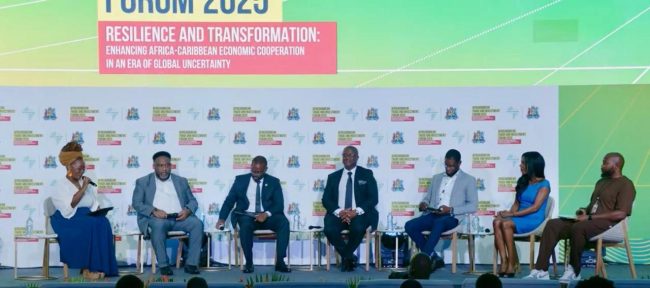
Linton-George, an acclaimed fashion designer from Kingston, Jamaica, was one of the speakers at the Panel on “CANEX Connections: Creating Markets from Culture” during the 4th Africa-Caribbean Trade and Investment Forum 2025 (ACTIF2025), held at the Radisson Conference Centre, in St. George’s, Grenada from July 28-30, 2025 with the theme “Resilience and Transformation: Enhancing Africa-Caribbean Economic Cooperation in an Era of Global Uncertainty.”
The Forum is an initiative of the Africa Export-Import Bank (Afreximbank) and was hosted by the Government of Grenada.