
Deaths, injuries, violence, drama recorded in nationwide protests in Nigeria


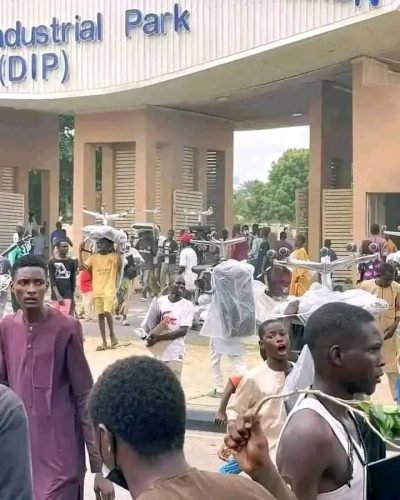
At least eleven people have reportedly died in clashes between Nigerian security forces and protesters on the first day of a nationwide “#EndBadGovernance” protests across the country. Violence, looting of property and some hilarious dramatic situations were also recorded in some locations.
Reports indicate that six individuals were killed on Thursday, August 1, 2024, during confrontations with police in Minna, Niger State. The clashes occurred as authorities attempted to dismantle a roadblock set up by protesters.
In Borno state, four youths were reportedly killed while in Kano, another protester was killed and one critically injured by stray bullets from police during a breach of the government seat in the city. There were also destruction and widespread looting of government and individual property in Kano, leading to the declaration of curfew in the ancient city.
Curfew has also been declared in some hot spot states.
In Edo state, a truck loaded with bags of rice believed to be part of the Federal Government’s palliatives, hidden away by politicians, in a warehouse was looted.
In Abuja, the nation’s capital and some other locations across the country, police deployed tear gas against demonstrators. Protests were also reported in Kaduna, Katsina, Lagos, Delta, Edo, and Yenagoa, the capital of Bayelsa State, with the hashtag “#EndBadGovernance.”
Security forces and armored trucks were mobilized in many cities. In Lagos, where numerous businesses closed for the day, a middle-aged woman was seen carrying an empty pot, drumming and chanting alongside younger protesters.
There was also a man, stark naked, marching with the protesters in Lagos, while in Abuja, some youths who came with the “No to protest” group were lamenting that they too are hungry and actually are in support of the protest but had to carry the “No to protest” placards because they were given N5000 (Five thousand Naira) each by some people who came to their community with buses to carry them to go and protest against the protest.
The protests were sparked by a astronomical hike in the prices of everyday commodities following the controversial removal of fuel subsidy and the foreign exchange policy of the Tinubu administration, which has exacerbated hunger and literally, squeezed out Nigeria’s dwindling middle class. These have driven youth groups to organize mass actions.
The protests began earlier than planned in Niger State, signaling deep frustration, particularly in the northern part of the country where socioeconomic protests have historically been slower to gain traction. Analysts attribute this to the region’s acute malnutrition crisis, high insecurity, political instability, and food shortages.
Ikemesit Effiong, head of research at Lagos-based SBM Intelligence, noted that the northern region, being “much poorer,” is experiencing severe impacts from these issues. The combination of insecurity, political instability, and food shortages has left many families hungry and frustrated.
In anticipation of mass protests similar to those in Kenya, the government increased security presence in several cities on Thursday. In Lagos, pro-government counter-protesters faced little resistance. However, the heavy-handed approach to managing the protests may have inadvertently increased their visibility, a phenomenon known as the “Streisand effect.”
On social media, one commentator noted, “The government’s efforts to stifle the protests had instead triggered a Streisand effect, giving them even more publicity.”
Despite appeals from religious leaders for young people to stay indoors and court orders restricting protesters to particular locations, demonstrators defied these restrictions. In Abuja, one protester told Channels TV, “Hunger has brought me out.”