Hunger is being weaponised – Sierra Leone’s President Bio says at UN Security Council

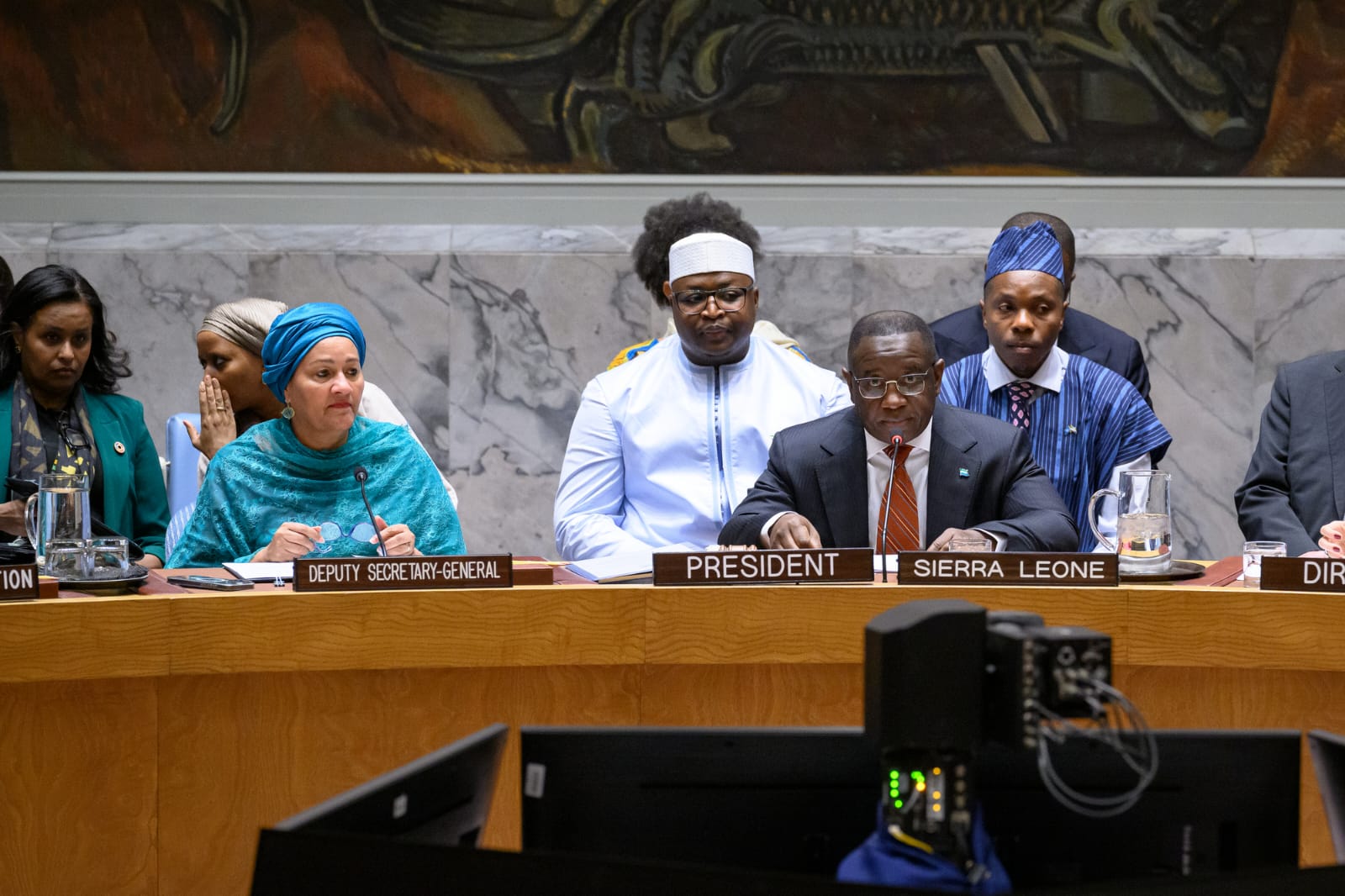
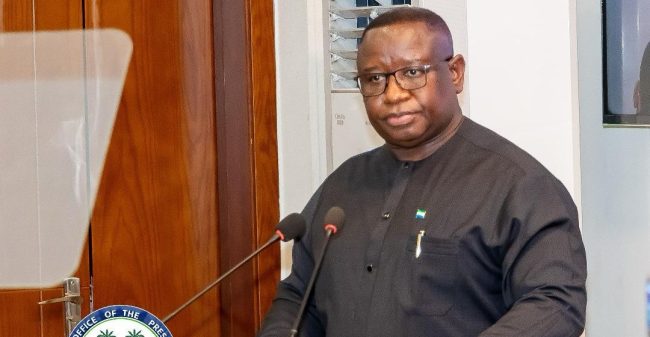
Sierra Leone’s President Julius Maada Bio, at the recent United Nations Security Council (UNSC) High-level Open Debate on Threats to International Peace and Security—Conflict-Related Food Insecurity, has warned that around the world, “hunger has been weaponised,” and has called for food security to be affirmed as “peace security, not a secondary humanitarian issue.”
At the debate, which served as the principal signature event of Sierra Leone’s tenure as President of the Security Council for November, President Bio, who is also the current Chairman of the Economic Community of West African States (ECOWAS), stressed that starvation is not collateral damage, but a crime, insisting that “food insecurity must be viewed through the lens of a driver of conflict, as well as a peacebuilding imperative.”
The high profile program was also briefed by H.E. Ms. Amina J. Mohammed, Deputy Secretary-General of the United Nations and Chair of the United Nations Sustainable Development Group, Ms. Joyce Msuya, Assistant-Secretary General for Humanitarian Affairs and Deputy Emergency Relief Coordinator, H.E. Dr. Ibrahim Assane Mayaki, (VTC) African Union Special Envoy on Food Systems, and Mr. Maximo Torrero Cullen, Chief Economist of the Food and Agriculture Organization (FAO).
President Bio, who delivered Sierra Leone’s National Statement, drew attention to the country’s history as a lesson “that peace is not inherited — it is cultivated, season by season, through peaceful settlement of disputes, justice, and equity,” and named hunger, as “a form of violence — slow, silent, and corrosive.”
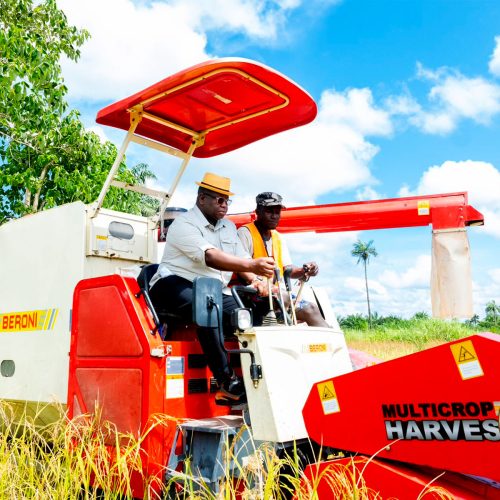
He also noted that his country’s experience teaches “that peace must be fed – literally and figuratively – every season,” and gave the example of Sierra Leone’s Feed Salone initiative, which is designed to transform the nation’s food systems from subsistence and dependent on imports to self-sufficiency, with the mission of feeding the nation from within, pointing out that the initiative is both a local model and a regional contribution to the global pursuit of peace through food security.
Read full text of President Bio’s statement AT THE UNITED NATIONS SECURITY COUNCIL HIGH-LEVEL OPEN DEBATE ON THREATS TO INTERNATIONAL PEACE AND SECURITY: CONFLICT-RELATED FOOD INSECURITY, UN SECURITY COUNCIL CHAMBER, UNITED NATIONS HEADQUARTERS
17TH NOVEMBER 2025
Protocols
I am pleased to return to this historic Chamber — for the second time in two years during Sierra Leone’s tenure on the Council — to address an issue that tests our shared humanity and global stability: conflict-related food insecurity.
Last year, we discussed reforming this Council to make it more representative.
Today, we discuss how to make it more responsive — because even a reformed Council without moral standing will not preserve peace.
Sierra Leone’s own history has taught us that peace is not inherited — it is cultivated, season by season, through peaceful settlement of dispute, justice, and equity.
And today, as we gather under this roof of our multilateral collective security scheme, we must remember that hunger, too, is a form of violence — slow, silent, and corrosive.
I thank Her Excellency Deputy Secretary General Madam Amina Mohammed, Assistant Secretary-General Joyce Musuya, Dr Ibrahim Assane Mayaki, and Mr. Maximo Torero Cullen for their thoughtful briefings and for the leadership they continue to provide in addressing global food systems and humanitarian coordination.
The Charter of the United Nations begins with a promise “to save succeeding generations from the scourge of war.” That mandate extends beyond ending wars
to preventing the conditions that make wars inevitable.
As former UN Secretary-General Dag Hammarskjöld warned, our task is “to save humanity from hell.” In our century, that “hell” is not only found on battlefields; it is found in the empty bowl, the barren field, and the malnourished child.
Conflict situations around the world — and the images that have filled our screens and newspapers — must convict us out of global complicity.
Emaciated infants clinging to life, mothers whose bodies can no longer produce milk, fathers unable to provide a single meal for their families, and children who brave siege and bombardment in search of food — only to lose their lives to unexploded ordnance — are not distant tragedies; they are moral failures of our collective humanity.
From Gaza to the Sahel, from Sudan to Ukraine, and in parts of Haiti, hunger has been weaponised — a silent siege that kills long after the guns fall silent.
It corrodes social cohesion, fuels displacement, and when combined with exclusion and despair, can ignite instability.
In Africa, the world’s youngest region — where over 60 percent of the population is under 25 — rising expectations without opportunity or nourishment can quickly turn hope into unrest.
This is why Sierra Leone has called for this debate: to affirm that food security is peace security, not a secondary humanitarian issue.
I wish to highlight three main points:
My first point – starvation is not collateral damage; it is a crime.
International law prohibits the starvation of civilians as a method of warfare.
Resolution 2417 (2018) condemns its use; Resolution 2573 (2021) demands the protection of agricultural land, water, and energy infrastructure indispensable to civilian survival.
The Geneva Conventions and the Rome Statute classify deliberate starvation as a war crime.
The framework exists; what is lacking is compliance and enforcement.
This Council must ensure unimpeded humanitarian access, predictable deconfliction mechanisms, and the removal of blockades and bureaucratic impediments
that turn hunger into a weapon.
Early-warning systems must track how conflict disrupts production, storage, markets, and transport so that early warning leads to early
action.
The Black Sea Grain Initiative demonstrated that dialogue, even amid conflict, can sustain vital supply lines.
Above all, there must be accountability.
When civilians are deliberately starved, perpetrators — State or non-State — must face consequences.
No ambition can justify starving a child or destroying a harvest. The law forbids it. Our conscience forbids it.
My second point is that food insecurity must be viewed through the lens of a driver of conflict, as well as a peacebuilding imperative.
Conflict destroys food systems — fields are mined or burned, livestock stolen or lost, roads and ports are blocked, markets shuttered, prices spike beyond reach — while hunger deepens grievance and fuels renewed violence.
This cruel cycle is evident in Sudan, the Sahel, eastern DRC, Gaza, Yemen, and Haiti, where food insecurity has reached catastrophic levels.
There can be no sustainable peace on an empty stomach.
Food security must therefore be integral to peacebuilding, not an afterthought.
Peace agreements must protect food systems and guarantee humanitarian access.
Post-conflict recovery must restore livelihoods — through seeds, tools, feeder roads, and access to markets.
Women and youth must be central to this transformation — as producers, traders, and innovators — because when families can plant, harvest, and sell in peace, reconciliation becomes real and durable.
My third point, which relates to the peace and development nexus, and as President of Sierra Leone, I bring to this agenda our own national experience — our Feed Salone Initiative — as both a local model and a regional contribution to the global pursuit of peace through food security.
Sierra Leone’s experience teaches that peace must be fed — literally and figuratively — every season.
Our flagship national development initiative, Feed Salone, places food security at the heart of national development.
It aims to raise productivity, reduce import dependence, create rural jobs, and build climate resilience.
The Programme stands on FOUR PILLARS:
FIRST is PRODUCTION, which involves access to seeds, mechanisation, irrigation, and research.
The SECOND pillar is RESILIENCE, focusing on climate-smart practices and land restoration.
The THIRD pillar is MARKETS AND VALUE CHAINS, involving rural infrastructure,
processing, and finance.
The FOURTH pillar is HUMAN CAPITAL, which involves empowering women and youth, improving nutrition, and linking protection to productivity.
Our goal is not merely to grow food, but to grow peace — putting livelihoods in people’s hands, dignity in their homes, and hope in their communities.
Sierra Leone is also advancing regional cooperation on early warning, strategic reserves, and trade facilitation so that grains can move when people need it most.
As Chair of the ECOWAS Authority of Heads of State and Government, Sierra Leone’s voice carries the shared aspirations of a region determined to transform its challenges into opportunities.
From the Sahel to the Atlantic, ECOWAS Member States are integrating food security into peacebuilding, climate adaptation, and trade frameworks.
The ECOWAS Regional Food Security Reserve and our Early Warning and Response Network (ECOWARN) are being expanded to anticipate crises, coordinate humanitarian corridors, and stabilise markets.
These efforts are part of a continental commitment under the African Union’s Comprehensive Africa Agriculture Development Programme (CAADP) and the
Malabo Declaration on Agricultural Transformation.
We commend the United Nations agencies, international financial institutions, and private-sector partners whose innovations and investments continue to sustain millions.
Together, we must now move from fragmented responses to a coordinated global food security compact.
Intentions must now become implementation.
I propose SIX CONCRETE ACTIONS as part of a solution-driven approach:
I. Protect Food Systems in Conflict. Integrate protection of civilian food assets — such as fields, herds, storage facilities, mills, and sources of water and energy for
agriculture — into Council mandates and sanctions regimes.
Have standard language in Council documents, mandates, and sanctions criteria. The Council must also ensure the implementation and compliance with its
resolutions, including Resolution 2417 (2018).
II. Institutionalise Early Warning. This requires regular, integrated UN reporting on the impacts of conflict on food systems and humanitarian access, enabling the Council to act before famine occurs.
III. Safeguard Access and Deconfliction Mechanisms. Condemn and sanction the obstruction of humanitarian relief, as well as the diversion and deliberate withholding of food aid as a tactic of war. Support predictable, needs-based humanitarian corridors and ensure deconfliction.
IV. Advance Accountability. Promote impartial investigations into starvation crimes; support the integration of starvation prohibitions into domestic law;
and, when appropriate, allow accountability measures to proceed.
V. Link Peacebuilding Finance to Food Security. Ensure that peacebuilding strategies and financing instruments prioritise livelihoods, rural infrastructure, and climate-smart agriculture as essential peace dividends, rather than optional extras.
VI. Lastly, promote women and youth empowerment by supporting programs that enhance land tenure, access to finance, skills training, and market opportunities for young agricultural entrepreneurs, transforming potential conflicts into foundations of stability.
Starvation is never a natural outcome of conflict — it is a choice — a choice to break the law and betray our shared humanity.
This Council has the duty to deter that choice and to hold violators to account.
Sierra Leone’s voice in this Council is that of a nation that has journeyed from fragility to stability — and of a region that continues to choose dialogue over division.
As President of Sierra Leone, I have witnessed the power of principled engagement, even in difficult times. We may not always have the same interests, but we must always defend the same humanity.
Africa is not here to be pitied for its challenges but to be partnered for its solutions. Our Continent holds 60 percent of the world’s arable land, the youngest population, and the greatest potential for innovation in sustainable agriculture.
What we need is not sympathy, but solidarity — to unlock Africa’s power to feed itself and to help feed the world.
Preventing tomorrow’s wars requires treating food security as central to peace and security, not peripheral to it.
Sierra Leone will continue to do its part: through Feed Salone at home, through ECOWAS in our region, and through principled, bridge-building leadership in this
Council.
Let us reaffirm faith in the multilateral system as the only credible platform to prevent starvation, uphold international law, and preserve our shared humanity.
Together, let us ensure that no child is starved into submission, no harvest held hostage, and no community driven to violence by hunger.
If we align our laws with our conscience, our mandates with the needs of people, and our resources with the scale of the challenge, we will redeem the Charter’s promise to succeeding generations.
Let us plant the seeds of justice, water them with compassion, and guard them with courage — so that peace may take root not only in our resolutions, but in the daily lives of those we serve.
For peace is not a season; it is a covenant we must renew with every act of humanity.
I THANK YOU.