

Isaac Adaka Boro is indisputably a militant foundational hero in the struggle for the political and economic freedom of the people of the Niger Delta region of Nigeria. He is widely regarded as a courageous, fearless, visionary, and pragmatic leader whose uncommon dedication to the liberation of his people during the 12-Day Revolution (23 February to 6 March 1966), and his subsequent deployment into the Nigerian military service to keep Nigeria one, made him an enigma.
A regional and continental icon, a symbol of resistance against economic marginalization, and a vibrant and credible freedom fighter, he drew a roadmap that clearly defined the struggle for resource ownership and control and the self-determination of his people, thus laying a solid foundation for minority rights advocates to build on subsequently.
That Boro, like John the Baptist, was one of the forerunners in the struggle for self-determination is not in doubt, considering the fact that since the 1950s, when the Nigerian constitutional conferences for independence started at Lancaster House in London, our forebears, notably Chief Harold Dappa-Biriye and his able team, mandated by the Rivers Peoples Conference, presented, at the resumed sitting of the 1954 Constitutional Conference, studied facts with intellectual rigour and laid their demands for a fair, just, and equitable Nigerian government on the floor of the conference, believing that the emerging new Nigerian Republic would accommodate the wishes and aspirations of the Ijaws and other ethnic nationalities in the Niger Delta—self-determination and the right to own and control their resources.
This studied and meticulously reasoned presentation by Chief Harold Dappa-Biriye in 1954 at the constitutional deliberations in Lancaster House, advocating self-determination and the creation of a Rivers State, did not stand in isolation. Rather, it formed part of a sustained sequence of petitions, memoranda, and constitutional engagements between 1954 and 1957. These cumulative interventions, delivered with juridical precision and moral urgency, gradually impressed upon the British Government the gravity of minority anxieties within the emerging Nigerian federation. It is therefore historically defensible to assert that the events spanning 1954 to 1957 assuaged and ultimately persuaded the colonial authorities to establish the Willink Commission in September 1957, formally known as the Commission of Inquiry into the Fears of Minorities and the Means of Allaying Them.
The Commission, chaired by Sir Henry Willink, presented its report to Parliament in July 1958 through the Secretary of State for the Colonies, acting at the command of Her Majesty the Queen. In language at once clinical and sobering, the report described the territory inhabited by the Ijaw and other Niger Delta peoples as “neglected, poor and backward.” That characterization, rendered in 1958 as an administrative assessment, has lingered as a haunting indictment. More than six decades later, the persistence of structural underdevelopment in the Niger Delta suggests that the anxieties articulated in 1954 were not ephemeral grievances but prophetic warnings, warnings that history has yet to fully redeem.
Boro, no doubt, was incensed not only by the utter neglect of the area, but also by the unpreparedness of the Federal Government to confront these key developmental issues facing the Niger Delta region. This majorly gave rise to his taking up arms against what he perceived as an uncaring federal government in a bid to restore the honour and dignity of the Ijaws within the Nigerian political and economic landscape.
The 12-Day Revolution, its roadmap, and the demands of the NDVS greatly inspired Ken Saro-Wiwa, Asari, and Tompolo in later years in their demand for a fair, just, and equitable resource ownership and control framework, as well as self-determination, as evidenced by the invocation of the 1991 Ogoni Bill of Rights and the Kaiama Declaration in 1998, which bred a multiplicity of militant groups in the region. Their exploits brought the federal government to its knees, as the collapse of the Nigerian economy was imminent. Also, the peace and security of the nation were threatened by militants in the region openly kidnapping oil workers and vandalizing oil pipelines and facilities. It is therefore safe to say that Boro indeed set the stage for modern advocacy in environmental justice and the struggle against the marginalization of the people of the oil-rich Niger Delta.
In his demands before and during the armed insurrection against the federal government, Boro sought a greater Niger Delta, with political and economic autonomy couched in resource ownership and control for the inhabitants of the region.
Boro had noted as far back as the early sixties that “most of the youths were so frustrated with the general neglect that they were ready for any action led by an outstanding leader to gain liberty.” “We are clenched,” he said, “in tyrannical chains and led through a dark alley of perpetual political and social deprivation.” Inevitably, he noted that the day would come for Niger Deltans to fight for their long-denied right to self-determination. Boro wondered why Niger Deltans should see themselves as strangers in their own country.
That outstanding leader he spoke about was Boro himself, as it came to pass in the Twelve-Day Revolution. Sixty years later, the Niger Delta has yet to attain the self-determination he sought.
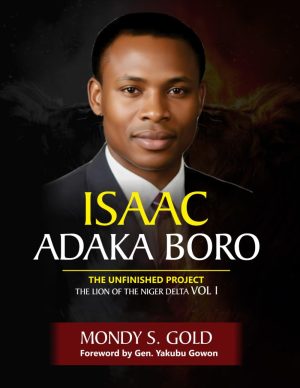
So, what are the lessons to be learned from Professor Mondy Selle Gold’s insightful and engaging book, Isaac Adaka Boro: The Unfinished Project? What are the expectations of Niger Deltans in particular, and Nigerians in general? What lessons should be drawn from Boro’s sacrifice for a united and progressive Nigerian nation? How would the Nigerian federal government react to Boro’s struggle for equity and justice, bearing in mind that it holds the key to a paradigm shift and meaningful change in the parlous state in which the region finds itself?
As General Yakubu Gowon, former Head of State, who lived through the early turbulent years of the nation and superintended over the unfortunate Nigerian civil war, stated in his foreword to the book, and I quote: “I urge you to not only view Boro’s actions through the lens of history but to consider the profound lessons his life offers for our present and future,” adding that his legacy should challenge us to reflect on how we can collectively ensure that every corner of Nigeria experiences the benefits of peace, development, and equality.
In his foreword, King Alfred Papapriye Diete-Spiff, first military governor of old Rivers State, corroborated General Gowon’s admonitions when he said that Boro’s story was not merely a historical account but a reminder of the enduring spirit of freedom, justice, and the relentless pursuit of equality.
Brigadier-General Godwin Alabi-Isama (rtd), former Chief of Staff of the Third Marine Commando Division (SMCDO), under whom Major Adaka Boro served during the Nigerian civil war and paid the supreme price, was even more poignant in his description and assessment of Boro’s service to the Niger Delta and Nigeria. Boro’s bravery and war skills, he said, were inspiring and sobering, sobering in the sense that Boro’s story calls for meditative reflection on our shared history and the sacrifices that underpin our citizenship.
General Alabi-Isama extolled Boro’s unyielding struggle for justice and equity. He expressed hope that his enduring lessons of courage and sacrifice would be translated into actions that would always be in the interest of the people, especially the Niger Delta’s struggle for self-determination.
So, in speaking about self-determination and equitable and accountable leadership of the Nigerian state, can present and future governments dwell more on the greater than the lesser challenges in nation-building? The greater challenge, to my mind, is the practice of true fiscal federalism, where the devolution of powers is clearly spelled out between the federal government and the federating units. In addition, resources should be owned and controlled by the constituent states. Also, colonial, archaic, obnoxious, vexatious, and rights-decapitating petroleum and land laws and clauses in the Nigerian Constitution should be abrogated.
Perhaps a glimpse into a few of these offensive and provocative laws that give room to the federal government to coerce, at will, the petroleum resources in the Niger Delta would throw more light on the evil and vicious overbearing powers of the federal government in the control of these resources domiciled in the difficult deltaic terrain of these communities, for which Boro fought.
A ready example of flagrant abuse of power by the federal government, as enshrined in the 1963 Nigerian Constitution—Item 25 of Part I under Section 69 of the Schedule of the 1963 Republican Constitution—placed “mines and minerals, including oilfields, oil mining, geological surveys, and natural gas” on the Exclusive Legislative List under the control of the Federal Government.
In my book, Redefining Nigeria: Essays on State, Nation, Leadership & Democracy, at page 386 of the hardcover copy, I stated, inter alia: “This provision in the Exclusive List means that only the Federal Government could legislate on oilfields, oil mining, natural gas, geological surveys, mines, and minerals. The mines and these minerals were located in a region in 1963. Why should legislating on them be exclusive to the federal government that did not own the regions in a federation?”
The founding fathers, I stated, erred, just as the federal government, the National Assembly, and the autocratic soldier rulers who held sway in the administration of the Nigerian state for quite a while erred in appropriating and misappropriating the mineral resources of Niger Deltans.
“This is not federal but a detestable unitary system of government in operation in Nigeria, and this has, unfortunately, gone unchecked.” It is a pity that this and other obnoxious laws against the Niger Delta were carried over into subsequent Nigerian constitutions.
These are the laws Boro stoutly rejected and fought against.
Only recently, the Northern Elders Forum suddenly woke up from its deep slumber and, in what appeared to be a feat of hypocrisy and self-preservation, remembered “regional ownership of mineral resources” when a gold refinery was proposed for Lagos.
Gold—precious gold—they insist, belongs to the North and must remain within the Northern geographic space.
Frank Odion Akpokwu, writing on this subject matter, said, and I quote: “Yet, the same voices raise no objection to refineries in Kaduna processing crude oil extracted thousands of kilometres away in the Niger Delta. There is no outrage. No moral argument. No appeal to ‘resource ownership.’” This is, indeed, a tale of two cities. This inconsistency, he said, is not accidental but structural.
Akpokwu bemoaned a system where, since the late 1960s, Nigeria’s resource governance framework has vested ownership and control of both oil and solid minerals in the Federal Government, while steadily weakening the principle of derivation that once allowed regions to retain meaningful benefits from their resources.
It is instructive to note that Chief Obafemi Awolowo, serving under General Gowon’s wartime cabinet and a proponent of federalism and resource ownership and control, sat in council with General Gowon to autocratically and unilaterally appropriate the petroleum resources of the Niger Delta through the Petroleum Decree of 1969. By that most unjust law, the federal military government forcefully seized the petroleum resources in the Niger Delta. Pitiably, since the return of democracy in 1999, no one talks about the serious infraction of the rights of Niger Deltans to their mineral resources. Rather, a more legislative noose was hung around the necks of the Niger Deltans when the offensive Petroleum Industry Act (PIA), 2022, was enacted. The PIA remains a subject of scrutiny and resentful engagement, begging for amendment.
As I stated in my book, Redefining Nigeria, at page 387: “The same violation of ownership rights was again legislated upon, with petroleum resources still in the firm control of the federal government.”
This is the highest level of political wickedness and legislative hypocrisy, a startling contradiction and inconsistency. In the USA, Canada, and other federations, oil and gas resources are owned by the component units and individuals in oil-bearing communities. Unfortunately, in the Petroleum Industry Act (PIA), 2022, ownership of petroleum is still vested in the federal government (including other minerals in Nigeria). It is an aberration in a federal state for a particular resource or resources in a state to be legislatively owned by a central government that does not exclusively own the land in the state.
To do justice to the unfinished project of Adaka Boro, the Lion of the Niger Delta, these rights-capitulating laws and the unitary system of government, in the name of a federation, should give way for Nigeria to be better administered equitably and accountably.
Professor Gold’s book is a painstakingly detailed historiographic account of a revolutionary who lived ahead of his time, a consummate fighter for freedom and justice who stood toweringly above the machinations of a self-inflicted dysfunctional system of government that has, over time, held its citizens hostage and denied them their rights and privileges.
This incisive book on Isaac Adaka Boro, written with uncommon intellectual depth, rigor, and moral clarity, is unreservedly recommended to various reading publics for its useful nuggets of vital information and education on bravery, patriotism, courage of conviction, equity, and justice, all directed toward good, acceptable, and enduring governance of an emerging state such as Nigeria.
Isaac Adaka Boro: The Unfinished Project is a clarion call to Nigeria, especially its leadership, to have the political will, courage of conviction, and patriotic zeal to do what is right and appropriate in repositioning the Nigerian nation-state to attain the lofty and achievable goals for which Boro fought and died for her survival, peace, security, and accelerated progress.
Ekiye, a Journalist, Author & Publisher, writes from Yenagoa, Bayelsa State of Nigeria.