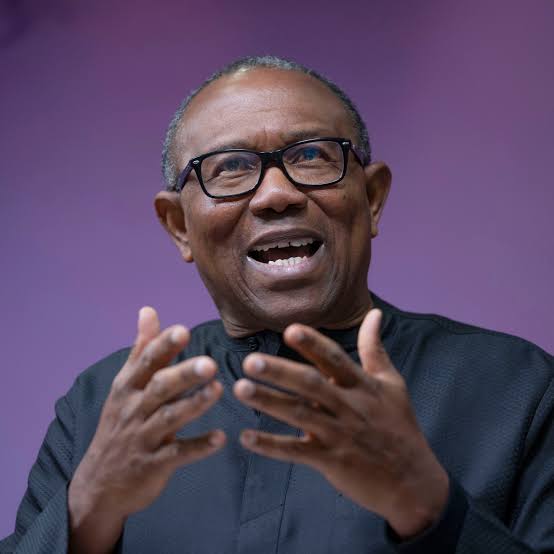
The 2023 presidential candidate of the Labour Party (LP), Mr. Peter Obi has said that Nigeria’s contingent of 789 delegates to the 2025 United Nations Climate Change Conference, otherwise known as COP30, compares favorably with that of China, a country whose population is about seven times larger, and whose economy and other indicators are far better than Nigeria’s.
Mr. Obi, a former Governor of Anambra State, said in an X (former Twitter) post, that the high cost of such a large contingent, for a nation that has about 150 million of its population “living in multidimensional poverty, struggling daily with food insecurity, inadequate healthcare, and limited access to basic services,” could, instead, have been “directed toward urgent social investments at home, improving healthcare, education, and living conditions to lift our people out of poverty.”
Full text of the tweet reads:
In Delegations, Nigeria competes well.
Again, in a bitter twist of irony, we thank Nigeria for having the third-largest delegation at COP30, with 749 delegates, similar to China with 789 delegates.
While Nigeria needs to have a strong voice in global climate discussions, this spectacle comes at a heavy cost to our people with about 150 million living in multidimensional poverty, struggling daily with food insecurity, inadequate healthcare, and limited access to basic services. Yet, our leaders travel in large numbers, funded by taxpayers, attending climate talks abroad while the citizens they are meant to serve continue to suffer.
Compared to China, which had about the same contingency, China has a high HDI, while Nigeria has a low one, with a key measure of life expectancy at the lowest 54 years, against China’s 79 years. China’s GDP stands at $18.74 trillion, while Nigeria’s GDP is barely 1% of that size, a little over 200 billion dollars. China’s GDP per capita is about $13,300, whereas that of Nigeria is below 10% of that, reflecting the deep economic disparity between the two nations.
Moreover, 63% of Nigerians live in multidimensional poverty, which is about 150 million people, the highest number in the world, facing deprivations in health, education, and living standards, while it is only 3.9% in China; meanwhile, China’s population is about seven times larger than ours.
This stark contrast illustrates why Nigeria should not be sending a delegation of this size. The human and financial resources expended on hundreds of officials travelling abroad could instead be directed toward urgent social investments at home, improving healthcare, education, and living conditions to lift our people out of poverty.
Our participation on the international stage must reflect responsible leadership, one that truly prioritises the needs of our people and demonstrates our genuine capacity to engage meaningfully in global climate action.
A New Nigeria is POssible. -PO