



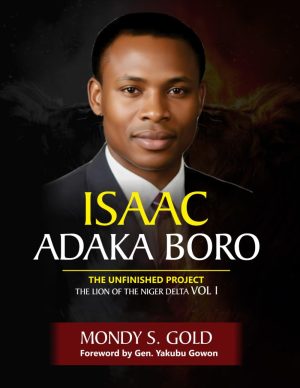
This book, which comes in two volumes, is a must read. It is the untold story of Major Isaac Jasper Adaka Boro, PhD honoris causa, O.O.N., Commander of the 19 Brigade, Third Marine Commando Division, Nigerian Army in the Nigerian Civil War (1967 to 1970), a man whose legacy has remained indelible beyond the twentieth century in which he lived.
Isaac Jasper Adaka Boro was born at the zero hour of 12.00 midnight on September 10, 1938, in the oil rich Niger Delta. Professor Mondy Selle Gold, the erudite author of this remarkable compilation, has undoubtedly produced a compendium on Isaac Boro that is nothing short of a bombshell. Never before have so many secrets of the man been laid bare.
Driven by the revolutionary spirit of Boro himself, Professor Gold has unearthed and brought to the fore many aspects of Isaac Boro’s life that were hitherto considered settled or inaccessible.
For example, Isaac Boro’s birthplace was long believed to be Oloibiri. Boro himself documented this in his autobiography, The Twelve Day Revolution. However, Professor Gold’s probing research establishes otherwise. Isaac Boro was born at Kaiama, in the maternity ward of Mrs. Christiana Koripamo. How could this be? Could it have been Olobiri Town beside Kaiama rather than Oloibiri in Ogbia? Could it have been a typographical error, since Boro himself was not alive to review the edited manuscript? Discover the details within these pages.
Prof Gold was quick to observe also that Isaac Boro’s birth was not ordinary, but seemed rather, an early quintessential injection of a defender into Niger Delta territory as a providential safeguard against unchallenged encroachment, especially on the Ijaw, in whose land abundant natural resources resided. This assertion demands exploration. Don’t miss it!
Did Isaac Boro kill 150 people even before he joined the army?
Mondy Gold’s book has the answer. Isaac Boro became a second master to his father in an Anglican primary school at the age of 19. He left the teaching work 3 months later to enlist in the Nigeria Police Force from where he went to university. In this period he infrequently visited home until he came for the revolution, which itself was shortlived, and terminated in his arrest, trial and condemnation. He was released from prison in Lagos, enlisted in the Nigerian Army there in Lagos, and was posted to the war front where he later died. There was no space in this short and eventful life to have massacred 150 innocent people without reason: certainly not as a 19 year old, or as a serving police officer, or during his years in the university, or as an inmate in the Lagos Correctional Centre at Kirikiri. None of the purported 150 victims were ever known or their identities established. Meanwhile he killed no one during the revolution. If he did, it would have appeared in his trial proceedings. Argue with facts. Details only in this book!
Who killed Isaac Boro?
Isaac Boro was killed by an Igbo man, a Biafran soldier who fled Ogu Town when federal troops attacked it. Get a copy of the book to know the details. See the photo of the soldier who killed Isaac Boro, courtesy Brig. Gen. Alabi-Isama (retired) who was Isaac Boro’s immediate boss in the Third Marine Commando Division.
Did Isaac Boro betray Ndi Igbo?
Far from the truth! Isaac Boro started life like any ordinary child, innocent and loving. But the Amassoma Women’s Riot of 1958 and the naked impunity of the police who came to arrest them excited him, compelling him to opt for police service. But his uninspiring experiences in the police force, followed by his student unionism days at the University of Nigeria, Nsukka taught him that life demanded more than just playing the good boy.
For example, at Nsukka, he was approached by the Eastern Nigeria government, led by Dr Michael Okpara and Sir Akanu Ibiam, to sue the federal government on behalf of the Eastern government over the conduct of the 1963 census. Then when he was seen to be succeeding, they sought to replace him with one of their own. Find out what happened next. Only in this book!
Isaac Boro, an Easterner, abandoned the Biafra cause to join Nigeria to fight against Biafra. Why?
A second reason some Igbo brothers call Isaac Boro a betrayer was because he joined the Nigerian Army instead of the Biafran Army in the civil war.
On the 23rd of February 1966, Isaac Boro declared a Niger Delta Republic in Eastern Nigeria territory. General Aguyi-Ironsi, from the East, was Head of State and Supreme Commander of the Nigerian Armed Forces. Lt. Col. Odumegwu-Ojukwu, also from the East, was the military governor of the Eastern Region. Isaac Boro himself was an eastern Ijaw. At that point, it was an all Eastern Nigeria affair. Igbo people were in control. Why did they not concede a state to Isaac Boro at that point? Instead, they tried him in the Eastern Region in a Port Harcourt high court presided over by Justice Phil-Ebosie, also from the East and sentenced him to death in the East for treason. The case was appealed to the Supreme Court in Lagos where it was dismissed.
Isaac Boro was awaiting execution in Lagos when northern military officers struck and took over power. They created Rivers State, pardoned and released Isaac Boro and let him join the federal army to go and secure the newly created Rivers State and keep Nigeria one.
The events leading up to and necessitating the declaration of the Niger Delta Republic are all meticulously documented. It was the decision of Igbos who were in control at the time that created the fiery Adaka Boro. Know the facts. They are daringly laid bare in this book, complete with the actual Nigerian Army war maps that were given to Isaac Boro to go and overrun Biafran strongholds, courtesy Brig. Gen. Alabi-Isama (retired). This is the same Isaac Boro that would have turned the table in favour of Biafra if he had been respected in the East. Every Igbo person needs to read this book, to equip themselves with the truth and not depend on unfounded or malicious propaganda. This critical information gives reason for understanding and dialogue for the future, not continued apportionment of blame. A daring expository, all in this book!
The first secession attempt in Nigeria
It was Niger Delta in Isaac Boro’s Twelve Day Revolution. The Biafra declaration came later. That was why Reno Omokri (now ambassador) was quick to ask what moral justification the Southeast has to expect the Niger Delta to support Biafra without question when they did not support an earlier attempt by the Niger Delta people to break away from Nigeria. All the related facts with dates are fully documented in this book. Everyone of Ijaw extraction needs to keep a copy of this book.
To all who are Ijaw, you need to know “Who Is Who” in the Ijaw emancipation struggle. How many generations of constitutional agitators are there in the history of the Ijaw struggle to date? Who started the IYC, INC? How many generations of militant agitators have we had? What specific achievements are the different generations of agitators remembered for? Who was the first militant general to have a camp? Who were the key figures of the Kaiama Declaration? These are all issues that have been visited, a daring and all-encompassing effort!
How was the Twelve-Day Revolution fought?
The interviews with surviving veterans of the struggle, and letting them tell their own stories, is a highly commendable approach that has contributed immensely to making the characters in the book come alive. This first hand, information gathering approach enhanced authenticity and enriched content, making the story compelling, enabling readers to visualize scenes of events as though they themselves were physically present.
The Niger Delta Volunteer Forces were divided into three divisions. All operational details and what happened are meticulously documented with the names of the actual actors and live interviews with dynamite stories. Enjoy a time travel as they take you back to the trenches of the revolution, and relive their experiences. Only in this book!
Family involvement
The active and unlimited involvement of the Boro family members in this compilation has been a source of enrichment and added authenticity, a privilege which the Boro family acknowledges with unalloyed appreciation. The Internet is currently flooded with a lot of misinformation about Isaac Boro.
We are happy that this book has come to end the reign of malicious fabrications, putting things in proper perspective.
Read about the Boro family’s side of the Isaac Boro saga, their excitement and fears, escapes in the heat of the trauma, and the pains of bereavement following. The personality of Isaac Boro is brought to the fore in a vivid representation of the person, revealing his likes, dislikes, weaknesses and strengths.
With its depth of content and scope of coverage, this book has undoubtedly become not only an authoritative source of information about Isaac Boro but also a compendium of Ijaw political history.
A world yet in need of true change
Isaac Boro and other legends around the world stood up for justice and fairness, some of them suffering incarceration or even paying the supreme price in the process. It is sad to note that though the world claims to have become civilized, in reality it only basks in its euphoria. The unwholesome face of opportunism continues to enjoy considerable global acceptance and protection. Otherwise, why would the Trans-Sahara Gas Pipeline from the Niger Delta to Europe commence without reference to the Niger Delta people from whose soil the gas will be extracted?
Where is the conscience of the world, if Europe, in the midst of their avowed defense of Human Rights, can sign a memorandum of understanding with the Nigerian government excluding the Niger Delta people who will suffer the direct consequences of removal of the gas from under their feet, and their homes. They are the ones to bear the geological consequences of the extraction: in earth tremors, other seismic consequences and terrestrial devastation in the future. It is unfortunate that much as world leaders frequently preach humaneness, practical approaches remain a far cry from the ideal. What is the way forward for the endangered people of the Niger Delta? Details only in this book!
Internationalization of Isaac Boro’s sacrifice and the Ijaw emancipation struggle
The comparative analyses with other world-acknowledged heroes such as Martin Luther King, Mahatma Gandhi, Nelson Mandela and others who sought to elevate the status of humanity has put Isaac Boro on the same pedestal as these legends. Little wonder that this book has already been nominated for the Hollywood International Best Book of the Year Award 2026, so short a time after its release, evidence that it carries the global consciousness for a better world.
Thus, this unique compilation undoubtedly stands to educate an under-informed international community of the plight to which the Niger Delta people have been subjected since the first oil well was struck at Oloibiri in 1958. It is also a reminder to the role Isaac Adaka Boro and his compatriots played in bringing to limelight the sufferings of the Niger Delta people. Prof Gold’s work is a handbook on Ijaw affairs, and a comprehensive dossier with which to convince the international community at public debates to justify support for a Niger Delta People’s Republic. I recommend it to everyone irrespective of gender, Creed, location or calling. Get your copy now!
Conclusion
The Boro family is most grateful to Professor Mondy Selle Gold for this painstaking effort to put together such a well-researched document on Isaac Boro, to enlighten and equip the present generation, and serve as a repository of information for posterity. May God who put this wisdom in him continue to strengthen him for greater exploits.


