
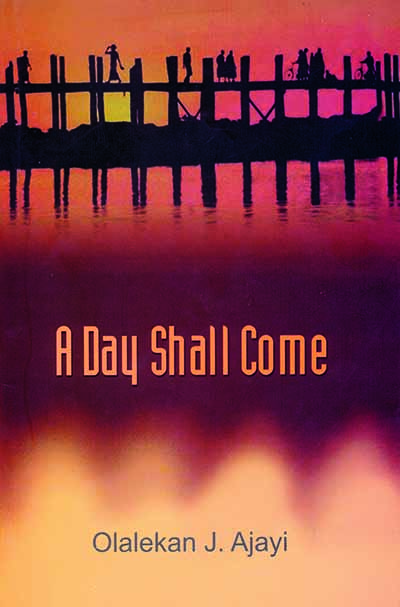
Parables of despair and hope
Title: A Day shall come
Author: Olalekan Ajayi
Publisher: Ebony Books
Year: 2015
Pages: 117
How do you expect a broth to taste after two years of being in the making? If you are a gourmet, the answer is pretty simple: it is either the broth would taste better or bitter, depending on the condiments or master chef behind the cooking. A Day Shall Come is Olalekan Ajayi’s debut collection of poems, but this bard doesn’t sound like a greenhorn. His is a product of twenty years gestation.
In the “Introit” section, the poet leads us to his cerebral universe. His choice of title is “Right of Passage”, and, like a prophet of old, he never bears swords but “Just a calabash of ink” and “famished sheet”. Ajayi makes it clear that the bardic enterprise isn’t for all-comers. Hence: “Only the circumcised hearts embrace the Muse”. The poet’s journey is one of solitude, he tells us. Like a mad man, voices ring in his head: “They bid me speak, write in measured wrongs”.In doing this, the poet subjects himself to privations. Food doesn’t matter to him in this scribal engagement. Hence: “My parched tongue and empty bowels mock me/ The scroll shall be my bread and ink my drink”. From his experience, the fact is laid bare that, to begin your poetic ministry, the bard has to undergo rigorous tutelage. After Ajayi’s immersion in the bardic fold, he is a changed person. He admits: “With my free verses and blend of new forms/ I shall better the art of poetasters.” There is no feeling of ennui.
A Day Shall Come is structured in eight sections dealing with poetry itself, his angst, birth and rebirth, love, hope, life, and tributes. From his poetic testaments, it is crystal clear that Ajayi, the former literary editor of Observer newspaper, is a disciple of the Neruda school of poetry, to whom solitude and emotional interrogation are a fine art in order to distill the bardic process.Mind you, the words came to the poet pure, undiluted, and his role is to beautify it with tropes, as he hints in the poem “Guardians of the Word”. No matter how the swords attempt to silence Nigerian poets, new voices will always emerge with vehemence: “The word did not die/ From darkness emerged/ New voices/ Voices that uttered the word louder….”
In the Angst section, Ajayi begins with “A Difficult Path” where the voice finds himself at the intersection of confusion on the path to take to his destination. It is a moody atmosphere in “Abomination” where laughter deserts the personas because of the retrogressive goings-on around. What do you expect when the farmlands are famished?
Aluta Continua echoes the poem “August 19, 1994”. Here, the poet captures the mood of a group of protesting, miffed students, united against “Decrees by the bespectacled dictator”, charging towards “the despot’s palace”. Ajayi captures the tragic end of the uprising when he pens: “Sullen faces returned to the citadel/Unable to tell the tales of quick deaths”. This section features other interesting poems such as “Broken Cord”, “Brother’s Keeper”, “Confessions”, “Dungeons of Agony”, among others.
Poems in the Birth/Rebirth section dwell on issues concerning existence in a society where people are determined to assert their importance at homes, towns and kingship. The section on Redemption deviates from a mundane course to embrace a spiritual essence.
Journey motif echoes in some of these poems, whether it is Nature beckoning in “A Return” or in “Distilled Water” where they soberly return or in “For One Hundred Years” where futility has trailed relationship among Nigerians, exemplified by palm wine being carried across borders for vain amity. “What Mother told Me” is an apologia to the young wife, who has to lead a life of servitude for her husband because the society wills it.
Amour proper is in the air in the Loves Themes section. No matter the despondent air hovering over Ajayi’s verses, the tingling sensation that love kindles among lovers cannot be dumbed down for whatever reason. The pride of a lover, honeymoon, unforgettable lover, unrequited love, waiting for love and a declamation to a wife are poems that border on womanhood and its many sides.
Life and Tributes sections are characterised by personal lyrics in which paeans subdue the pervading gloom. But in defamiliarising his diction, the poet leaves his readers bewildered in poems such as “The Message”, “Distilled Water”, etcetera, where meaning is evasive. In all, Ajayi, has carved the right niche at the right time in this debut.
Culled from The SUN
There’s God, history, redemption, love, tears and more in Ajayi’s poetry
Reviewer: Nathaniel Bivan
Reading on a road trip is by far one of the best ways to enjoy a book besides being at sea (my take, of course). The former is how I read Olalekan Ajayi’s ‘A Day Shall Come’.
“Don’t judge a book by its cover” goes that now ancient saying. Many people judge a book by its cover, after all there’s so much competition on what to pick up and what to dump when it comes to reading. So, when I saw the picture of people walking on a bridge at dusk (well, probably dawn) on the cover of this book, there was a curiosity to find out, to unravel why. Whether that curiosity was satiated at the end of the collection of poetry is another question altogether.
Anyway, poets have a way of pricking ones curiosity by using a word that packs a lot of punch (or maybe, leaves you in limbo), probably either to assert their positions as poets, or well, just to make you read on. This was how it was with the first part of this book. The word is ‘Introit’ and it leads to one poem, ‘Rite of Passage’, a song-like poem that seeks to tell its reader a little about the poet’s need to speak, being unable to resist the urge to let words pour from the fountain that is his pen, a journey he must share:
Tonight, I enter the forest of words
The moon a lamp unto my naïve feet
Like a prophet of old I bear no sword
Just calabash of ink and famished sheet
There’s history, there’s God, redemption, love, tears and more in Ajayi’s poetry. You are reminded about the sovereignty of the one who creates and fashions out man’s history. Not even the white man writes this history or dictates it, even when it may seem so. Man, however, discriminates and builds barriers where there should be none; this is the flow of thought in ‘Brother’s Keeper’:
Before the burning flares
We knew no boundaries
Now you erect barriers
Ours are hymns of peace
But you chant war songs
When this collection leads one to ‘Love Themes’, it doesn’t disappoint. Love is universal and this poet is graphic when he creates lines about the physical, man and woman brand of it. Lamentations of betrayal, deceit, and more that leads to heartbreak, are found in a number of poems, the anguish of a woman who once held the eyes of her man, the cry of a wife who dares to reclaim her husband. These themes of love, relationships, glaring in everyday life, (including sparse sketches and footnotes) and almost visible emotion, strengthen this work.