By Cecilia Ologunagba
New York, July 10, 2025
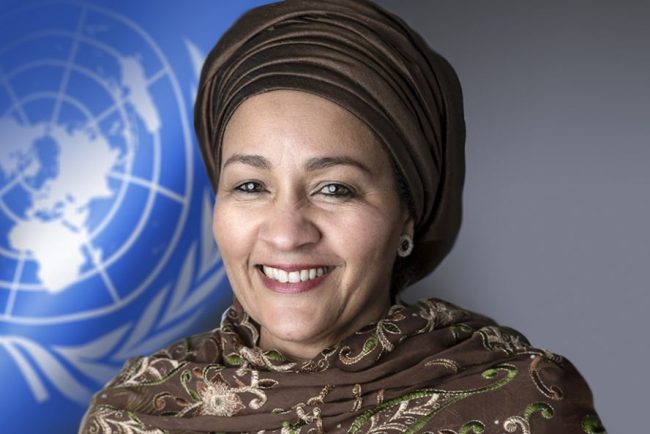
UN Deputy Secretary-General, Amina Mohammed, has highlighted the vast potential of the Blue Economy in the Gulf of Guinea, stressing the importance of protecting the ocean, unlocking its economic power, and ensuring maritime security to deliver benefits for people.
Mohammed said this at the International Conference on the Blue Economy in the Gulf of Guinea in Yaoundé, Cameroon, where she is attending the Conference on behalf of the Secretary-General, António Guterres.
According to Stéphane Dujarric, the UN spokesperson, Mohammed also underscored that the Blue Economy is not only central to SDG 14 — which is Life Below Water — but is also a powerful enabler of the entire 2030 Agenda and the African Union’s Agenda 2063.
During her visit, the deputy secretary-general also held bilateral meetings with senior government officials, including the Prime Minister of Cameroon, Joseph Dion Ngute.
“They discussed regional challenges, strengthening the cooperation between Cameroon and the United Nations, and accelerating progress on the Sustainable Development Goals,’’ Dujarric told journalists on Wednesday in New York.
Also speaking on Sudan, he said the Office for the Coordination of Humanitarian Affairs, says the situation in North Darfur state remained alarming, as fighting continues to drive families from their homes.
“On Tuesday, shelling reportedly hit the market area inside the Abu Shouk camp, killing three civilians and injuring many more.
“As a reminder, this is a displacement camp where famine was confirmed last year. This tragic incident is another reminder of the toll this conflict is taking on civilians,’’ he said.
According to him, prior to yesterday’s incident, the International Organisation for Migration reports that more than 3,200 people had fled Abu Shouk camp and parts of El Fasher between June 26 and July 6, and that they were seeking safety in places like As Serief, Tawila and At Tina.
In the Kordofan region, the humanitarian situation is also deteriorating.
Dujarric said the ongoing violence was forcing more people to flee, often into areas with little or no assistance.
IOM said that on July 5, nearly 800 people were displaced from Bara, in North Kordofan state, and are now sheltering in White Nile state.
Despite the challenges, he said, the humanitarian partners were doing everything they could to keep services running.
“In North Darfur, they are supporting over 1.7 million human beings with basic healthcare, using both remaining health facilities and mobile clinics. However, medical supplies are running critically low.
“We and our partners are rushing assistance to the Darfur region. “
Meanwhile, flash flooding threatened to make it more difficult for humanitarians to reach people in need. Today in eastern Sudan, heavy rains triggered flash floods in the Northern Delta locality of Kassala state.
“This comes as authorities began releasing water from several major dams to manage rising floodwaters. Office for the Coordination of Humanitarian Affairs (OCHA) is closely monitoring the situation and will provide updates as they come in.
“Our OCHA colleagues reiterate the need for the safe and the unimpeded humanitarian access and calls on the international community to scale up support for the most vulnerable people in Sudan.
“This year’s 4.2 billion dollars response plan for Sudan is less than 25 per cent funded, and that is halfway into the year, and it has just 917 million dollars in the bank,’’ the spokesperson said.