
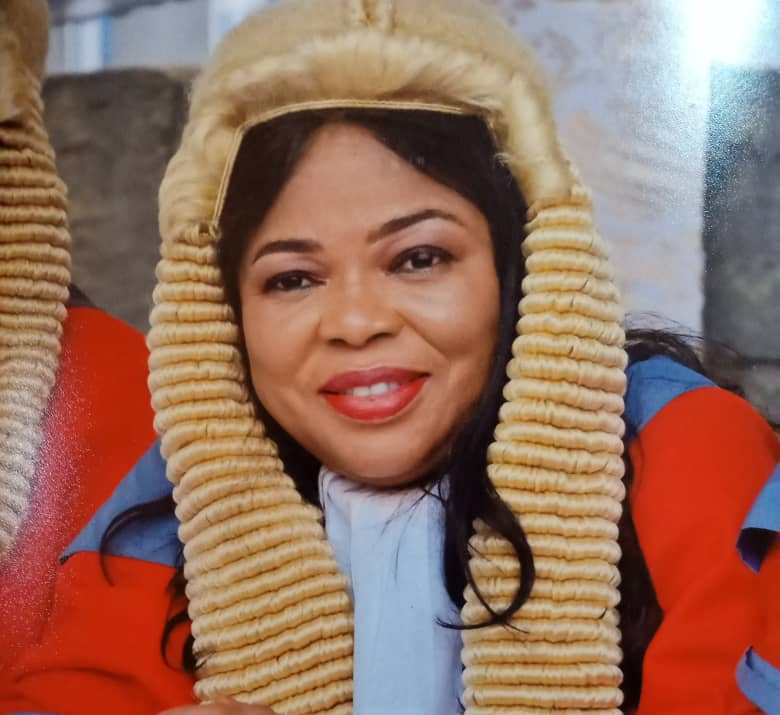
Being PAPER DELIVERED BY HON. JUSITCE V.C. ISIGUZO DURING THE FIDA IMO STATE LAW WEEK HELD ON THE 23RD DAY OF NOVEMBER, 2021 AT THE FIDA SECRETARIAT, OWERRI IMO STATE
WOMEN AS ENDANGERED SPECIE: FACT OR FICTION, “PRACTICABILTY OF VAPP LAW.”
PROTOCOL
Introduction:
There are two species which constitute the human race: the Male (man) and the Female (woman). These two species are equally essential for the survival of the human race. Unfortunately, since the time of creation women have been looked at as the lesser of the two species. Even Adam upon being confronted by God in the garden of Eden as to why he ate the forbidden fruit shifted the blame to Eve, because, he has seen a subordinate in her whom he can shift all his responsibilities and failures to.
Over the millennia, the Adamic mindset persists, has evolved, and has led to the enthronement of Patriarchy in our society. Women are seen as being inferior to men. The female child is seen to be less desirable than the male child. In the olden days, women were seen as servants, properties, someone to be seen and not heard. Ostensibly, this perception had the backing of law and culture. It is important to note that at creation God never said that the woman is inferior to the man, but this concept was purely conceived by man.
ARE WOMEN ENDANGERED SPECIES?
Endangered species is any specie that is at risk of extinction because of a sudden rapid decrease in its population or a loss of its critical habitat.[1] Going by this definition, it might be difficult for one to believe that women are endangered species, because our numbers have not reduced dramatically, neither have we lost our habitat, however, I believe this would have been the case if not for some proactive and activist measures taken to curb the trend, women were certainly on their way to extinction.
In some parts of the world, including Nigeria, the birth of a female child is an occasion for gloom not cheer. It has been reported that in China, India, and South Korea pre-natal gender tests (a test to know the sex of an unborn baby) are flourishing, and if the result shows that the unborn baby is female, the baby is aborted.[2] With these practice in vogue the birth ratio of women has reduced tremendously and it is only a matter of time before women become endangered species on earth.
In addition to the above, women suffer many forms of injustices such as sexual violence, domestic violence, female genital mutilation, child marriages, and a host of other discriminatory and repugnant practices too numerous to mention.
However, in recent times, efforts have been made to correct some of these injustices, and obnoxious practices. The law has become a useful tool in creating an equal and just world for women. The Violence Against Persons (Prohibition) Act, 2015 (VAPP) is one of such laws. But whether this law is practicable is subject to discussion in this conference.
Overview of Violence Against Persons (Prohibition) Act (VAPP)
The Violence Against Persons (Prohibition) Act (VAPP Act) was enacted on the 28th day of May, 2015 after being assented to by the former President Goodluck Jonathan. VAPP Act sets out to prohibit all forms of violence against persons in public and private life, provide maximum protection and effective remedies for victims and punishment for offenders. This law sets out to protect women, men and all other vulnerable persons in the society from various forms of violence such as the following –
(A) Sexual and Domestic Violence
For the first time in our legal system, the law recognises that a man can be raped. This was achieved by broadening the definition of rape. By section 1 of the VAPP Act, rape is defined thus –
(1) A person commits rape if –
- he/she intentionally penetrates the vagina, mouth or anus of another person with any other part of his body or anything else;
- the other person does not consent to the penetration; or
- the consent is obtained by force or threat of intimidation of any kind, or by fear of harm, or by false or fraudulent representation as to the nature of the act, or the use of any substance or additive capable of taking away the will of such person or in the case of a married person, by impersonating his/her spouse.
Prior to this law, rape was seen as a crime only a man can commit against a woman as drawn from the definition in s.357 of the Criminal Code. However, it is important to acknowledge that almost all reported cases of rape are perpetrated by men against women.
Sexual and domestic violence has remained a perennial issue militating against the survival of the woman. There have been many high profile instances where women have paid the ultimate price simply because they were women. The story of how Miss Vera Uwaila, the 100 level Uniben student who was gruesomely raped and murdered in the church she went to study is still fresh in our minds.[3] In some parts of the world a woman is said to be killed every four hours and half of these women die in the hands of their intimate partners. A worrying dimension to the sexual and domestic violence perpetrated against women is the fact that society seems to rationalise these nefarious acts by blaming the victim. It is often alleged that women who have suffered this form of violence must have put themselves in a compromising position.[4] This perception is most unfair and unjust.
The VAPP Act prohibits all forms of rape and penalizes such act with life imprisonment for any person found guilty of committing such offence.[5] The Act also provides for the creation of a convicted sexual offenders register that will be maintained and accessible to the public.[6]The Act vests the National Agency for the Prohibition of Trafficking in Persons (NAPTIP) the responsibility to administer the law and collaborate with relevant stakeholders so it is presumed that they are the body responsible for creating and maintaining the convicted sexual offenders register.[7]
(B) Female Genital Mutilation (FGM)
FGM is the generic term used to describe all procedures involving the removal of the external female genitalia or other injury to the female genital organs for non-medical reasons.[8] This is often carried out on girls between the ages of 0-15 years and has severe consequences on the girl child such as severe pain, bleeding, shock, difficulty in passing urine, infections and might even lead to death. The consequences of FGM extends even up to adulthood such as chronic pains, chronic pelvis infection, development of cysts, abscesses and genital ulcers, excessive scar tissue replacement, reduced sexual enjoyment, and other psychological consequences such as post-traumatic stress disorder.
The reasons adduced for carrying out this obnoxious cultural practice includes to reduce promiscuity in women, to ensure virginity of a lady before marriage, and fidelity after marriage, to increase her husband’s sexual satisfaction, or as a form of rite of passage into womanhood in some societies etc.[9]
It has been observed that in every society in which it is practiced, FGM is a manifestation of deeply entrenched gender inequality and is supported by both men and women. Those who refuse to submit themselves to such practice often face widespread community condemnation as a result.[10]
The circumcision or genital mutilation of the girl child or woman has been prohibited by the Act. FGM attracts a term of imprisonment of 4 years to anyone found guilty of doing so.[11]
(C) Child/Forced Marriage
A recent report by Save the Children International showed that 48% of girls in Northern Nigeria get married before the age of 15. That same report also read that 44% of girls in Nigeria get married before their 18th birthday and Nigeria is the 11th country in the world with the highest rate of child marriages.[12] These are not figures Nigeria should be proud about considering the fact that the Child’s Rights Act and Laws of various states prohibits any person under the age of 18 years from contracting a valid marriage.[13]
Child Marriage has grave negative consequences on the girl child as there is said to be a link between child marriage and her level of education, adolescent sexual and health complications, maternal/child and neonatal health, literacy, poverty and long term economic growth.[14] It is important to note that the Child’s Right Law prescribes life imprisonment for any person who has sexual intercourse with a child (someone under the age of 18) regardless of whether the offender thought the child was above 18 or whether it was done with the consent of the child.
(D) Economic Abuse and Denial of Succession Rights
Economic abuse has been defined in the Act as
- forced financial dependence,
- denial of succession rights,
- the unreasonable deprivation of economic or financial resources to which any person is entitled or requires out of necessity, including –
- household necessities,
- mortgage bond repayments, or
- payment of rent in respect of a shared residence
- and the unreasonable disposal or destruction of household effects or other property which any person has an interest in.[15]
Customs which exclude a female child from partaking in the estate of her father after his death have been held to be unconstitutional and contrary to S. 42 (1) and (2) of the 1999 Constitution as amended. This was the decision of the Supreme Court in UKEJE V UKEJE (2014) 11 NWLR (PT 1418) 384. This decision was followed by the High Court of Imo State sitting at Aboh Mbaise in IHEMADU V UWAZIE Suit no: HAM/13/2017. In the said judgement recently delivered by Hon. Justice Ijeoma Agugua, the Court declared that Mrs. Reginald Ihemadu (Nee Nwimo) who is the only surviving child of her late father is entitled by law to exclusively inherit the estate of her late father. The court also awarded seven million naira damages against the defendant.
By virtue of section 6 of the VAPP Act, customs which deny a woman succession rights are in addition to being unconstitutional also criminal and can attract a term of 2 years imprisonment or a fine of five hundred thousand naira, or both, for any person convicted of the offence.
(E) Harmful Widowhood and other Traditional Practices
Harmful traditional practices is defined in the Act as “all traditional behaviour, attitudes and practices which negatively affect the fundamental rights of girls, women or any person and includes harmful widowhood practices, denial of inheritance or succession rights, female genital mutilation or female circumcision, forced marriage and forced isolation from family and friends.”
All forms of harmful widowhood practices such as forced isolation from family and friends, drinking water used in bathing deceased husband, forced shaving of hair, have been criminalised by the Act. Supporters of such harmful widowhood practices face a jail time of 2 years imprisonment or less.[16]
(F) Domestic Violence and Abuse
The act of forcefully evicting a spouse from his/her home and preventing a spouse from having access to his/her home is prohibited and criminalised.[17] The act of forcing a woman to pack out of her matrimonial home and preventing her from having access to her home is now criminal and might attract imprisonment for two years for those found guilty of it. Even those who attempt to throw a woman out of her home, and those who incite, abet or assist someone who does so in any way might be convicted and sentenced to one year imprisonment.
The VAPP Act also criminalises other forms of domestic violence and abuse such as abandonment of spouse, children or other dependants without any means of survival,[18] emotional, verbal and psychological abuse,[19] spousal battery,[20] incest,[21] etc.
(G) Other remarkable provisions of VAPP Act
(I)Power to award compensation: The Courts are given powers to, in addition to sentencing convicts, award appropriate compensation to victims of rape and other forms of domestic violence.[22]However, the Act does not provide the exact amount that will constitute appropriate compensation as that is left solely to the discretion of the judge.
(II) Application for Protection Order: The law extensively provides for Protection Order.[23]The Act provides for the application of a Protection Order to be made to the High Court by any complainant following a complaint of violence. A protection order is an official legal document signed by a judge that restrains an individual or state actor from further abusive behaviour towards the victim. This provision is very laudable as it curtails and mitigates, on the short term, the abuse of persons especially in private spaces. It also shows that the law is both curative and preventive in its measures.[24]
(IV) Superiority of the Act: Where there is a conflict between the provisions of this law and the provisions of the Criminal Code or Penal Code, the provisions the VAPP Act supersedes.[25]
IS THE VAPP LAW PRACTICABLE?
Domestication of the Law: The VAPP Act as enacted is only applicable in the Federal Capital Territory, Abuja. For it to be applicable in other states in Nigeria, it needs to be domesticated by the laws of that state. So far some states have domesticated the law, some have domesticated watered down versions of the law, while some states are yet to domesticate it or are at different stages of domesticating same. It has been reported that only 18 states in Nigeria have domesticated the VAPP Act. I have been informed that Imo State is one of such states yet to domesticate this law. The Violence Against Persons (Prohibition) Bill was passed by the Imo State House of Assembly on 27th of July 2021, but is awaiting the Governor’s assent. I hereby call on the governor to expedite granting assent to the bill as it will greatly assist in the fight against Sexual and Gender based violence. The fact that it must be domesticated presents a problem to its practicability because it needs to be enacted before it can be implemented.
Culture and Tradition: As noted earlier in this paper, many of the violent acts criminalised by the VAPP Act arise from cultural and traditional practices which enthrone patriarchy. This will pose a major problem to the practicability of this law, as those expected to implement it, victims, offenders and other stake holders live in societies with customs and traditions. Though not all customs and traditions are bad, those customs which dehumanize and denigrate a person are a breach of fundamental rights and have no place in the 21st century.
To overcome this problem, efforts should be made to sensitize the community on the provisions of the VAPP Law and its importance. People should be made aware of the fact that some of their cultural practices and traditions are now criminal. Organisations such as Federation of International Female lawyers (FIDA) are in a prime position to see to the implementation of the provisions of the VAPP Law by instituting actions in courts to enforce its provisions.
CONCLUSION
I believe that one of the most profound ways to prevent women from being endangered species is to empower and educate them. While growing up, I was the 7th child in a family of 8 children; 7 girls and 1 boy. My father still endeavoured to train all his daughters up to university education. He once told me that the reason he was training me was so as to enable me buy powder for myself, in the event my husband does not buy me powder. Today, that powder has turned out to be more than just powder. The education I received has made it possible for me to become a High Court Judge.
There are many other women who through education have been able to make a mark for themselves and empower others. Dr. Ngozi Okonjo Iweala, Director General World Trade Organisation, Hon. Justice Mary Odili, Justice of the Supreme Court of Nigeria, Hon. Justice Ijeoma Agugua, Fmr Acting Chief Judge of Imo State, and Hon. Justice T.E. Chikeka, Acting Chief Judge of Imo State are just few examples of women making impact around the world, including every member of FIDA. These women are by no means endangered species.
The time for seeing women as inferior to the men has passed. The girl child is as important as her male counterpart. If we all work together, we can achieve a just and equitable world for everyone, including women.
Thank you.
Hon Justice V.C. Isiguzo
[1]Dublin, Holly. “endangered species”. Encyclopedia Britannica, 22 Nov. 2019, https://www.britannica.com/science/endangered-species. Accessed 15 November 2021.
[2]Women–an endangered species. World Dev Forum. 1987 Nov 30;5(21):1-2. PMID: 12269045.
[3]https://www.vanguardngr.com/2020/08/how-we-killed-100-level-uniben-student-inside-church-suspects/
[4]https://www.sowetanlive.co.za/sundayworld/lifestyle/talk/2018-05-29-opinion–women-are-becoming-an-endangered-species-/
[5]S. 1 VAPP Act
[6]S. 1(4) VAPP Act
[7]S. 44
[8]https://www.endfgm.eu/female-genital-mutilation/what-is-fgm/
[9] UNFPA, Female Genital Mutilation (FGM) frequently asked question, https://www.unfpa.org/resources/female-genital-mutilation-fgm-frequently-asked-questions#why, 11/15/2021
[10]ibid
[11]S. 6 VAPP Act
[12] Victoria Edeme, 48% of Girls in Northern Nigeria marry before the age of 15, https://punchng.com/48-of-girls-in-northern-nigeria-marry-before-age-15-report/, 11/15/2021
[13]Section 21 Childs Right Act
[14]Victoria Edeme, Ibid
[15]S.46 VAPP Act
[16]S. 13 and S.15 VAPP Act
[17]S. 9
[18]S. 16
[19]S. 14
[20]S. 19
[21]S. 25
[22]S. 1(3), 2(5)
[23]S. 28-36 VAPP Act
[24]Law Pavillion, Violence Against Persons (Prohibition) Act, 2015, https://lawpavilion.com/blog/the-violence-against-persons-prohibition-act-2015/ accessed on 17/11/2021.
[25]S.45(2) VAPP Act


