Africa cannot outsource its digital sovereignty – NIMC


By Funmilola Gboteku/ Stellamaris Ashinze
Lagos, Sept. 2, 2026
The Director General of the National Identity Management Commission (NIMC), Abisoye Odusote, has urged Africa to develop homegrown expertise to secure its digital sovereignty.
Odusote said this during the opening ceremony of the two-day GITEX Nigeria Tech Expo 2026 in Lagos on Wednesday.
She said Africa’s digital transformation required local expertise in cryptography, cybersecurity, resilient infrastructure and digital trust architecture.
Odusote maintained that digital sovereignty would remain incomplete if African countries depended on external expertise to design and secure critical digital systems.
“We cannot outsource the intellectual foundation of our digital sovereignty.
“Universities and research hubs must cultivate African cryptographers, trust architects and specialists capable of securing the systems that underpin our digital economy,” she said.
She identified public key infrastructure (PKI) as a critical component of trusted digital transactions, providing authentication, electronic signatures and accountability.
Odusote explained that trusted digital infrastructure would become increasingly important as commerce, government services and economic activities moved across borders.
She stressed that national and subnational systems did not need to be identical but must be able to understand and validate one another.
According to her, countries also needed greater alignment on certificate policies, trust service governance, data privacy and legal frameworks.
Odusote warned that connectivity without adequate trust mechanisms could expose digital transactions to fraud, increase costs and undermine confidence in online services.
“Connection without trust breeds vulnerability. Without trust, friction increases, transactions slow down, costs rise and the risk of fraud multiplies.
“With trust, onboarding becomes easier, paperwork disappears, and cross-border trade can accelerate,” she said.
The NIMC chief said Nigeria’s National Identity Management Act 2026 had provided a legal foundation for NIMC’s role as the root certificate authority for the country’s national PKI.
She urged states and institutions to participate fully in the national trust architecture to strengthen Nigeria’s digital public infrastructure.
Odusote also called for systems capable of adapting to emerging technologies, particularly artificial intelligence and quantum computing.
She advocated an African digital trust framework, cross-border use cases and continental capacity building to strengthen secure digital transactions.
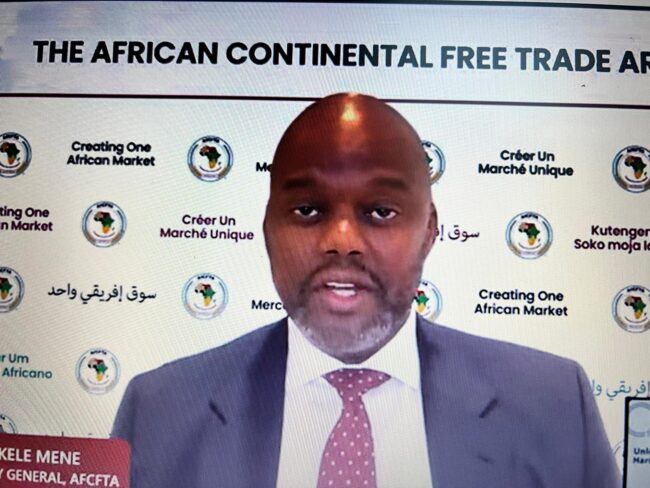
Also speaking, the Secretary General of the African Continental Free Trade Area (AfCFTA), Mr. Wamkele Mene, warned that disconnected digital systems could undermine Africa’s ambition to operate as a single market.
Mene said national systems must communicate across borders if African businesses were to trade seamlessly within the continent.
He identified digital identity, digital payments, cross-border data flows and electronic trade documentation as critical elements of an interoperable digital trade architecture.
Mene explained that interoperability would reduce barriers for small and medium enterprises entering African markets while helping customs authorities improve risk assessment and clearance.
He also said investors and large enterprises would benefit from improved market intelligence and stronger regional supply chains.
Mene warned that Africa could create new barriers to trade if digital systems remained confined within national boundaries.
“If our national systems cannot communicate with one another, we risk replacing physical fragmentation with digital fragmentation.
“Our digital public infrastructure must therefore be designed as an essential platform for continental trade, not simply as a tool for domestic service delivery,” he said.
The AfCFTA chief urged countries to accelerate implementation of the Protocol on Digital Trade and increase investment in interoperable digital infrastructure.
He said Africa should also develop its own digital capabilities rather than simply importing infrastructure and solutions from outside the continent.
“Africa has the talent, innovation and technical expertise to shape its own digital transformation.
“We must ensure that digital infrastructure serves not only large corporations but also SMEs, youth entrepreneurs, informal traders and smallholder farmers,” Mene said.
The News Agency of Nigeria (NAN) reports that GITEX Nigeria 2026 is being held in Abuja and Lagos from Aug. 31 to Sept. 3.
The event brings together policymakers, investors, technology companies, startups and other stakeholders to examine digital transformation, artificial intelligence and emerging technologies.