
August 10, 2026
Only days after this year’s celebrations, a very different picture of Morocco emerged.
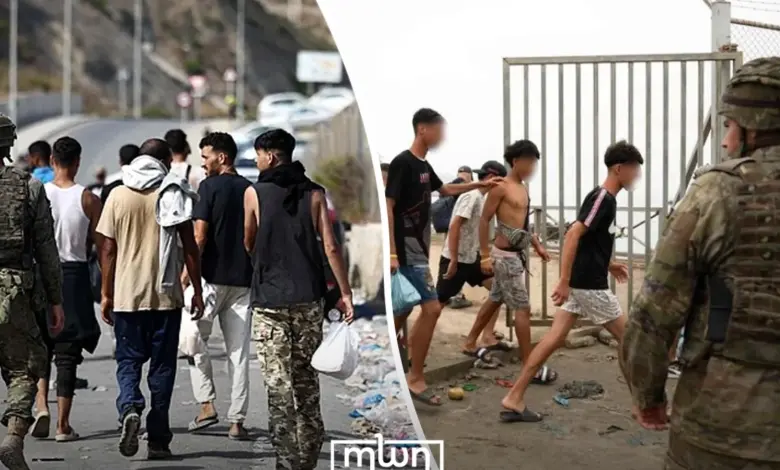
For several days, the images from Ceuta eclipsed those of Throne Day. The enclave has long been a crossing point for migrants from sub-Saharan Africa, elsewhere in North Africa, the Middle East, and Asia. But what interested me about this particular moment was what it revealed about Morocco itself. How could a country celebrating one of the most transformative periods in its modern history witness, almost simultaneously, such a large spontaneous attempt to leave?
Explanations appeared immediately: unemployment and housing shortages; strains on healthcare; corruption and human smuggling; rumors spreading through TikTok and WhatsApp; diplomatic tensions between Morocco and Spain; recent Spanish court rulings and immigration policies that may have altered perceptions of the border; persistent jobless growth; anxieties about artificial intelligence and automation; and development strategies that had produced impressive infrastructure without enough meaningful opportunities. Each illuminated part of the story. None fully explained what made Ceuta so unsettling.
Part of the answer lay not simply in why people were trying to leave, but in who they were. Among those moving toward Ceuta were not only unemployed young men but university students, skilled workers, healthcare professionals, parents with children, and entire families. Morocco itself faces shortages in fields ranging from healthcare and engineering to agriculture, construction, and tourism. If unemployment alone explained the crossings, why were physicians contemplating departure? If poverty were sufficient, why did engineers, teachers, entrepreneurs, and middle-class families also imagine lives elsewhere?
That question stayed with me after the beaches had emptied.
In the days that followed, I watched dozens of videos posted by people who had attempted the crossing and returned home. Some spoke directly into their phones from modest apartments; others sat in cafés or parked cars. Journalists interviewed them outside police stations, in family living rooms, and on neighborhood streets. Taken together, the videos formed something like an ethnographic archive of aspiration: ordinary people talking about work, dignity, family, and the future.
One young physician acknowledged that Morocco had given him an excellent medical education and that its hospitals need doctors, yet he imagined greater opportunities for specialization, research, and professional recognition abroad. A recent university graduate spoke not simply about finding work but about the life she hoped to build over the next twenty years. Parents imagined different educational futures for their children. Skilled workers compared not only wages but stability, recognition, and what life might look like for their families.
Their circumstances differed, but beneath them lay a remarkably similar question. It was no longer simply, Where can I find work? It was, Where can I build the life I imagine?
I grew up in the Ziz Valley of southeastern Morocco during the 1970s, when migration already occupied an important place in village life. Europe entered our oasis long before most of us had ever seen it. It arrived after evening tea, when glasses of hot mint tea still rested on woven mats and someone carefully unfolded a handwritten letter from France. The room grew quiet as each line was read aloud. When the reading ended, the letter passed slowly from hand to hand before being folded along its original creases and tucked back into its envelope.
As children, many of us were enlisted to write responses to such letters for parents, grandparents, neighbors, and other villagers who could not write, carrying news to sons, brothers, husbands, and other relatives working in France about births, weddings, harvests, illnesses, and the everyday life of the village. Almost every letter ended with two familiar refrains: send l-manda (le mandat), the money order that helped pay for school supplies, medical expenses, irrigation repairs, weddings, and countless household needs; and wa la yakhossona illa an-naẓar fī wujūhikum, “all we lack is seeing your faces.” The closing lines usually dissolved into duʿāʾ: prayers for good health, God’s protection, success in work, and a safe return home. Money sustained the household, but the letters reminded those abroad that what was most deeply missed could not be enclosed in an envelope.
Europe also arrived through cassette tapes, photographs passed from hand to hand, and the annual return of migrants, whose arrival each summer marked the season as surely as the ripening of figs, grapes, and dates. France, Belgium, Holland, and later Spain became places we knew through stories long before we knew them through geography. Distance, in those years, was measured not only in kilometers but in absence.
The circumstances changed from one letter to the next, but the questions rarely did. How is everyone? Is it raining? Is the harvest good? Has the money arrived? Are the children doing well? Did you pass your national exam? We miss your faces. May God protect you until we meet again. Migration promised a better life, but it was bound up as much with family obligation as with personal ambition. People spoke of seasonal work, supporting parents, building a family home, and saving enough to marry. Europe represented hard work, sacrifice and, for many, eventual return.
Half a century later, the letters have become WhatsApp messages and video calls, but the conversations continue. What has changed is the world against which a life is imagined. Distant lives that once reached our oasis intermittently, through letters, photographs, cassette tapes, and summer visits, now arrive every morning before breakfast. A cousin’s commute in Brussels. A niece’s graduation in Montréal. A former classmate’s medical residency in Lyon. Another life no longer waits for summer. It unfolds on a smartphone screen.
That was the difference I heard in the voices of the returnees from Ceuta. The desire for a better life had remained remarkably constant; what had changed was how that life was imagined. The physician was not fleeing unemployment. The graduate was not speaking only about income. Parents were not simply comparing food prices or rent. They were comparing lives, different ways their own lives might unfold. Ceuta began to look less like a migration crisis alone than a glimpse of something deeper: a changing relationship between prosperity, mobility, belonging, and the future.
Long before anyone crosses a border, another life must first become imaginable.
That realization changed my question. I was no longer asking simply why people wanted to leave, but how particular futures came to appear more plausible, desirable, or attainable than others. Economists can tell us about wage differentials; political scientists about institutions and border regimes; journalists about unemployment, smugglers, and rumors circulating online. These explanations help us understand why people move. They tell us much less about how futures become believable.
Part of the answer lies in how profoundly Morocco itself has changed. The Morocco of my childhood looked outward largely through migration and remittances. Today’s Morocco is an African investor, an industrial exporter, a diplomatic bridge between Africa and Europe, and increasingly a destination for migrants, students, and international business. But perhaps the more consequential transformation has taken place inside Moroccan families. Migration has become woven into kinship itself. Distant lives have become part of everyday family life.
This brought me back to a subject I have spent much of my professional life studying: development. For much of the twentieth century, governments built roads, ports, schools, hospitals, and universities believing these investments would do more than modernize economies. They would enlarge opportunity and persuade citizens that the lives they hoped to build could be built where they already lived.
Amartya Sen famously recast development as the expansion of freedom rather than simply the accumulation of wealth. Sen asked what people are free to do. Ceuta asks where a life worth living can be built. But possibilities are never produced by individuals alone. Roads, schools, hospitals, migration networks, family histories, and digital connections shape not only what people can do, but what futures come to feel imaginable, and where. I came to think of this as the social production of possibility: the many ways a society shapes which futures people can imagine, and which they come to believe they might actually live. Development, seen this way, does more than expand freedom. It changes the world in which a life can be imagined.
The consequences appear in ordinary things. A railway does more than connect Tangier to Casablanca; it enlarges the world within which mobility is imagined. A university produces graduates who can picture careers in Rabat, Paris, Montréal, Tucson, or Brussels. A smartphone does more than connect a family; it makes distant lives part of everyday experience.
Here lies one of modern development’s great paradoxes. The institutions that broaden people’s opportunities also enlarge the range of lives against which they compare their own. As those comparisons become ordinary, the future imagined by the nation and the futures imagined by its citizens no longer necessarily coincide. Most of the time they reinforce one another. Increasingly, they do not.
Seen in that light, the conversations after Ceuta looked different. The physician, the university graduate, the skilled workers, and the families I watched were not rejecting Morocco or denying its transformation. They were weighing one future against another. Looking back at the shoreline, I saw individual lives briefly converging in the same place, each carrying a different past and imagining a different future. What united them was not a single reason for leaving but a common question: where could the life they sought best be built?
Morocco is hardly alone. Ireland, Portugal, India, South Korea, and many other societies have confronted versions of the same paradox. In different ways, their institutions educated people, broadened opportunities, and opened paths that earlier generations could scarcely have imagined. In doing so, they also widened the world within which a life might unfold. Morocco makes the transformation especially visible because remarkable developmental achievements coexist with deep transnational ties. The returnees from Ceuta were not standing outside that story. They were among its products.
Statistics rarely capture how intimately this transformation is experienced. Every parent hopes education will open doors for a child; few imagine that some of those doors may lead elsewhere. A university degree celebrated at graduation may eventually become a passport to another life. What appears to the nation as a dilemma can be experienced within families as pride and longing, opportunity and absence, all at once.
Throne Day and Ceuta tell different stories about the same transformation. The handwritten letters of my childhood have largely disappeared, but the conversations they began continue.
Every year, when Throne Day returns, television screens across Morocco will again fill with familiar images: Al Boraq gliding north, container cranes rising above Tanger Med, solar fields stretching across the desert, preparations for another World Cup milestone. Millions will watch a country continuing to invest in tomorrow.
The key question is no longer simply whether a nation can build tomorrow, but whether its people can still imagine themselves in that tomorrow.
Also published in Morocco World News






Eloquent article, Hsain.