By Cecilia Ologunagba
New York, Sept 8, 2026
The United Nations (UN) says the Ebola outbreak continues to spread in the eastern provinces of the Democratic Republic of Congo (DRC), with more than 3,200 deaths reported.
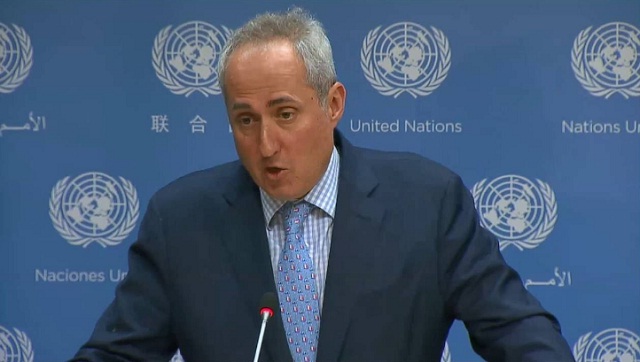
UN spokesperson Stephane Dujarric gave the update on Tuesday while briefing journalists at the UN headquarters in New York.
“Today, our Humanitarian Coordinator, Damien Mama, began a four-day visit to North Kivu to assess response efforts and review the broader humanitarian situation.
“Last Friday, the Government, together with the World Health Organisation (WHO), the Africa Centre for Disease Control and Prevention and partners, launched a revised Ebola multisectoral response plan requiring $1.3 billion over the next six months.
“The plan calls for a major expansion of surveillance, contact tracing, treatment, community engagement and preparedness activities,’’ he said.
Meanwhile, Dujarric said the Food and Agriculture Organisation has been scaling up support in Ituri and North Kivu, helping communities reduce the risk of animal-to-human transmission through veterinary surveillance and training, while also providing seeds, tools, poultry and cash assistance.
“Humanitarian needs across the country remain immense. The $2.1 billion Humanitarian Response Plan is only about half funded.
“We stress the urgent need for additional resources to sustain humanitarian operations and support efforts to contain the outbreak,’’ he said.
In a related development, the World Food Programme (WFP) is calling for greater international support for the population, particularly hungry people in remote areas far from lifesaving Ebola treatment centres.
“Ebola is a health crisis; there’s no question about that,” David Stevenson, WFP Country Director for the DRC, said.
“But at the same time, since Ebola is in eastern Congo and that area is so tragically affected by conflict, by food insecurity, by displacement, it needs to have a comprehensive approach.”
Eastern DRC has long been a restive region in a country that has battled Ebola 17 times since the virus was first discovered some 50 years ago.
WFP has been on the frontlines since the current outbreak was declared on May 15. Caused by the rare Bundibugyo species, it is the fastest on record, with more than 5,500 cases and 2,642 deaths in the first 100 days alone.
Stevenson has visited Ituri province, the epicentre of the crisis, and has seen how years of fighting, displacement and lack of access to sufficient food have affected local communities.
“It’s a place where there are over 500,000 people in IPC 4 of hunger and food insecurity,” he said, referring to the five-phase classification scale used by humanitarians.
“That’s one notch short of mortality from starvation.”
The veteran humanitarian stressed that food assistance is critical because when people go hungry, they cannot prioritise other challenges, including Ebola.
“If you can’t feed your family, it’s pretty difficult to adhere to health protocols, which is so necessary now,” he said.
“People changing their behaviours, people becoming more compliant to what is needed in the response to Ebola without the basic means to feed themselves is not going to work.”
With the epidemic moving faster than the response, underlying challenges must be considered, “and that means food assistance needs to be part and parcel of the community approach.”
Stevenson, the main challenges are building more Ebola treatment centres and securing more resources for food assistance – and getting it out “to the very remote rural areas.”
Despite logistical hurdles, including “terrible” roads that are often impassable, “we always find a way to deliver,” he insisted, but lamented what seemed like international indifference.
DRC Ebola response is among WFP’s top operations – alongside Ukraine, the Gaza Strip, Sudan and South Sudan – and he underlined the need for increased financial support.
“I’m stunned that we don’t have the response from the international community directly supporting the food assistance that’s needed so that collectively we can end Ebola.
“Given the level of the challenge that’s out there, it’s really incumbent on me to be very clear with such an appeal, and we’re asking for support now,’’ he said.
Stevenson has witnessed first-hand how medical care combined with adequate nutrition is saving lives amid the outbreak.
During a recent visit to an Ebola treatment centre, he saw a woman who “let out this amazing smile”.
The head of the treatment centre explained that she had been cured of Ebola and was now heading home.
“The majority of the people affected by Ebola never get to a treatment centre, hence the need for us to be helping build more,” he explained.
“Obviously, this woman who had recovered from Ebola recovered not only because of the medical care she received, but also because of good nutrition, because of food support, which is essential collectively for individuals affected,” he added.
“But, the same logic is true for the entire province, for the entire region of Ebola – that you have to have a comprehensive programme including food assistance, and I think that’s now better recognised and needs to be better resourced.”