AfricaLead StoryLocalNews

Peter Obi in US: Why rich Africa has poorest people on earth and what diasporans must do

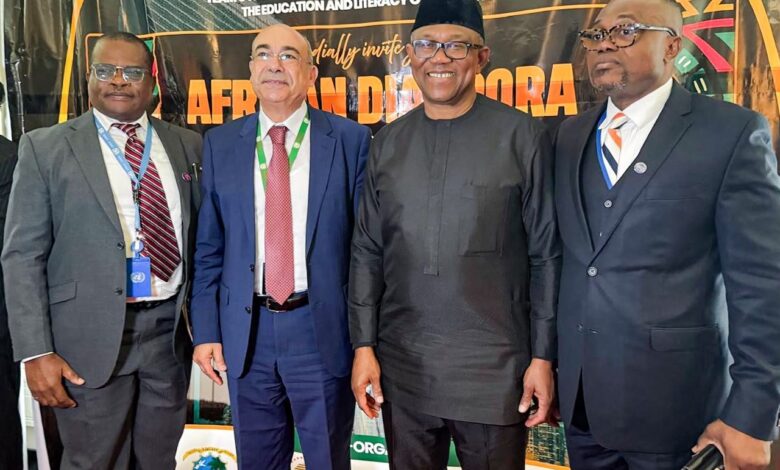
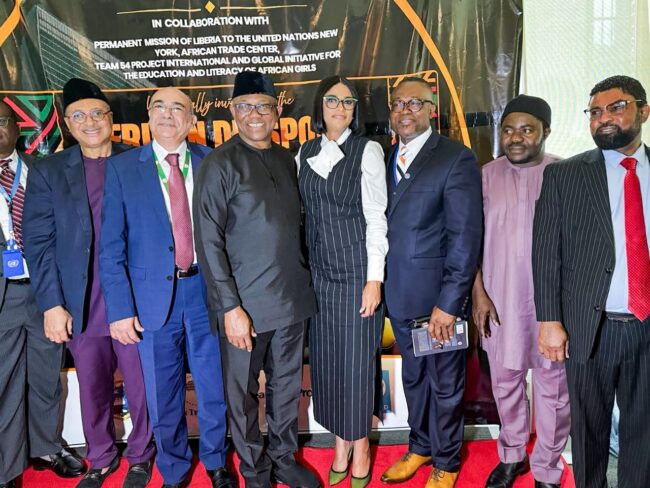
Presidential candidate of the Nigeria Democratic Congress (NDC), Mr. Peter Obi, has identified why Africa, which he said is the richest continent on earth “remains home to the largest concentration of the world’s poorest people.”
Mr. Obi, a former Governor of Anambra State, who said this in a Keynote presentation, at the Mandela Hall, African Union Permanent Observer Mission to the United Nations in New York, however noted that Africans in the diaspora can contribute significantly towards reversing the trend.
The presidential candidate of the Labour Party (LP) in Nigeria’s 2023 general election, in an X (former Twitter) post, said that he spoke on the theme: “The Role of the Diaspora African in Sustainable Development across Africa,” at the program held on Friday, July 10, 2026.
His post in full:
The Role of the Diaspora African in Sustainable Development
On Friday, July 10, 2026, I had the honour of delivering the keynote address at Mandela Hall, African Union Permanent Observer Mission to the United Nations in New York, on “The Role of the Diaspora African in Sustainable Development across Africa.”
Africa is a continent of immense riches. Indeed, it is the richest continent in the world, not only because of its vast mineral resources but also because of its greatest asset, its people. It is the second largest continent by landmass, after Asia, covering more than 30 million square kilometres. It is also the second most populous continent, with over 1.5 billion people. Significantly, more than one billion of these are young people in their productive years, making Africa home to the largest youthful workforce in the world.
When this demographic advantage is combined with nearly one billion hectares of arable land, about 60% of which remains uncultivated, it becomes clear that Africa possesses everything required not only to feed itself but also to become the food capital of the world.
Regrettably, despite this enormous potential, Africa remains home to the largest concentration of the world’s poorest people. Of the approximately 800 million people living in extreme poverty globally, nearly 60% are in Africa. That is about 480 million people, with Nigeria and the Democratic Republic of the Congo among the countries most affected. In other words, nearly one in every three Africans lives in extreme poverty. Likewise, in multidimensional poverty, Africa continues to bear the greatest burden.
The question, therefore, is simple. With all these advantages, why has Africa not been able to lift its people out of poverty?
It means there is a missing link. That missing link is Competent Leadership with Capacity, Compassion, Character, and Commitment to good governance.
What Africa needs is leadership that will rise to the challenge and drive the continent in the right direction. This means competent leadership with character, capacity, compassion and commitment to begin turning the continent around. When we get leadership right, everything else begins to change. We start realising our true potential.
So, what is the role of the Diaspora African in this journey? You have an enormous role to play.
Because you live in societies where institutions largely work, where democracy is strengthened by accountability and where systems function more effectively, you have both an opportunity and a responsibility to help build Africa. It is time to become stronger advocates for good governance. Even where you cannot vote, your voices matter. They should be heard both at home and abroad whenever things are going wrong on our continent. Stand firmly for what is right. Speak truth to the leaders who visit you. Let them know where they are getting it wrong. That is what some of us have continued to do.
The contribution of the African diaspora extends far beyond advocacy. History teaches us that many of the world’s great economic transformations were driven, in part, by their diaspora communities.
Japan offers one example. Following the Meiji Restoration of 1868, the country embraced modernisation and benefited immensely from Japanese scholars, professionals and citizens who studied and worked abroad, especially in Germany, before returning home to drive the technological transformation for which Japan is admired today.
China presents another remarkable example. It was under Deng Xiaoping’s reforms, beginning in 1978, that China embraced education, innovation and global engagement. These reforms created opportunities for the Chinese diaspora to contribute significantly to the country’s extraordinary economic transformation. In 1980, China had more people living in poverty than Africa. Today, China has reduced extreme poverty dramatically, while Africa continues to struggle with the challenge. China has less than 10% of the figure living in extreme poverty in Africa.
India also demonstrates what is possible. Its diaspora physicians and medical professionals played a significant role in developing a healthcare system that has made India one of the world’s leading destinations for medical tourism. Africa has countless brilliant doctors and healthcare professionals across the diaspora who possess the knowledge and experience to help achieve similar progress. What remains essential is the creation of an enabling environment that will attract them home.
To that end, I called on Diaspora Africans to remain actively engaged in shaping the democratic future of our continent. Their voices matter in advancing free, fair and credible elections across Africa. Elections conducted with integrity are the foundation of legitimate governance. They create the pathway to competent leadership capable of delivering the policies, institutions and opportunities our people deserve. When we create the enabling environment necessary for sustainable development, we start unlocking Africa’s potential.
Let us therefore work together, those at home and those abroad, to build a continent defined not by its challenges, but by its achievements, its unity, peace and its shared prosperity.
A NEW Nigeria is POssible. -PO