December 2025
Thank you to the Togolese people, the Government of Togo, the African Union, and all of the people and organizations who made the 9th Pan African Congress possible. Also, thank you to the participants, some of whom were in attendance and some who were not in attendance. Our collective engagement is what broadens our deliberations and enables us to dig deeper into the essence of our Pan Africanist struggles. However, I would caution that we cannot simply beat each other up and push for our personal voices to be heard because we speak louder or simply have more name recognition. We need to consider giving grace to each other and building consensus, which is necessarily slower than taking simple votes; however, the outcomes create more ownership of the results.
All protocols observed.
We pour libations for our ancestors who carved paths of struggle, success, resistance, renewal, and possibilities.
I arrived at the 9th Pan African Congress drenched in the tears of our Ancestors and the weight of the exhaustion of our people. We also carry the hopes, dreams, and struggles of the Ancestors in our bones, DNA, blood, and in our souls. They are waiting for us, their diverse and scattered children, to wake up from the externally imposed stupor. We must break the chains of mental slavery and the colonization of the African mind. Our pathway to breaking these chains has been built through decades of African-centered ways of thinking and doing, and now we must actuate them.
As a pathway for thinking outside of the European box, we must return to African memory in African culture, spirituality, traditions, and African social systems. African memory is symbolized by the Elephant and its long memory, its power, and its sense of family. The elders must leave footprints for the youth to follow and then create space for them to grow into and beyond those positions.
Remember this today! Clap your hands or stomp your feet to symbolize the stomping of the great majestic African Elephant, who always leaves footprints that can be followed. Some of our great elephants are Frantz Fanon, W.E.B. Du Bois, Queen Njinga, Imhotep, Kwame Nkrumah, Henry Sylvester Williams, Zumbi dos Palmares, Winnie Mandela, Malcolm X, Yaa Asantewaa, Ella Baker, Thomas Sankara, Nanny of the Maroons, Marcus Garvey, many others, and you reading this here today.
One of the major considerations for the 9th Pan African Congress rests on the decolonization of the African global mind. To understand this, let us look back at W.E.B. Du Bois’s comment in his 1900 report from the First Pan African Conference held in London and organized by Henry Sylvester Williams of Trinidad. Du Bois remarked in the conference’s summary statement that “the problem of the twentieth century is the problem of the color line.” By this comment, he meant that racism and racialized inequality—particularly white supremacy on the global stage—continued to imperil African progress, and I would add, the humanity of the African person or being. That conference and Du Bois’s analysis occurred on the heels of the Berlin Conference and the continued scramble for Africa and African resources by European colonialists and business enterprises. The scramble was spurred on by European greed and strategies of divide and conquer, and by the ongoing war against African people and the African mind through imperialism.
The war against the African mind is central to our deliberations here at the 9th Pan African Congress and to building on the outcomes of the Algiers Declaration (2025), which strives to have colonialism classified as a crime against humanity. We must reflect on the writings of Na’im Akbar, who wrote Breaking the Chains of Psychological Slavery, where he argued that Africans must realize that European colonialists, enslavers, and imperialists came to understand that they did not need physical chains to confine and control Africans or others whom they oppressed around the world. They engaged in a systematic strategy of mental bondage. This was similar to the strategies used for mental slavery against enslaved and formerly enslaved Africans in the diaspora.
Repeatedly, British, Portuguese, Dutch, German, Spanish, Belgian, American, and French societies used deliberate tactics to divide and conquer, confuse, dehumanize, coerce, trick, and manipulate African people across the continent and around the world. As this was occurring, African people fought back in this war against our humanity, traditions, spirituality, culture, and ways of governance.
I posit today that we, the global African community, must employ our hundreds of thousands of years of intellectual history in our Pan Africanist thinking and aspirations. We must actually become Ubuntu Pan Africanists. We must become Sankofa Pan Africanists and not just talk about these things.
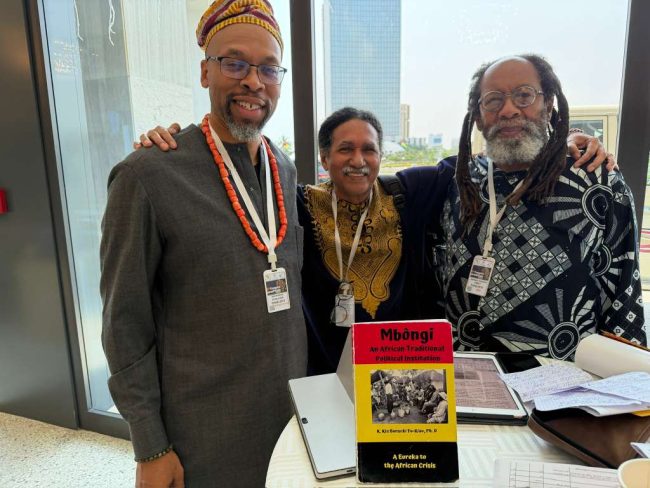
Fu-Kiau’s work on Mbongi points us toward African-centered ways of governance and problem-solving. We must keep in mind that Carter G. Woodson warned us in 1933 to be wary of The Miseducation of the Negro, where he pushed us to be introspective in our attainment of degrees and knowledge so that we do not simply take colonized or enslaved thinking and pedagogical strategies, employ them, and then believe we are improving the lives of our people. We must rid ourselves of colonial thinking while maintaining our knowledge of it so that we do not replicate it. Doing so would subconsciously imperil our people further. Let us wake up, Africans. We have new strivings today for our people and by our people.
To get there, we need to heal from the ravages of White Supremacy, Colonialism, Neo-Colonialism, Settler Colonialism, Imperialism, and mental slavery. Reparations are key to our repair here.
Minister Atta of Algeria spoke about generational trauma and the importance of not forgetting during the Algiers Conference. We need to heal from trauma while also not classifying all of our experiences as trauma; that is, we must recognize that there was not only trauma—there was also struggle, resistance, and progressive action occurring at the same time. My Grandmother’s Hands by Resmaa Menakem is a useful tool here.
Today, we need a revolution of thought and action. By thought, we mean documenting the history and continuity of colonialists’ specific crimes. By action, we mean that this body must produce specific, actionable steps that are bound by clear timetables.
Central to this point is that we must not separate the ideas of colonialism and imperialism. Imperialism is the imposition of a way of being—a projection of Western ways of doing, being, and thinking—and the use of sanctions for violations of those European norms, beliefs, and strictures. By contrast, colonialism refers to the full or partial seizure, control, and domination of a country—its resources, people, and politics—and the installation of a settler-controlled polity and economy. Imperialism is a necessary tool of colonialism and has been central to the colonization of the African mind. Therefore, to unravel and end the impact of colonialism as a whole system, we must fight imperialism at every level as part of our efforts to decolonize the global African mind. African-centered education for primary and secondary schools is central to this endeavor. We position that this commitment needs to be adopted by African regional bodies, the African Union, and African governments within five to ten years of this declaration.
Finally, African governments, regional bodies, and the African Union must plan for the exponential advancement of Artificial Intelligence (AI). We argue that failure to do so will position Africa and African people for a modern-day recolonization of African history, mind, culture, and data. The development and deployment of the technology to support AI can expose the continent and its people to further environmental catastrophes. This has already begun to happen to the African American community in Boxtown (South Memphis), Tennessee, in the United States.
African memory is symbolized by the Elephant and its long memory. The elders must leave a pathway—a set of footprints—for the youth to follow and then move out of the way.
- So, I say stomp like an Elephant to leave an imprint for youth engagement.
- Stomp like an Elephant to crush the remaining tentacles of Colonialism.
- Stomp like an Elephant to break down the memory and bondages of our individual and collective trauma.
- Stomp like an Elephant to end the oppression and exploitation of African women and girls.
- Stomp like an Elephant to end the disease of white supremacy, control, and domination of African physical and mental spaces.
- Stomp like an Elephant.
- Stomp like an Elephant, stomp like an Elephant, and change the world!
Ubuntu! Amandla! Awethu!
Dr. Kokayi Khalfani is a Professor of Sociology and Africana Studies & Director, Africana Institute, Essex County College, USA