
The Aburi Accord and why it collapsed By Emeka Asinugo (See some vintage pictures)


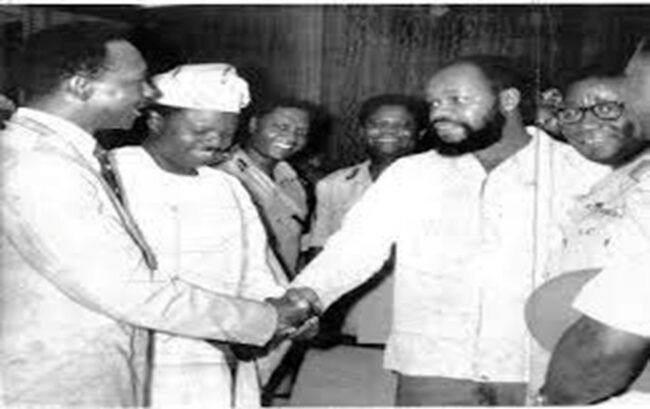
Of recent, a video clip has been circulating in the social media of a gentleman who heavily criticized the Biafran warlord, General Emeka Odumegwu-Ojukwu, for the failure of the Aburi Meeting that was held in Ghana on 4 and 5 of January 1967. The meeting was to mend fences and restore the unity of Nigeria. That meeting still stands out as one of the most consequential but tragically misunderstood episodes in Nigeria’s sociopolitical history.
Convened in the quiet hills of Aburi, Ghana, away from the tension and bloodshed that engulfed Nigeria following the coups of 1966, the gathering brought together the country’s top military leaders in a last-ditch effort to salvage national unity. What emerged from that meeting has since been known as the Aburi Accord, an agreement that was never formally codified into a single binding document, but carried the hopes of a nation on the brink. Within months, those hopes collapsed, giving way to a devastating civil war. The story of the Aburi Accord was not just about what was agreed, but also about how those agreements were vaguely interpreted, never implemented as agreed, and ultimately became undone.
To understand the significance of Aburi Accord, we must first appreciate the context in which it took place. Nigeria in 1966 was reeling from two military coups that shattered its fragile post-independence democracy. The first coup in January 1966, led largely by young army officers, resulted in the assassination of key political leaders, particularly from the Northern Region. That coup brought an Igbo man, General Aguiyi Ironsi, forward as the military Head of State. The counter-coup in July, driven by northern army officers, reversed the power structure and brought Lieutenant Colonel Yakubu Gowon to leadership. Consequently, widespread ethnic violence erupted, especially against people of Eastern Nigerian origin living in the North. Thousands were killed, and many more fled back to their home region in fear. Trust among Nigeria’s regions collapsed, and the country stood dangerously divided.
It was against this backdrop that the military leadership agreed to meet in Aburi. The choice of Ghana as a venue was deliberate. It was a neutral ground and a calmer environment, removed from the immediate pressures and hostilities that were eating up Nigeria. The aim was simple but urgent: to find a political arrangement that would keep holding the country together while the authorities addressed the deep-seated grievances that challenged the governance of the day.
The Eastern Region, led by Lieutenant Colonel Chukwuemeka Odumegwu-Ojukwu, came to the meeting with a clear position. They were to demand for security for the people of their region, and a restructuring of Nigeria that would prevent further domination of the country by any part or persecution of any. The Federal Military Government, led by Gowon, sought to preserve national unity and at the same time, accommodate some degree of decentralization.
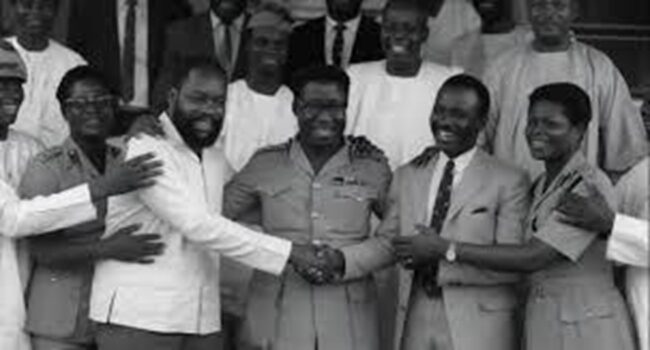
The discussions at Aburi were frank, at times emotional, but largely cordial. The leaders spoke openly about their fears, suspicions, and expectations. Central to the Eastern position was the insistence that no region would feel safe under a system where the central authority could deploy military force without consent. This led to one of the most critical understandings at Aburi: that the Nigerian military would be reorganized on a regional basis, and that troops would not be moved from one region to another without the approval of the regional governor concerned. For Ojukwu, this was not merely a procedural matter, it was a fundamental guarantee of safety for his people.
Another key aspect of the discussions was the role of the Supreme Military Council, an organization that was made up of the country’s top military leaders. At Aburi, it was agreed that this council would be the highest decision-making authority, and that major national decisions would require full consultation. The implication, as understood by some participants, was that decisions would be made by consensus rather than imposed by the central authority. This understanding significantly curtailed the powers of the Head of State, transforming the governance structure into something closer to a collective leadership arrangement.
Equally important was the question of regional autonomy. The Eastern delegation argued strongly that each region should control its internal affairs, which included administration, security, and economic resources. There was little overt resistance to this idea during the meeting, and the general tone suggested acceptance of a looser federation in which the central government would handle only limited functions such as foreign affairs, currency, and communications. To Ojukwu and his supporters, this amounted to a confederal system in all but name.
Despite the seeming apparent success of the agreement, the Aburi discussions suffered from a critical weakness: they were not translated into a detailed, mutually agreed legal framework. Much of what was decided was based on verbal exchanges and shared understandings, rather than precise written clauses. In the relaxed atmosphere of Aburi, this may have seemed sufficient. But once the participants returned to Nigeria, the lack of clarity became a major problem. Each side began to interpret the outcomes in ways that aligned with its own expectations and strategic interests.
For the Eastern Region, Aburi represented a binding commitment to a decentralized, confederal Nigeria in which regions would enjoy near-total autonomy and the central government would operate largely as a coordinating body. This interpretation was rooted in both the explicit statements made during the meeting and the broader context of insecurity that had driven the Eastern leadership’s demands. Ojukwu believed that anything less than this arrangement would leave his people vulnerable to further violence.
The Federal Military Government, on the other hand, viewed Aburi as an agreement to improve consultation and grant some additional powers to the regions, but not to dismantle the federal structure. Gowon and his advisers were concerned that a confederal system would weaken the country to the point of disintegration. They also faced pressure from other regions and from external actors who favoured a strong central government. As a result, when the time came to implement the Aburi decisions, the Federal Government took steps that significantly altered its substance.
The most notable of these steps was the issuance of a decree intended to give legal effect to the Aburi discussions. The decree clearly diverged in key respects from what the Eastern Region believed they had been agreed on. It maintained central control over the military, allowed for decision-making by majority rather than consensus within the Supreme Military Council, and preserved significant powers for the federal authority. To the Eastern leadership, this was a clear breach of the Aburi understanding. What they had seen as guarantees of autonomy and security were, in their view, systematically eroded by the decree.
The breakdown of trust that followed was swift and decisive. Ojukwu rejected the federal decree, insisting that it did not reflect the true spirit or content of the Aburi Accord. Efforts to reconcile the differing interpretations failed, as both sides became increasingly entrenched in their positions. The Eastern Region began to take steps toward self-determination, while the Federal Government moved to assert its authority and maintain the territorial integrity of Nigeria. By May 1967, the situation had escalated beyond political negotiation, culminating in the declaration of independence by the Eastern Region and the outbreak of civil war shortly afterwards.
The collapse of the Aburi Accord can, therefore, be traced to several interrelated factors. Foremost among these was the ambiguity of the agreement itself. Without a clear, detailed, and mutually endorsed written document, the Accord was vulnerable to divergent interpretations. What one side considered settled and binding, the other viewed as provisional and subject to modification. This lack of precision proved fatal in a context where trust was already in short supply.
Equally significant was the deep mistrust between the parties. The events of 1966 had created wounds that were far from healed, and each side approached the Aburi negotiations with its own fears and suspicions. While the meeting temporarily eased tensions, it did not eliminate the underlying anxieties that shaped each leader’s perspective. When disagreements arose over implementation, there was little goodwill left to bridge the gap.
External influences also played a role. Nigeria’s strategic importance and economic potential meant that foreign powers had a vested interest in its stability. Many of these actors favoured a strong, centralized government and were wary of any arrangement that might lead to fragmentation. While their involvement was not always direct, their preferences helped shape the environment in which the Federal Government made its decisions.
Finally, there was the issue of political will. Implementing the Aburi Accord as understood by the Eastern Region would have required a fundamental restructuring of Nigeria’s governance system, with far-reaching implications for power and resource distribution. Such a transformation would have been difficult under any circumstances, but especially so in a period of crisis. The Federal Government ultimately chose a path that it believed would preserve national unity, even at the cost of abandoning key elements of the Aburi understanding.
In retrospect, the Aburi Accord represented both the moment of possibility and a cautionary tale. It showed that dialogue and compromise were possible, even in the face of deep division. At the same time, it highlighted the dangers of ambiguity, mistrust, and incomplete agreements in high-stakes negotiations. The failure of Aburi was not inevitable, but it was the result of choices and circumstances that, taken together, made its success increasingly unlikely. More than half a century later, the lessons of Aburi remain relevant. They speak to the importance of clarity in agreements, the need for genuine commitment to implementation, and the central role of trust in any effort to resolve conflict. Above all, they remind us that peace is not secured simply by reaching an agreement, but by ensuring that all parties share a common understanding of what that agreement means and are willing to uphold it, both in letter and in spirit.
Chief Sir Asinugo, PhD., M.A., KSC, is a UK-based veteran journalist and author