
We have just celebrated Easter: life’s victory over death and the joy of the Resurrection. Jesus is alive appearing to his disciples, eating with them, and teaching them. His presence is close and tangible again. Then, forty days later, he ascends.
At first glance, it can feel like a loss. It may seem as though the story ends just when things are improving. But the Ascension is not about Jesus leaving us behind. It is about Jesus lifting humanity into the very life of God and changing forever how he is present to us.
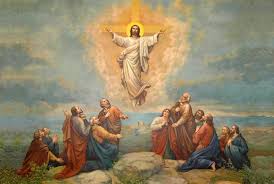
Acts 1:9 depicts the disciples gazing up at the sky. You can almost picture them, frozen, staring into the clouds, trying to hold onto that last glimpse of Jesus. And who could blame them? If you had walked with him, learned from him, and watched him die and then rise again, wouldn’t you want him to stay?
But then the angels gently interrupt them (Acts 1:10-11): “Why are you standing there looking at the sky?” It’s a subtle but powerful moment. The message is clear: don’t just stand there. Don’t get stuck looking upward. The mission is now. Go and do what I taught you! Because the Ascension doesn’t mark Jesus’ absence—it marks a transition.
Before the Ascension, Jesus was present in one place, at one time, in a visible, physical way. After the Ascension, he is present everywhere, through the Spirit, through the Church, through us. This is the key—the Ascension is not about distance; it’s about expansion. Jesus is not further away. In a mysterious way, he is closer than ever. And that changes how we understand our lives as Christians.
The Gospel tells us that Jesus blesses the disciples as he ascends. That detail matters. His final gesture is not one of departure but of blessing. It’s as if he is saying, “Everything I have given you, everything I have taught you, now goes with you.” And then the disciples did something surprising. They return to Jerusalem “with great joy.” After Jesus has just disappeared from their sight. That only makes sense if they have begun to understand what the Ascension means: that their relationship with Jesus is not ending—it is deepening. They are no longer just followers. They are now witnesses. And that word, witness, is at the heart of this feast. Jesus says, “You will be my witnesses… to the ends of the earth.” Not just believers. Not just admirers. Witnesses.
A witness is someone who has experienced something real and cannot keep it to themselves. Think of how we naturally share positive news—a new job, a birth in the family, a moment of unexpected joy. We don’t need to be told to talk about it. It overflows. That’s what the Ascension calls forth in us: a faith that overflows into witness. However, this is where the challenge arises.
Many of us are comfortable being quiet believers. We keep our faith personal, private, and contained. And there is value in that—faith is deeply personal. But the Ascension reminds us that it was never meant to be private.
If Christ is truly alive, if he has truly transformed our lives, then that reality must touch how we speak, how we act, and how we love.
“Witness” doesn’t always mean preaching on a street corner. Often, it looks much simpler—and much harder. It looks like patience when you are frustrated. It looks like forgiveness when you have been hurt. It looks like integrity when no one is watching. It looks like hope when everything around you feel uncertain. In those moments, we make visible the presence of the risen and ascended Christ. Because now we are his Body in the world. That is another profound truth of the Ascension: Jesus entrusts his mission to us.
Jesus could have stayed. He could have continued appearing, teaching, and leading directly. But instead, he chooses to work through ordinary people—through the Church, through each one of us. That is both immense dignity and great responsibility. It means that when people encounter us, they should catch a glimpse of Christ. Not perfection—because we are far from perfect—but something real. Something authentic. Something that points beyond us. And we don’t do this alone.
The Ascension always points us toward Pentecost. Jesus promises the Holy Spirit, the Advocate, the one who will guide and strengthen the disciples. The same Spirit is given to us. So, when we feel inadequate, we will remember that the mission is not ours alone. God is at work within us. There is one more dimension of Ascension that is easy to miss but deeply important. When Jesus ascends, he doesn’t shed his humanity. He carries it into heaven. That means our human nature—our joys, our struggles, our bodies, our lives—has a place in God.
The Ascension is a promise about our destiny. We are not meant for smallness. We are not meant for despair. We are meant for communion with God. In a world that often feels heavy with division, anxiety, and uncertainty, the Ascension reminds us that heaven is not just a distant hope. It is our future, already begun in Christ. And so, we live with a kind of tension: our feet on the ground, but our hearts lifted.
We don’t stand there staring at the sky, disconnected from the world. Instead, we engage the world more deeply because we know where it is ultimately leading. We become people of both action and hope. So today, the question for us is simple but challenging:
Where is Christ calling you to be his witness? Maybe it is in your family, where relationships are strained. Maybe it is in your workplace, where honesty or compassion is tested. Maybe it is in your community, where someone needs to feel seen and valued.
The Ascension is not just something that happened to Jesus. It is something that happens to us every time we allow our lives to be lifted beyond ourselves and every time, we reflect his love in the world. So don’t just stand there looking at the sky.
Go. Live the Gospel. Be a living presence of Christ for others. And trust that the one who has ascended is still with you, closer than you think and leading you where you are meant to go.
Amen.