The Trinity of State Decay (I): The mirage and the shadow By MAX AMUCHIE

A nation does not declare its own decline. It performs normalcy — until the performance can no longer hold.
What follows is not an announcement, but a pattern — visible to those willing to look beyond the performance.
Last week, this column offered the definitive articulation of The Insecurity Triad — the convergent system through which kidnapping finances violence, banditry governs territory, and terrorism reshapes the ideological order. It also made a promise: that the Trinity of State Decay would follow as the macro-diagnostic lens—the theory that explains not merely what the Triad does, but why it is structurally possible—why the state does not stop it. Why, in important senses, the state cannot.
This is that column.
One clarification before we proceed. Last week I referred to the first element of this Trinity as the Administrative Mirage. The more precise term — and the one this framework now canonises — is the Institutional Mirage. The distinction is deliberate and consequential. “Administrative” suggests a failure of management: the wrong people, the wrong processes, the wrong execution. That is a recoverable condition. “Institutional” names something far graver — the failure of the very structures through which legitimate authority is constituted and expressed. That is not a management problem. It is a structural mutation. The precision matters because the diagnosis must be exact. A misnamed illness invites the wrong cure.
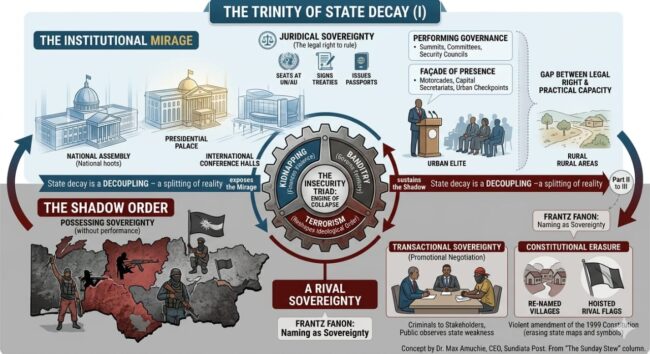
The Trinity of State Decay holds that Nigeria’s crisis is not simply one of state weakness or failure in the traditional sense. It is a decoupling — a splitting of reality into two rival orders: the Institutional Mirage, which performs sovereignty without possessing it, and the Shadow Order, which possesses sovereignty without performing it.
Between them operates The Insecurity Triad — the operational framework through which organised violence is produced, financed, and sustained.
These three elements are not sequential. They are simultaneous. They are mutually constitutive. And together, they describe not a country in crisis, but a country in transformation — toward something that no existing framework has yet fully named.
This is the core claim.
Now let’s look at elements of the Trinity.
The first is the Institutional Mirage.
The Nigerian state exists. This is not in dispute. It issues passports, signs treaties, seats delegates at the African Union and the United Nations, dispatches ambassadors, and convenes legislative sessions. It possesses, in the language of international relations, juridical sovereignty — the legal right to rule, recognised by the community of nations.
What it increasingly does not possess is empirical sovereignty — the actual capacity to rule: to protect its citizens, enforce its laws, secure its borders, and deliver the basic functions through which a state justifies its claim to authority over people and territory.
This gap — between the legal right and the practical capacity — is the Institutional Mirage. It is not a gap born of poverty alone, nor of incompetence alone, though either or both may be present. It is structural.
The Mirage is maintained by two interlocking performances.
The first is the performance of governance. Summits are convened. Committees are inaugurated. Security councils meet. Declarations are issued. Each of these acts reassures the urban elite — and the international community — that a system exists, that the state is functional, that the problem is being managed. Fifty kilometres outside a state capital, farmers are fleeing their fields. Villages are being renamed by gunmen. Communities are learning that no one is coming.
The performance is not cynical in a simple sense. In many cases, the actors within it believe in what they are doing. But belief in process is not the same as process producing outcomes. Governance is replaced by the ritual of governance — the meeting held in place of the action, the declaration issued in place of the protection, the committee inaugurated in place of the problem solved. The ritual is maintained because it is the last remaining evidence that the state is real.
The second is the façade of presence. The motorcades, the grand secretariats, the uniformed officials at checkpoints — these constitute a thin crust of visible authority. They are not nothing. But they are concentrated in spaces where the state was never truly absent: the capital, the commercial city, the airport corridor. In the spaces where the state is most needed — the rural northwest, the insurgency-ridden northeast, the contested middle belt — the façade does not reach. There, the absence is not symbolic. It is territorial.
The Institutional Mirage, then, is the structural condition in which a state maintains the international performance of sovereignty while progressively losing the domestic substance of it. It is not collapse. It is something more insidious — the appearance of function in the presence of dysfunction. A state that has collapsed is visible in its collapse. A Mirage state is invisible in its decay precisely because the performance continues.
And it is the Mirage — not mere weakness — that creates the condition for what comes next.
This logic produces a structural split in sovereignty. If the Mirage is the performance of authority, the Shadow is its possession.
Nature, it is said, abhors a vacuum. So does political geography.
In the spaces the Institutional Mirage vacates — or never truly occupied — a Shadow Order has emerged. It is essential to be precise about what this means, because “shadow” can imply something furtive, marginal, illegal-but-minor. What has emerged in Nigeria is none of these things. It is a rival sovereignty: a structured, territorial, self-financing order that governs populations, extracts resources, adjudicates disputes, and in some regions commands greater practical authority than the formal state.
The Shadow Order is not a consequence of criminals filling a gap. It is the relocation of authority from the centre — the loss of its monopoly on the power to protect, to tax, to name, and to decide. It expresses itself in two particularly revealing ways.
The Promotional Negotiation. When the formal state sits across a table from bandits — or terrorists, or both — to negotiate ceasefires, ransom arrangements, or “peace deals,” something precise and devastating is occurring. It is not diplomacy. It is an act of transactional sovereignty. The state, by negotiating, elevates the criminal from a subject of the law — someone to be prosecuted, dismantled, defeated — to a stakeholder of the land: someone whose compliance must be purchased or secured, whose demands have standing, whose survival the state has implicitly agreed to manage rather than end.
This is what might be called the Psychology of the Table. The population watching these negotiations does not see a state managing a crisis. It sees a state that has conceded the terms of its own authority. The lesson absorbed is not that the state is not working but that the Shadow holds leverage the state does not. Every negotiation of this kind is a quiet transfer of legitimacy — conducted in public or in the forest, often celebrated as pragmatism, and devastating in its long-term structural and political consequences.
The Constitutional Erasure. This is the most precise and the most devastating expression of Shadow sovereignty — and it is almost entirely unreported as what it actually is.
The 1999 Constitution of the Federal Republic of Nigeria, as amended, is not merely a legal document. It is a sovereign map. It names — by schedule — 36 states of the Federation and their capitals, the Federal Capital Territory, and 774 local governments and their headquarters. Each entry is a sovereign seal: evidence that the state has claimed, recognised, and accepted responsibility for that space and the people within it.
When armed groups — or rival sovereign invaders — drive ancestral owners from their land and rename the villages, they are not merely committing displacement and violence. They are conducting a violent amendment of the Constitution. They are erasing the state’s map and drawing their own. They are performing, through force, the counter-constitutional act of renaming the republic.
This is where the work of Frantz Fanon becomes indispensable — not as a borrowed abstraction, but as a precise analytical tool. Fanon, in The Wretched of the Earth and Black Skin, White Masks, argues that naming is sovereignty: that the coloniser’s first act of domination is not the gun but the renaming — the erasure of indigenous identity through the imposition of a new lexicon of place, person, and possibility.
But renaming is not the only instrument of this counter-constitutional act. Rival sovereign invaders — terrorists and armed groups operating under ideological banners — go further. They hoist their own flags, their own insignia over the communities they seize. This is not mere symbolism. It is a territorial declaration — the physical assertion that the Nigerian state’s sovereign seal over that space has been revoked and replaced. Where the Constitution places a community under the authority of the Federal Republic, the hoisted flag of a rival order places it under a different authority entirely. The flag is the constitutional amendment made visible.
What is occurring in Nigeria’s conflict zones is precisely inverted and internalised colonisation, in which armed non-state actors perform the naming rituals and hoisting of flags of sovereignty over populations that the formal state can no longer protect.
The Shadow Order, in this sense, does not merely fill the space the state vacates. It governs it, on its own terms, by its own logic, with its own map — and it marks that governance in the oldest sovereign language there is: the name of the land.
But how exactly does the Mirage create the conditions for the Shadow to thrive? And what is the engine that locks them together in a loop the state seems unable to break? A country still named on paper, but being renamed in practice.
Part II follows next week — where the Trinity of State Decay receives its definitive formulation.
Don’t miss it.
Trust is Sacred. Stay Seasoned.
•Dr. Max Amuchie is the CEO of Sundiata Post, the developer of The Insecurity Triad Analytical Framework, and the theorist of the Trinity of State Decay. He writes The Sunday Stew, a weekly syndicated column on faith, character, and the forces that shape society, with a focus on Nigeria and Africa in a global context.
X — @MaxAmuchie | Email: max.a@sundiatapost.com | Tel: +234(0)8053069436