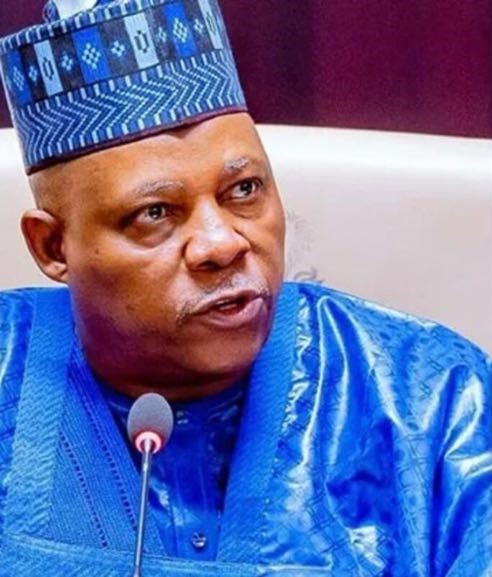
In recent days, a striking claim has circulated widely across social media platforms and informal news channels, that Nigeria’s Vice President, Kashim Shettima, allegedly declared that if he is given some $500 million, he would automatically end insecurity in northern Nigeria. For many Nigerian citizens already weary of years of violence, displacement from ancestral homes, and loss of livelihood, such a statement, if it was true, would appear not only simplistic but deeply insensitive. It would suggest that a crisis that is fundamentally rooted in complex historical, political, and socio-economic realities could be resolved so simplistically. Understandably, the claim triggered anger and suspicion among the citizens, and renewed scrutiny of the Vice President’s past.
But there is a problem. There is no credible, verifiable record that the Vice President ever made such a statement in the manner it was presented. In actual fact, discussions about funding security operations or rebuilding conflict-affected regions had taken place in the pasta. Nigerian leaders, including Shettima during his tenure as governor of Borno State, often spoke about the enormous financial requirements needed to stabilize the North-East. It came up that billions of dollars were mentioned in relation to reconstruction, humanitarian aid, intelligence gathering, and military operations. However, reducing such complex conversations to a viral soundbite like “give me around $500 million and I will end insecurity”, is a distortion that strips away context and replaces nuance with sensationalism.
For the ordinary Nigerian trying to make sense of this, it is important to understand how such narratives emerge. In today’s digital age, information does not always travel in its original form. A speech can be trimmed into a short clip. A nuanced argument can be reduced to a single sentence. Numbers mentioned in passing can be turned into bold promises. By the time the message reaches the public, it often bears little resemblance to what was originally said. This is where overzealous content creators enter the picture. In a highly competitive online environment where attention equals revenue, there is a strong incentive to produce content that attracts clicks, shares, and engagement. Unfortunately, accuracy is sometimes sacrificed on the altar of virality. A dramatic quote, even if unverified, will travel faster than a carefully explained policy position. A sensational headline will draw more traffic than a balanced analysis. And in the race to capture audience attention, context becomes collateral damage.
It is not difficult to see how the alleged statement attributed to the Vice President fits neatly into this pattern. The claim is provocative. It touches on a deeply emotional issue. It reinforces existing frustrations about insecurity. And it lends itself easily to political interpretation. Whether shared out of genuine concern, partisan interest, or the simple desire for online engagement, the result is the same: a piece of information that spreads rapidly without sufficient scrutiny.
Yet, when we step back and consider the realities of the security challenges in northern Nigeria, the implausibility of the claim becomes evident. For one, the insurgency in the region is not a problem that can be solved overnight or with a fixed sum of money. It involves a web of factors that include religious extremism, mass poverty, unemployment, weak institutions, porous borders, and regional instability. Addressing these issues requires sustained effort across multiple military, economic and social fronts. It demands effective coordination between federal, state and local governments, collaboration with neighbouring countries, and the involvement of local communities.
Indeed, statements that had been reliably attributed to the Vice President reflected an awareness of this complexity. He had spoken about the need for coordinated strategies, intelligence-driven operations, and long-term development initiatives. He had acknowledged that insecurity is not a single-dimensional problem and that its resolution cannot be reduced to a quick fix. These positions are consistent with what security experts and policy analysts have long projected.
We might then ask why the distorted version gained more traction than the verified one. The answer lies partly in human psychology. People are more likely to believe and share information that aligns with their existing perceptions or emotions. In a climate of frustration and distrust, a statement suggesting that leaders are either naive or dismissive of citizens’ suffering can easily find an audience. It confirms what some already suspect, and therefore requires less verification before being accepted.
There is also the issue of political polarization. In Nigeria’s highly charged political environment, statements, whether they are real or imagined, are often weaponized to score points against opponents. A misquote can quickly become a tool for criticism, while attempts to correct it may be dismissed as damage control. In such an atmosphere, truth struggles to keep pace with narrative. This is not merely an abstract concern. The danger is that the spread of distorted information has real consequences. It shapes public opinion, influences political discourse, and can erode trust in institutions. When citizens base their judgments on inaccurate information, the quality of democratic engagement suffers. Debates become less about facts and more about perceptions. Solutions become harder to achieve because the problems themselves are misunderstood.
For journalists and media organisations, this moment serves as a reminder of our critical role. The responsibility to verify information, provide context, and challenge misleading narratives has never been more urgent. In an era where anyone with a smartphone can act as a publisher, professional journalism must distinguish itself through accuracy and integrity. This is not simply a matter of professional pride, it is essential for the health of public discourse. At the same time, the public also has a role to play. Media literacy, the ability to question, verify, and critically assess information, is no longer optional. Before sharing a sensational claim, it is worth asking: Where did this come from? Is there a credible source? Has it been reported by reputable outlets? These simple questions can help stem the tide of misinformation.
Back to the claim about the Vice President, the most reasonable conclusion, based on available evidence, is that it is either a misinterpretation or a fabrication. It does not reflect the complexity of the issue at hand, nor does it align with his documented public statements. To treat it as a literal expression of policy or intent would be to misunderstand both the man and the challenge he is addressing. None of this is to suggest that public officials should be beyond criticism. On the contrary, scrutiny is an essential part of democratic accountability. Citizens have every right to question the effectiveness of government policies, demand better security, and hold leaders to their promises. But such scrutiny must be grounded in accurate information. Criticism built on false premises ultimately weakens the very cause it seeks to advance.
The video claim, however, offers a broader lesson about the information ecosystem we inhabit. The speed at which information travels today is both a blessing and a challenge. It allows for rapid dissemination of news and ideas, but it also creates fertile ground for distortion and misinformation. Navigating this landscape requires vigilance from all stakeholders: content creators, journalists, public officials, and citizens should all be involved. VP Shettima could not have been so insensitive as to reduce a deeply entrenched security crisis to a simple financial transaction. The more plausible explanation is that his words could have been reshaped in the echo chambers of social media, amplified by those eager for public attention, and accepted by audiences hungry for answers. Recognizing this does not solve the problem of insecurity, but it does help ensure that the conversation about it is anchored in reality rather than illusion.
For the ordinary Nigerian, clarity begins with questioning what is seen and heard. Not every viral statement is true. Not every widely shared claim is accurate. And sometimes, the most responsible response is to pause, verify, and seek the fuller picture before drawing conclusions.
Chief Asinugo, PhD., M.A., KSC is a UK-based veteran journalist and author.