Odoemelam Amala was self-employed as a trader at a small market in Aba, Abia state; he was feeding his family well until this current federal administration came to governance and changed everything for him and his household.
He used to buy cheap fuel then when there is no power supply in town to make ice blocks which he sells to his numerous customers comprising mainly retailers of drinks and other food products requiring some cooling.
Amala was getting good money from this “late night and early morning” business with which he fed, clothed, sheltered his family and trained his children in school.
But when Bola Tinubu became Nigeria’s president in 2023, the reality of his first speech during which he declared that he had “removed the fuel subsidy”, gradually but persistently ushered many Nigerians including Amala and his family into the heart of poverty.
Running their well-stocked shop, feeding the family, paying his children’s schools fees and taking care of the family’s healthcare needs became a Herculean task in the new governmental administration.
The harsh effects of the fuel subsidy removal policy on his family continued decimating the family’s main business and income which consistently nose-dived until it was hard for them to feed.
Things got worse when a child of the family fell sick and there was no money to take him to the hospital for medical treatment.
So the family, pushed into poverty by harsh economic policies, helplessly resorted to herbal treatment for the sick child and the consequence was the eventual death of the young boy.
Prof Abayomi Adebayo, a professor of Development Economics and lecturer at the Obafemi Awolowo University, Ile Ife, Osun State corroborated the type of experience the Amala family were having.
“From casual observation on the streets of Nigeria, I see pervasive practical reality of the “one-meal-a-day” poverty experience; I see children and women walking miles to fetch water from contaminated sources.
“I see informal survival traps in which under-employed people on the streets hawk for hours and manual labourers earn volatile daily wages that inflation has eroded; I see many people under pressure for survival falling into traps of predatory local moneylenders.
“I see many frustrated graduates trying their hands on farming and all kinds of informal businesses but are destabilised because the general economic system is unstable for them to make meaningful headway,” he said.
He summed his experiences with the pressure of poverty around Nigerians thus: “So, I will say poverty is getting deeper with a mix of economic exhaustion, forced lifestyle and mental burden of unpredictable daily economic swing.”
Poverty as a scourge, has claimed many lives, destroyed glorious destinies and crushed people who were willing and who struggled without help to be freed from its shackles.
Prof. Joseph Onuoha, a professor of Economics Education at the Department of Social Science Education, University of Nigeria (UNN) said that poverty in economic terms, is a condition in which an individual or household lacks sufficient and sustainable resources to meet basic needs and maintain a minimum acceptable standard of living.
“These resources include income, consumption, productive assets, employment opportunities, and access to essential services such as food, adequate housing, healthcare, education, safe water, and sanitation.
“Poverty is therefore not simply the absence of money; it is the inability to command sufficient goods and services to live a decent life.
“Economists measure poverty using indicators such as income, consumption expenditure, and multidimensional deprivation, taking into account the cost of living and household needs,” he said.
Prof Onuoha’s explanation of the effects of poverty agrees with the idea that poverty is a scourge which creates critical socio-economic cum political problems that affects almost all areas of the sufferer’s life and also has a huge devastating effect on communities.
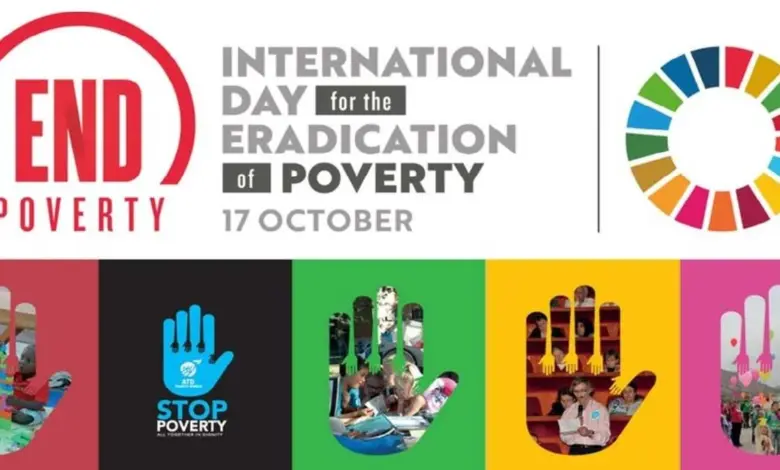
It is in recognition of the global challenges poverty creates and the need to checkmate it that the United Nations General Assembly resolved to set aside in its calendar, October 17 every year, as the International Day for the Eradication of Poverty since 1992.
The United Nations (UN) said that the day is observed with global events dedicated to raising awareness about the challenges of poverty on millions of human lives and promoting actions to eradicate it in individual lives and societies.
“The day serves as a reminder of the millions of people worldwide who live in poverty and the need for concrete actions to address its multifaceted causes.
“The observance creates a time to reflect on the progress made in poverty reduction and the work that still needs to be done to achieve social and economic justice for all.
“The day also acknowledges that poor people are often the first to fight against poverty and it highlights the importance of their voices in the fight against it,” the UN said.
The International Day for the Eradication of Poverty has its Umbrella Theme for 2026 – 2028 as “United for Peace and Human Rights”, while the focus theme for 2026 is “Safe Homes for All”.
The 2026 focus theme reinforces the need for “adequate, secure housing as the basic foundation of for dignity, security and community participation” which conditions are necessary for an individual to be capable off making a choice, becoming an economic agency and living with dignity.
This level of living ensures movement from living below to living above $2.18 per day threshold adjusted according to purchasing power parity as the World Bank International Poverty Line shows.
The United Nations on its website said the 2026 observance emphasizes that approximately 1.1 billion people live in slums or informal settlements worldwide, while millions continue to face multidimensional poverty, rising food/energy costs, and institutional barriers.
The current population of the Earth, according to the World Population Clock, is about 8.3 billion and approximately 1.1 billion people in that population are homeless and same number live in acute multidimensional poverty according to World Bank updates.
Living in acute multidimensional poverty, means that such persons lack basic needs like housing, healthcare, education, and quality standard of living and regrettably, half of these multidimensionally poor individuals, about 584 million, are children under the age of 18 according to the World Bank.
More worrisome is the estimation that the largest number of people living in extreme multidimensional poverty are found in Sub-Saharan Africa, with Nigeria and the Democratic Republic of the Congo having major portions of the global total.
As of September 2026, official and institutional figures indicate that 133 million to 150 million Nigerians are experiencing multidimensional poverty or severe economic deprivation.
The Nigerian Bureau of Statistics (NBS) through its Multidimensional Poverty Index (MPI) report declared that 133 million Nigerians which is 63 per cent of the country’s population, suffered from multidimensional poverty and so have no basic healthcare, education, clean water, or proper sanitation among other needs.
Furthermore, PriceWaterHouseCoopers (PwC, an accounting firm) and some development analysts submitted that monetary and multidimensional poverty indices affects between 140 and 150 million Nigerians following the hardships introduced into the Nigerian economic system by fuel subsidy removal, inflation and other economic shifts in Bola Tinubu’s administration..
The number amounts to about 62 to 70 per cent of Nigeria’s current population which is estimated at 243.6 million people according to Worldometer Nigeria Population which statistics was arrived at using the latest United Nations (UN) data.
Nigeria’s recklessly expanding cases of multidimensional poverty is not just unbelievable, it is unfortunate, awkward, weird, disastrous and mind boggling considering the amount of natural resources the country is endowed with.
A Public Affairs Analyst, Mr Nnamdi Elekwachi says that “Nigeria has no business being described as the Poverty Capital of the World because it has abundant human and natural resources, including a hardworking and productive population, to unlock its growth potential”.
He however stressed that it is “persistent governance failures — corruption, regulatory capture and policy incoherence and other ills that has kept it trapped in every index of poverty.”
Elekwachi gave further insight into what brought Nigeria to its present position of earning the sobriquet – “the Poverty Capital of the World.”
“Nigeria has the means to be a great nation with majority of its population living well above the poverty line but what it lacks is the ability to convert those means into shared prosperity because leakages swallow value before it reaches households.
“Take solid minerals for an instance, while national attention stays fixed on oil, vast deposits of gold, lithium, tin and other solid minerals are mined largely by non-state actors and informal operators illegally and without licences from the Nigeria Mining Cadastre Office (MCO).
“The Ministry of Solid Minerals itself has acknowledged that the sector loses billions of dollars annually to illegal mining, often in collusion with foreign off-takers, so the nation is resource-rich and yet revenue-poor,” he lamented.
The Director-General, National Senior Citizens Centre (NSCC), Medinat Akinyemi-Obe, recently said during an event in Abuja that many citizens go to bed hungry; not because Nigeria is poor, but because they have been forgotten.
Of course Akinyemi-Obe’s assessment of one of the causes of poverty in Nigeria is true and manifest as the political leadership forgets the people who brought it to power only to focus on their own personal wants and those of their cronies.
Her idea aligns with the United Nation’s statement that people living in poverty are usually subjected to discrimination, and institutional maltreatment.
According to Elekwachi, the years of mismanagement and corruption, which results from focus on the personal wants of political leaders, do not just steal money; they break the link between national wealth and household welfare hence “poverty contains — and persists”
“That explains the paradox of today: the government reports higher FAAC allocations, foreign reserves have improved from $32bn to over $40bn, the current account turned positive, and global rating agencies have upgraded Nigeria’s outlook.
“Yet household economies have collapsed. This is economic disequilibrium — macro gains without micro transmission. Disposable income is gone, the kitchen-table economy has shrunk, and livelihoods are squeezed. It is what economists call a cost-of-living crisis.
“So while macro indicators look creditworthy, the World Bank’s latest poverty assessment still shows multidimensional poverty rising, with over 40% of Nigerians poor and another 10-15% vulnerable,” he said.
The unfortunate situation in Nigeria leads observers to ask “what could be the results of unchecked ravaging multidimensional poverty and what solutions could there be for it?
Prof Adebayo said the time to tame the hydra-headed monster of multidimensional poverty is now because if left unchecked, the resultant loses and chaos will be unbearable.
“First, the rate of all sorts of crime will soar. Fraud or 419 will increase. The poor under health challenges will die in their condition except there is divine intervention.
“The pressure to leave Nigeria will increase despite hopeless global migration conditions and lives of Nigerians will be more miserable,” he said.
Adebayo said Nigeria’s label as the Poverty capital of the World is a “resource curse” phenomenon that is erasable if several deeply interconnected structural economic and political factors could be corrected.
He emphasised the need for government to sale government refineries to individual operators to ensure workability, reduction in petroleum products cost and also the functionalization of the local government system if Nigeria intends to truly fight poverty.
The Economist urged government to massively empower farmers to boost high productivity through mecahnised agriculture which is an economic powerhouse.
Onuoha further posits that to overcome the current persistent slide into multidimensional poverty, Nigeria must adopt an integrated strategy combining political accountability, economic transformation, and social development to check the scourge.
“Politically, government should strengthen transparency, truly fight corruption through due process, ensure effective utilisation of public funds and other resources, and make federal, state, and local governments accountable for measurable development outcomes.
“Economically, priority should be given to controlling inflation, increasing food production, improving electricity and transport infrastructure, supporting small businesses, expanding affordable credit, and promoting labour-intensive industries that create decent and sustainable employment.
“Agricultural development, vocational training, digital skills, and entrepreneurship should receive particular attention to enable young people, women, farmers, and informal-sector workers to earn adequate and reliable incomes,” he said.
Onuoha pointed out that social protection programmes should also provide targeted support to the poorest Nigerian households, especially during economic shocks and that Nigeria should invest substantially in accessible and quality education, affordable healthcare, nutrition, safe water, sanitation, and decent housing.
He stressed the need for government to prioritise underserved rural communities and regions affected by insecurity, while universities, traditional institutions, religious organisations, cooperatives, and community associations should participate in identifying local needs and implementing development programmes.
“My central recommendation is that Nigeria should pursue a people-centred poverty-reduction strategy that measures success by improvements in citizens’ actual living conditions, rather than by government expenditure or economic growth alone.
“Each state and local government should establish measurable poverty-reduction targets, publish implementation results, and evaluate progress regularly.
“Ultimately, Nigeria will make sustainable progress when citizens can afford nutritious food, secure decent employment, educate their children, access healthcare, and build productive assets that protect them from future economic hardship,” he said
Analysts are of the opinion that if Nigeria must substantially check poverty in the country, decision-making processes in key political leadership circles must begin from the grassroots and be supported by evidence-based policy-making procedures.
They submitted also that every government project must aim at improving the people’s lives and must be fully implemented and targetted at ensuring conscious efforts at eradicating poverty yielded measurable results.