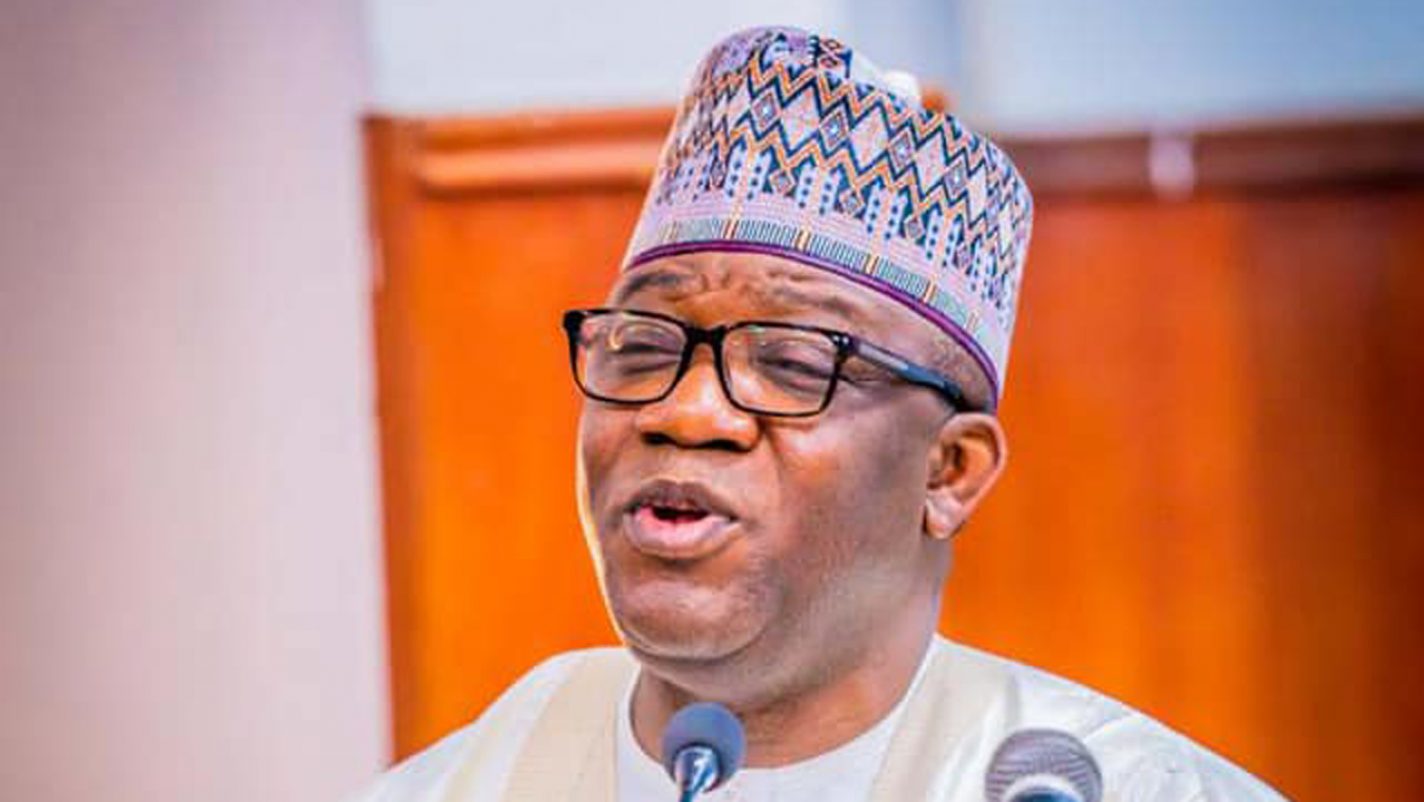
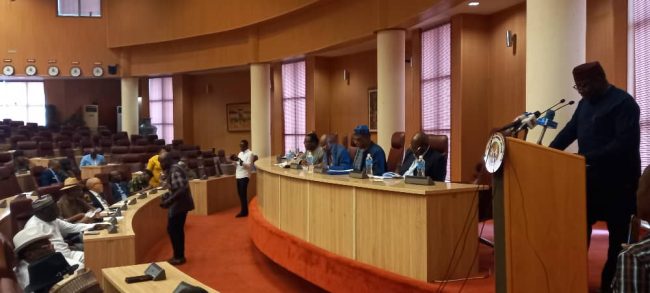
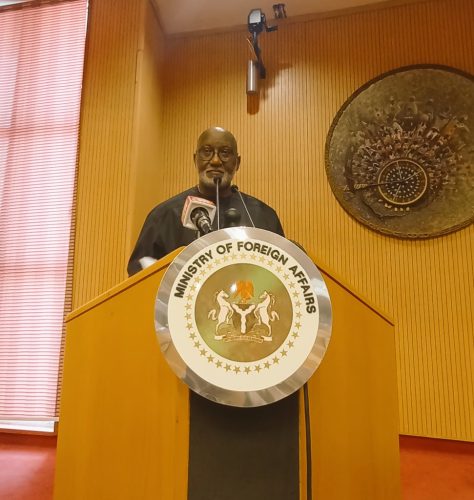
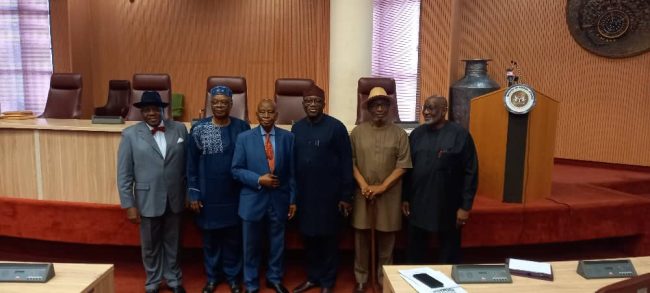
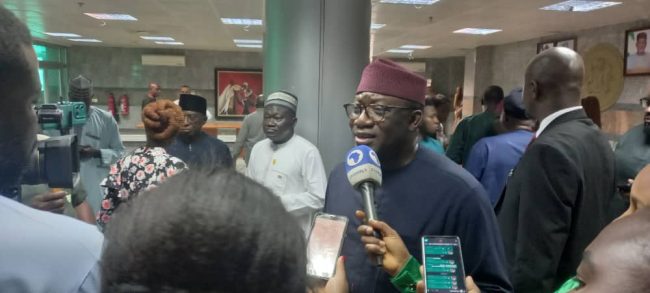
 Being Text of the Annual Lecture Delivered by His Excellency, Dr. Kayode Fayemi, CON, Former Governor of Ekiti State and Former Chairman of the Nigeria Governors’ Forum to the Society for International Relations Awareness (SIRA) on Wednesday 18 October, 2023, Abuja, Nigeria.
Protocols
- Allow me to start by celebrating the leadership and members of the Society for International Relations Awareness (SIRA) for putting this platform together and, in so doing, providing us with an opportunity to step out of our everyday preoccupations with our national affairs and shifting our gaze to the global scene where a lot is also going on that matters for us as a country, a continent, and a people. There is a way in which amidst the many and ever more complex domestic challenges which our country has been grappling with these past decades, our individual and collective energies and attention have been trained much more on our internal affairs, to the neglect of the equally many and increasingly complex developments in the world around us and what they mean for our own prospects.
- This occasion reminds me of a culture of public engagement on international affairs that was once strongly embedded in our national system in the first three decades of our independence. As a student during that period, the culture of public engagement with international affairs played an important role in shaping my world outlook, just as it did for many in my generation. As a precocious Secretary – General of both ANUNSA (All Nigeria United Nations Students Association) and YUSSAN(Youth United in Solidarity for Southern Africa in Nigeria) at the University of Lagos, I spent a good deal of my late teenage years volunteering at ANC and SWAPO Keffi offices in Ikoyi, Lagos under the tutelage of late Comrades Mark Shope and Herman Ithete, both Chief Representatives of ANC and SWAPO in Nigeria at the time. From consciousness about the crime that was apartheid, awareness of the imperative of completing the liberation of Africa from colonial domination, and alertness to the costs of the East-West Cold War on our continent to pride about the position and role of Nigeria as the most populous black nation on earth, the quest for a revival of the pan-African ideal, and the need for a new world order, we were all the richer for the public political education which we gained through various campus clubs, professional associations, and dedicated media columns and programmes that brought the world to us in real time and vivid terms.
- The sterling work which the Nigerian Institute of International Affairs carried out in accordance with its mandate also played a vital role in cementing that culture that ensured that happenings around Africa and across the world did not seem as remote and of no concern to us as they may have appeared. We learnt, as students, about the theoretical basis for the organic interfaces between domestic and foreign policy; for the ordinary Nigerian citizen, the blend between the two was almost taken as given, and it ensured that while we were proud of the many elite diplomats who were doing our country, continent, and the African world proud, foreign policy was not in any way narrowed to an elite affair.
- In, therefore, accepting the invitation which the inimitable and indefatigable Owei Lakemfa extended to me on behalf of SIRA to speak, I did so without hesitation partly out of a nostalgia for the yesteryears of a popular national engagement with world affairs and an earnest hope that we can revive that culture and expand it for the immense benefit which it will bring as much to our domestic governance as to our foreign policy. In fact, today more than even in a previous era, developments in the international system deserve to be monitored ever more closely not only by a highly professional foreign service but also by a conscious domestic public whose knowledge, engagement, and activism can only enrich the work of our diplomats as they bat for the country, for Africa, and for all black people around the world.
- I do not need to remind this audience of why today, more than before, we need to pay closer attention to developments in the international system. For one, many are the common challenges that are bedevilling the international community regardless of geography or national endowment. Foremost among those challenges is climate change and the scourge of epidemics and pandemics. For another, the world is presently traversing one of the most unequal phases in its history, with the implication it carries for our capacity to achieve the much desired structural transformation that will enable us to turn the table of underdevelopment. Furthermore, we are living witnesses to changes in global order, including a radical redistribution of economic power, that presages the end of the post-1945 multilateral system and its replacement by a new multi-polar order characterised by competing centres of power and influence.
- Indeed, it is the process of the gradual decomposition of the post-1945 multilateral system and the Pax Americana that underpinned it that is at heart of the current turbulence which we are witnessing in the international system. The present moment in world history is probably best captured by the analytic statement which was made in 1930 by the famous Italian political philosopher, Antonio Gramsci, about a different era that was equally defined by the multiple problems that were playing out in and around his native Italy: “The crisis consists precisely in the fact that old is dying and the new cannot (as yet) be born; in this interregnum a great deal of morbid symptoms appear.” It is a statement that was subsequently popularised as to assume the status of a global cliche.
- Periods of transition from one global order to another tend to occur gradually, and even sometimes imperceptibly for a period. Nevertheless, the forces of change that underwrite the transitions progress inexorably until the shift that they bring about bursts into the open. The transitional periods, given the triple dynamic of the decomposition, recomposition, and redistribution of power that they entail, tend to be marked by turbulence, instability, and even violence. At the height of the global hegemony of Great Britain and the Pax Britannica which it enforced, the capacity of that Island state to rule the waves on account, inter alia, of its industrial prowess and superior naval power, placed it in a position to enforce its will and demand compliance.
- Pax Britannica did not, however, go unchallenged as much from the European rivals of Great Britain such as France and later Germany, but also from emerging new centres of power such as the United States which, though previously a colony of the United Kingdom, was rapidly coming of its own to assume an important role as a pole of global economic growth and political influence. The decline of Pax Britannica began long before the onset of the First World War but that war, and the Second World War that inevitably followed it, marked its substantive and symbolic end. It was a violent end that claimed millions of lives. In the inter-war years, the world experienced massive convulsions that included the Great Depression and the economic and social dislocations that came with it. The air in Europe was filled with revolutionary fervour even as anti-colonial/ national liberation movements in Africa, Asia, and Latin America gathered momentum. The ill-fated League of Nations, an intergovernmental child of extremely difficult circumstances that was overwhelmed from birth by the many crises that were playing out, and which was further incapacitated by the rising tide of fascism in Europe, also finally collapsed.
- Pax Britannica was replaced by Pax Americana with the United States emerging formally as the single most powerful economic and political force in the international system. The global economic dominance of the United States was largely projected by its transnational corporations and the pre-eminent position that the U.S. dollar came to assume in international finance, commerce, and investment. Combined with the massive military capability that it had built up, and its ability to deploy power on a global scale, it is not surprising that the United States took on a frontline role in the making of the new global multilateral system that was built at the end of the Second World War, and at the heart of which lies the United Nations family of organisations, including the Bretton Woods twins, the World Bank and the IMF.
- Indeed, Pax Americana as a concept and practice may have embodied the pre-eminent position of the United States in global affairs after the Second World War. However, it was subject to contestation from the outset following the politico-ideological and strategic interest divergences between the United States and its allies in the West, on the one hand, and, on the other hand, Russia which, having paid a heavy price in lives lost during the Second World War, was determined to consolidate its Union of Soviet Socialist Republics (USSR) under a revolutionary socialist banner. In the Cold War that ensued and which eventually came to frame global politics until the 1990s, Russia bolstered its military arsenal to become a credible rival and competitor to the United States in the deployment of massively destructive military capability. The politics of deterrence such as it played out effectively meant that no overt effort was made by either of the two biggest nuclear powers to interfere in the spheres of influence that they had carved out for themselves and sought to control.
- The USSR, with Russia at its core, may have successfully matched the United States in the military-political-ideological fields. However, it struggled economically, and in the face of the increasing pressures on its continued sustainability, it ended up being dissolved. Not a few commentators, including, for a time at least, the well-known Francis Fukuyama, were quick to adopt a triumphalist narrative that stated that the United States, either on its own or with its Western allies, had won the battle for political, ideological, and systemic supremacy over its keenest rival and competitor. Capitalism, it was said, had shown itself to have triumphed over socialism/Marxism/communism, and liberal democracy had won over the “authoritarian” system of democratic centralism that the Soviets had practised. In the words of Fukuyama, it was the end of history. But was it?
- Fukuyama himself was to later admit that his proclamation of the end of history in the immediate aftermath of the dissolution of the USSR and its Warsaw Pact and COMECON was, to state it politely, a little premature. For out of the rubble of the old USSR, the Russian Federation reconstituted itself as an independent power which also claimed and retained the massive nuclear arsenal of the old Soviet Union. It may have become weakened but it was not entirely out and it was only a matter of time, especially following the accession of Vladimir Putin to power, for a resurgent Russia to reposition itself as a major force and power broker in its own right, complete with an upgraded and avant garde arsenal of conventional and non-conventional forces. The conventional components of that arsenal are presently being put to test by the US-led NATO in the war that is going on in Ukraine.
- The moment which the United States may have enjoyed as the sole remaining superpower still standing was clearly destined to be extremely short lived, and any thoughts about a unipolar world order under the untrammelled hegemony of America was clearly never going to happen. Even as Russia embarked on a path of rapid military-political resurgence, China led a pack of countries such as India, Turkey, Brazil, and a host of other middle powers (Is this, finally, the arrival of Prof Akinyemi’s Medium Powers?) to challenge and successfully erode the economic dominance of the United States. The re-emergence of China has been especially rapid and comprehensive, positioning it next to the United States as the second biggest economy in the world, and which, by all projections, is well on its way to overtaking America by the next generation. What the defunct Soviet Union and the resurgent post-Soviet Russia were unable to do in the economic arena, China was able to do.
- Beyond being the factory of the world, holding the biggest foreign exchange reserves, expanding its international trade, investment, and foreign aid profiles, enhancing its competitiveness in science, technology, and innovation, and growing its soft power, China has been carrying out a single-minded modernisation and expansion of its military capability. The massive financial resources at its disposal enable it to invest the kinds of resources in reinforcing its defensive and offensive capabilities on a scale which has already placed it among the topmost military powers in the world. Not to be left behind, other actors, mostly Middle Powers, are also asserting their global geopolitical interests more autonomously and aggressively, thereby contributing to the much more diffuse nature of power and influence in the present situation. A good example is what we are witnessing with BRICS nations.
- Scholars seeking to characterise the current international balance of power among nations talk about the emergence of a multipolar global order with multiple competing centres co-existing, uneasily. I suggest that that multipolarity itself speaks to a global reordering in which the old is dying simultaneously as the new is struggling to be borne. It is a tense and delicate transitional moment in human history that is packed with doubt and fear as old certitudes are dissolved, now pecking orders are emerging, and existing global governance institutions are straining at the seams. As the UN Secretary-General puts it, “we are now at an inflection point… power dynamics have become increasingly fragmented as new poles of influence emerge, new economic blocs form and axes of contestation are redefined.” (United Nations, A New Agenda for Peace, 2023) Not surprisingly, an unprecedented militarisation and arms race is taking place in which the old powers are expanding their defence expenditures (with military expenditures globally setting a new record, reaching $2.24 trillion in 2022, according to SIPRI and IISS), boosting their arsenals, and setting up foreign bases just as the new powers are taking various steps to boost their positions in as equal a measure as possible. More worryingly, nuclear conflict is once again an active part of public discourse.
- The precarious balances underpinning the evolving multipolar system represent a moment which requires enlightened leadership on all sides to navigate. And yet, it is precisely that kind of leadership that has increasingly been in short supply around the world as voices of narrow nationalism, raw xenophobia, blatant fear-mongering, and belligerent militarism overwhelm the political space and constrict avenues for meaningful dialogue to ensure that global change is delivered peacefully. As the drums of war are being beaten, and events are increasingly being interpreted tendentiously through the prism of what increasingly looks like a new Cold War, many observers have noted that we have not been edged nearer to a third world war than now. Indeed, there are even suggestions that we are already witnessing the first scene of the first act in a possible third world war following the outbreak of the military conflict in and over Ukraine.
- Turbulence such as we have seen during this transitional phase in global order has manifested itself in numerous arenas and touched every country in the world. From ever more frequent and frightening forest, floods, hurricanes, and tornadoes to much higher temperatures, irregularities in weather patterns, and the attendant droughts and famine, climate change is taking its toll on people and economy. Internal and cross-border migrations triggered or accelerated by climate change have, in turn, revived ethno-regional consciousness and produced serious inter-communal clashes over water resources, land, and pasture among farmers and pastoralists. International migration, undertaken through the most hazardous routes, have met with a rising tide of racist populism and extreme right nationalism that is changing the face of politics in Europe and North America.
- The crises and instability that are wracking the international system in this period of transition have also manifested themselves in the spate of security problems arising from radical extremist claims, mostly tinged with questionable religious motives, that have called the secular state into question and challenged its constitutional foundations. Although not limited only to Africa – and this point bears repeating at every opportunity – the continent has borne some of the harshest and most prolonged brunt to date of violence and insecurity underwritten by local and ambulant franchisees of Al-Qaeda, Islamic State, Ansaru, and other global networks of militants committed to the violent pursuit of an alternative vision of governance and development clothed in a contestable Jihadist ideology. For us here in Nigeria, the Boko Haram group which started as a small, highly localised movement has flourished to encompass huge swathes of northern Nigeria and the entire Lake Chad Basin. The entire Sahel belt stretching from West to East Africa and the Horn has been in a state of continuous turmoil for nearly two decades and the instability in Mali, Burkina Faso, Chad and now Niger are not unconnected to these untoward developments. .
- Violent militancy in the contemporary period is not only limited to non-secular or anti-secular groups. Various armed groups fighting different causes have emerged or re-emerged around the world and engaged state authorities in pitched battles. Taken together with the violence of the non-secular extremists, the activities of bandits, kidnappers, and other criminal gangs, the cost on people, communities, economies, social cohesion, and the mass displacement of populations can best be imagined. In this process, poverty has been accentuated and the social contract has been emptied of any meaningful content. It is not surprising that with the volatile cocktail of poverty, inequality, unemployment/underemployment, and mass insecurity, political systems faced with multiple pressures have succumbed to greater authoritarianism amidst democratic recession and reversals.
- It is usual in periods of transition in global order for those countries that are the weakest links in the chain of power and influence to bear some of the biggest costs of change. Africa has been badly hit by turbulence emanating from outside its boundaries such as the Covid-19 pandemic, the 2007/2008 sub-prime economic crisis, and the global climate change. The continent has also been grappling with its own internal challenges, both structural and non-structural. On top of rising poverty, growing inequality, currency depreciation, mounting inflationary pressures, and persistently high levels of youth employment, a new external debt crisis is hovering over many African countries which threatens another round of austerity and externally-imposed adjustment if not quickly contained. Historic social gains of the early post-independence years and early wins of the first decade of the return to democratic politics are being rapidly lost. Without a doubt, turbulence in the international system has been refracted into Africa to produce a season of anomie across our continent.
- In the face of this season of anomie, the temptation is strong, and has already been manifested, to resort to fragmented, disjointed, and uncoordinated actions. However, this need not be so. Nor should it be allowed to continue. Change in global order must necessarily come with its own challenges. But the various dimensions of change which are taking place also present opportunities. For us in Africa, one clear opportunity is the chance to win ample autonomous space within which to advance our ambitions of structural transformation and, in doing so, take a role as a co-rule maker as the new global order gets fashioned out. Yet while opportunities may be available to be tapped into in the context of ongoing realignments in the international system, they are not always given, nor do they last forever. Acting speedily, purposively, and with single minded determination is an imperative which must be embraced with boldness and vision by the governments and peoples of Africa. This is all the more so as periods of transition in global affairs are also known to be replete with various dangers, including war. One immediate threat which the continent must avoid is to be reduced simply – and yet again – to the site for a new scramble among the competing powers – big and medium, old and new – that are positioning themselves to be among the strategic drivers of a revamped, global multilateral system made as much as possible in their image and for the advancement of their vital interests.
- This is where visionary leadership must come in to help, in a forward-looking way, to develop a strategic, coordinated, coherent, and shared African approach to managing the turbulence in the international system as the process of change gathers momentum. The underlying preoccupation must be to ensure that amidst the turbulence in the system, Africans and all peoples of African descent are not made casualties and cannon-fodder as various interests compete for advantage. Nor should the hard won sovereignty of African countries be allowed to be compromised either by acts of omission or commission emanating from within or outside the continent.
- Visionary African leadership fit for these turbulent times will, additionally, demand close attention to the new global order that is evolving slowly, unevenly, unsteadily, and chaotically but surely. When the key pillars of the post-1945 global order that has now come under strain were established, most of Africa was under direct colonial rule and global Africa was under the weight of political oppression and exclusion. Today, the continent has every reason to assume a seat at the table and play the role of a joint-rule maker for the new order that is emerging. For this to happen, we require nothing less than a complete reset in our approach that begins with refusing to be corralled into the corner of any of the competing powers and insisting that the only thing that matters to us is the advancement of the needs and dignity of Africans at home and global Africa at large.
- To advance our own core interests and values, African leadership must also of necessity expunge the development aid framework from our thinking and instead embrace the audacity in defending our rights and interests in global affairs that has eluded us for way too long. It is demeaning that every now and again, our leaders get drafted to the capitals of competing powers on grounds of development aid and support. Leadership audacity was at the heart of the launching of the pan-African project. That audacity served us well in the struggle for independence and decolonisation. As President Kwame Nkrumah used to tell African leaders, we should neither face the east nor west, we should always face forward. As the world is being remade to reflect shifts in the balance of power, that ancient audacity must be rediscovered and deployed to maximum effect and for maximum benefit. Out of the turbulence of the moment, the path for continental rebirth must be cleared and a conscious effort must be made to extend the rebirth to global Africa.
- To rise to the challenge of the times, Africa must organise itself to develop and deploy the necessary strategic plans, policy packages and leadership resources that are fit for the era of rapid and complex change. It is this task of policy and leadership advancement that must be addressed as an urgent necessity if Africa is to play its rightful role in the ongoing dynamic of change in global order.
- Of course, it is altogether natural, for reasons of history, demography, economic weight, and human and natural resource endowment that Nigeria should play a frontline role in framing and harnessing the African response to a changing international system. Fortunately, our Foreign Service has a proud record of having been home to some of the best diplomats coming out of Africa for whom the world reserved a healthy respect. Allow me in this regard, and as I close, to pay a warm tribute to His Excellency, Ambassador John Kayode Shinkaiye – the one I fondly call my Egbon and namesake and His Excellency, Ambassador Brownson Dede, that icon of the liberation struggle for their distinguished service to the fatherland and the continent, and the role model legacies they left upon retirement. It is my hope that their huge contributions, as well as the contributions of others in their ranks, will undoubtedly serve as inspiration to the present generation of Foreign Service Officers, if only to underscore the point that we have no business as a country and a continent, to play second fiddle to anyone anywhere and at anytime. To this end, particular attention must be paid by the leadership in the Ministry of Foreign Affairs to the equipping of the next generation of our diplomats with the requisite policy and political tools and aptitudes that will allow them to hold their own as worthy bearers of the core values and interests of a renascent Africa in a changing international system.
- I thank you for your kind attention. God bless Nigeria. God bless Africa. God bless Global Africa. We have a world to gain! Let’s go for it in unity and faith.