
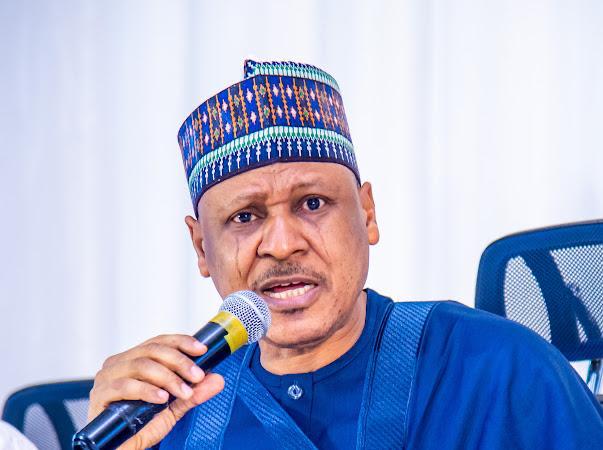
The Minister of Information and National Orientation, Alhaji Mohammed Idris, has called for a broader approach to the fight against corruption in Nigeria, saying the battle must go beyond arrests and prosecutions to include stronger institutions and systems that prevent abuse.
Idris made the call on Thursday in Abuja while delivering his remarks at the 4th Economic Confidential Lecture and 6th National Spokespersons Awards 2026, in Abuja.
The event, organised by Image Merchants Promotions Limited (IMPR), publishers of PRNigeria, Economic Confidential and Spokespersons Digest, featured the Chairman of ICPC, Dr Musa Adamu Aliyu, SAN, as a keynote speaker.
The minister, represented by the Director-General of the Voice of Nigeria (VON), Malam Jibrin Ndace, said corruption weakens institutions, distorts public expenditure and erodes public confidence, making sustainable economic stability difficult to achieve.
According to him, the fight against corruption should not be limited to prosecuting offenders, but must also address the systems and processes that create opportunities for abuse.
“But the fight against corruption must go beyond arrests and prosecutions. It must also focus on strengthening systems and institutions to prevent abuse,” he said.
The minister identified the increasing digitalisation of government processes, greater transparency in public financial management, improved procurement systems and the reduction of discretionary bottlenecks as critical measures for embedding accountability in governance.
He said the objective should be to establish institutions where accountability is built into the system rather than relying solely on the integrity or actions of individuals.
Idris said the Federal Government, under President Bola Ahmed Tinubu’s Renewed Hope Agenda, was implementing reforms designed to strengthen the economy, improve transparency and accountability, restore investor confidence and ensure that public resources deliver greater value to Nigerians.
He, however, stressed that even well-designed reforms would struggle to succeed if citizens did not understand their purpose or trust the process.
“Nigerians deserve to know what government is doing, why difficult decisions are necessary, and how those decisions will ultimately improve their lives,” he said.
The minister consequently charged government communicators with the responsibility of providing timely and accurate information while explaining policy decisions and acknowledging challenges.
He said effective government communication should not be reduced to propaganda, but must involve transparency, evidence and a willingness to engage citizens.
“Effective communication is not propaganda. It is about providing timely and accurate information, acknowledging challenges, explaining policy choices clearly, and demonstrating progress with facts and evidence,” Idris said.
He further emphasised the need for two-way communication, saying government must not only communicate its policies but also listen to citizens.
Idris described the media as an indispensable partner in the fight against corruption and the promotion of economic accountability, noting that investigative journalism and responsible economic reporting could strengthen accountability and help citizens make informed decisions.
He urged the government, media and citizens to collectively resist misinformation, sensationalism and distortion of facts, particularly in the rapidly evolving digital environment.
The minister also called on anti-corruption agencies to discharge their responsibilities professionally, while urging the media to hold public officials accountable without compromising factual accuracy.
According to him, strengthening accountability will boost confidence, while greater confidence will contribute to economic stability and create the public trust needed to sustain reforms.
“Ultimately, the responsibility is shared. Government must strengthen institutions and communicate transparently; anti-corruption agencies must discharge their responsibilities professionally; the media must hold power accountable while remaining faithful to facts; and citizens must continue to demand integrity in public life,” he said.
He commended Economic Confidential for convening the lecture, describing it as an important platform for national conversation on issues of economic governance, accountability and communication.