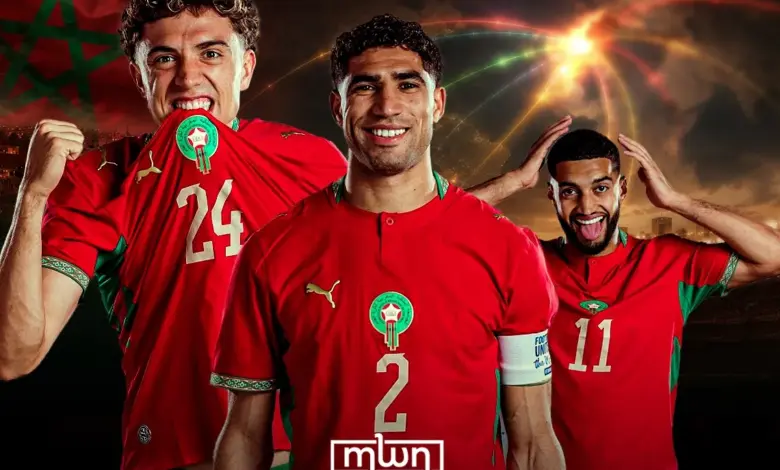
Football occasionally performs this miracle. It turns spectators into participants and strangers into companions. For a few hours, it creates a temporary homeland.
Yet it was not the match itself that stayed with me.
It was what happened afterward.
My phone began to vibrate with messages.
One arrived through Facebook from a former Mexican student. “¡Vamos!” he wrote. “For three hours I became marroquí, just as the whole Monterrey stadium did.”
A few minutes later another message appeared from a colleague in Atlanta, Georgia, whose family has deep roots in Brazil.
“What a game!” he texted. “Morocco is to be feared.”
Neither sender was Moroccan. Yet for several hours they cheered for Morocco with genuine emotion, celebrating every tackle, every save and every goal as though the outcome mattered personally. They had, however briefly, entered Morocco’s emotional world.
Football occasionally performs this miracle. It turns spectators into participants and strangers into companions. For a few hours, it creates a temporary homeland.
Reading those messages from my home in Tucson, I found myself thinking less about the penalty shootout than about the geography they traced. The match was played in Monterrey, Mexico. A former student in Mexico had become, in his own words, “Moroccan for three hours.” A Brazilian family was still talking about the beauty of Morocco’s football. My thoughts drifted instead to the villages of the Ziz Valley in southeastern Morocco where I grew up, villages from which generations of young men had departed, first for Morocco’s cities and later across the Mediterranean in search of work, opportunity and a different future.
For a few hours, Morocco seemed to exist simultaneously in Monterrey, Atlanta, Tucson, Amsterdam, Brussels, Madrid, Paris and the Ziz Valley. It no longer occupied a single place on the map. It existed wherever someone cared about its future.
That simple realization led me to a different question.
Why Morocco?
Why did a former student in Mexico and a Brazilian family, watching from thousands of miles away, find themselves emotionally invested in Morocco’s success?
The easy answer is football. It often invites us to cheer for the underdog. Yet plenty of underdogs pass unnoticed. Morocco has become something different: a country that others increasingly want to cheer for. But football is only the visible surface of a much deeper story.
The match in Monterrey was only the visible contest. A quieter competition had been unfolding for years in youth academies, around family tables and in football federation offices across Europe. The real question was never simply which team would win ninety minutes of football. It was which national project would persuade globally mobile young people that their future belonged, at least in part, to it.
Seen in this light, the penalty shootout was less an ending than a revelation. It exposed a transformation that had been unfolding quietly for decades. Football merely brought it into view.
No single sport can explain a nation. Yet sport sometimes illuminates social transformations long before they become visible elsewhere.
The deeper story begins with the Mediterranean.
We often imagine it as the line separating Europe from North Africa. Yet for Moroccans it has long been less a border than a corridor. Across the past century, the same stretch of water has carried soldiers, workers, students, footballers, physicians, engineers, entrepreneurs and dreamers. The sea itself has not changed. What has changed is the meaning of the crossing.
During the First World War, Moroccan soldiers crossed the Mediterranean to fight on European battlefields. They crossed again during the Second World War, serving in the struggle against fascism and helping liberate Europe from Nazi occupation. Their names rarely occupy the center of European historical memory, yet their sacrifices formed part of the human cost of Europe’s freedom.
After the wars came another crossing. This time men carried lunch pails instead of rifles. Moroccan workers helped rebuild postwar Europe in the coal mines of Belgium, the factories of France, the ports of the Netherlands, the railways of Germany and the construction sites of expanding European cities. Europe was rebuilt not only by Europeans, but also by workers from across the Mediterranean, including hundreds of thousands of Moroccans.
Their children entered European schools. Their grandchildren entered universities, hospitals, laboratories, engineering firms, businesses, cultural institutions and football academies. They became physicians, scientists, professors, artists, entrepreneurs, architects and elite footballers. The Moroccan national team is simply the most visible expression of this much longer history of movement, labor, sacrifice and attachment.
For decades this history was interpreted through a familiar vocabulary. Talent departed. Europe gained. Morocco lost. Economists eventually gave it a familiar name: brain drain. Later came more optimistic ideas, brain gain, brain circulation and transnational networks, but they all asked the same question: does migration ultimately weaken or strengthen the country people leave behind?
Watching Morocco’s national team, I began to wonder whether the question itself had become too narrow. What if migration was not simply a movement of people away from a nation, but also a transformation in the way a nation exists?
Many of Morocco’s finest footballers have not returned home in the traditional sense. They live in Europe, play for European clubs and move through global professional circuits. Yet when confronted with one of the defining choices of their careers, many choose Morocco.
Europe trained them.
Morocco gave their success another meaning.
That meaning did not emerge from football alone. It was cultivated around family tables, during summer visits, at weddings and Ramadan evenings, and in conversations in Darija and Tamazight. European academies refined technical ability; Moroccan families sustained emotional attachment. The national team became the place where those worlds met.
The decision to represent Morocco is often described as an individual sporting choice. Yet anyone familiar with Moroccan family life knows that such decisions rarely belong to one person alone. They carry the weight of parents who crossed the Mediterranean, grandparents who preserved memories of villages left behind, and children who learned that one could succeed anywhere in the world without ceasing to belong somewhere in particular.
Training produces skill. Belonging produces sacrifice. A player may learn the game in Amsterdam, Rotterdam, Brussels, Paris, Madrid or Barcelona, yet still feel that the deepest meaning of victory lies elsewhere: in the embrace of a mother after the final whistle, in the pride of a father, and in the emotional geography of a homeland that has always travelled with its people.
These players are not rejecting Europe. They embody multiple histories at once. They are European in formation and Moroccan in attachment. Morocco’s achievement has not been persuading its diaspora to abandon Europe. It has been persuading them that home can exist in more than one place.
European societies offered these young men excellent training and extraordinary opportunities. Yet opportunity alone does not answer the human desire for recognition. Morocco did not simply offer a place on the team. It offered the feeling that they were indispensable to a larger national story. For some, experiences of exclusion in Europe undoubtedly reinforced the search for belonging elsewhere. Yet Morocco’s appeal cannot be reduced to a reaction against discrimination. Its attraction also reflects the country’s growing confidence in offering a compelling project of its own.
The farther Moroccans travelled from Morocco, the more Morocco learned how to travel with them.
None of this happened accidentally. Looking back, it seems almost inevitable. At the time, however, almost no one noticed. Better academies. Better coaching. Patient scouting. Conversations with families as well as players. A federation that stopped treating Moroccans abroad as people who had left and began treating them as people whose futures remained intertwined with that of the country.
Over the past two decades, Morocco has quietly increased what I have come to think of as its national gravity. Not the power to compel people to return, but the capacity to make globally mobile Moroccans feel that their knowledge, talents and aspirations still have a place within a shared national future.
Under the vision of King Mohammed VI and the leadership of Fouzi Lekjaa, the Royal Moroccan Football Federation became more than an organization that develops footballers. It became an institution that cultivated belonging. Football was never simply about producing better players. It became an experiment in reconnecting a nation to itself.
There is another resource that economists and development agencies rarely measure. It is neither oil nor phosphates, neither remittances nor foreign investment. It is the remarkable capacity to persuade people scattered across continents that they remain participants in a shared national story.
I call this “Tamghrabit Capital.”
If diaspora capital consists of the knowledge, professional expertise, languages, international networks and institutional experience accumulated by Moroccans abroad, then Tamghrabit Capital is what enables those dispersed resources to become something larger than individual success. It is the cultural, emotional and civic infrastructure that transforms scattered lives into a shared national project. Diaspora capital provides knowledge. Tamghrabit Capital provides meaning.
Development happens when the two meet.
A generation ago, representing Morocco was often portrayed as the choice made when the doors of Europe remained closed. Today that assumption no longer holds. Some of Europe’s most gifted young footballers now choose Morocco even when opportunities with European national teams remain open to them. The change reflects more than sporting success. It signals that Morocco has become a credible destination for ambition as well as affection.
The contest is no longer simply over players. It is over the ability of nations to persuade globally mobile citizens that their talents matter to a larger collective future.
This suggests another way of imagining the nation itself.
Morocco increasingly resembles a distributed nation. It exists not only within its territorial borders, but wherever enduring relationships continue to bind people to a common future. Morocco lives in Casablanca and Rabat, but also in Amsterdam, Rotterdam, Brussels, Paris, Madrid, Montréal, New York and Tucson. Its territory is geographic. Its nation is relational.
Other societies have sought to cultivate similar relationships. Ireland has mobilized its global diaspora through business and cultural networks. India has drawn upon engineers and entrepreneurs abroad. China has encouraged overseas scientists to build research laboratories at home. South Korea transformed return migration into technological dynamism. Israel has long relied upon global networks of scholarship, finance and innovation. Morocco’s path is distinctive. Unlike Ireland, India, China, South Korea or Israel, where diaspora engagement first became visible through business, science or technology, Morocco’s first great demonstration of diaspora engagement has unfolded on a football pitch.
Football is simply the first domain in which Morocco has learned to transform diaspora capital into national capacity. The larger question is whether the same logic can animate medicine, artificial intelligence, education, entrepreneurship, cinema and scientific research. If football has demonstrated Morocco’s ability to reconnect with globally mobile talent, perhaps it also offers a glimpse of a broader development model, one in which migration is no longer understood primarily as loss, but as a reservoir of knowledge, experience and possibility waiting to be engaged.
Countries once competed for territory.
Today they increasingly compete for talent.
Tomorrow they may compete for belonging.
Morocco seems to be discovering this earlier than many other nations.
Football reveals something that development theory often struggles to capture. Roads matter. Universities matter. Laboratories matter. Investment matters. But so do recognition, trust, memory, family and hope. Development is emotional before it becomes economic.
Football also reminds us that emotion alone is never enough. Belonging opens the door. Institutions must keep it open. Scientists need laboratories, physicians need hospitals, entrepreneurs need transparent rules, and scholars need academic freedom.
Somewhere in Paris, a Moroccan oncologist may be collaborating with colleagues in Rabat. In Silicon Valley, an engineer may be advising a startup in Casablanca. In Montréal, an architect may be helping design a project in Tangier. These exchanges rarely receive the attention given to a World Cup match. Yet together they may prove every bit as consequential.
As someone whose own life has unfolded between southeastern Morocco and the American Southwest, I have come to see that migration is not simply the movement of people across space. It is also the movement of memory, obligation and imagination across generations.
Of course, my former student did not really become Moroccan for three hours. But his message captured something that millions of globally mobile Moroccans understand instinctively: belonging can travel farther than passports. Home is not always where one lives. Sometimes it is the story one continues to inhabit, the relationships one continues to nurture and the future one still feels responsible for helping to build.
A century ago, Moroccan soldiers crossed the Mediterranean to help defend Europe. Later, Moroccan workers crossed it again to help rebuild Europe. Today, their children and grandchildren continue to cross it carrying knowledge, languages, confidence and multiple identities. They have not ceased to belong to Europe, nor have they ceased to belong to Morocco.
Migration, it turns out, did not diminish Morocco.
It expanded it.
Football made that transformation visible.
The same forces that persuade footballers to wear the Moroccan jersey can also inspire physicians, scientists, AI researchers, entrepreneurs, artists and scholars—provided Morocco builds institutions worthy of their confidence. The challenge is to extend beyond sport what football has already demonstrated: the ability to transform diaspora capital into national capacity.
In an age of unprecedented mobility, perhaps the central question facing nations is no longer how to keep their people at home, but how to make home expansive enough that distance does not dissolve belonging. The Mediterranean remains the same sea it has always been. What has changed is what it carries. Once it carried soldiers who fought for Europe’s freedom, workers who helped rebuild its economies, and families searching for opportunity. Today it carries ideas, expertise, investment, memory, and possibility.
Looking back, Morocco’s victory over the Netherlands was never just another football match; it is Morocco’s long game.
It does not deny the costs of emigration. Every doctor, engineer, or researcher who leaves represents a real loss, and the voices calling for better opportunities at home deserve to be heard. The challenge is different: to build institutions that make departure one chapter in a relationship with the nation rather than its end.
Perhaps the future will belong not to the nations that succeed in preventing their people from crossing borders—few ever truly have—but to those that learn to make movement another form of connection, distance another expression of belonging, and diaspora capital part of a shared national future.
That, perhaps, is Morocco’s long game.
Also published in Morocco World News.
Prof. Ilahiane is an applied cultural anthropologist and a Professor at the School of Middle Eastern & North African Studies and the W.A. Franke Honors College, University of Arizona.