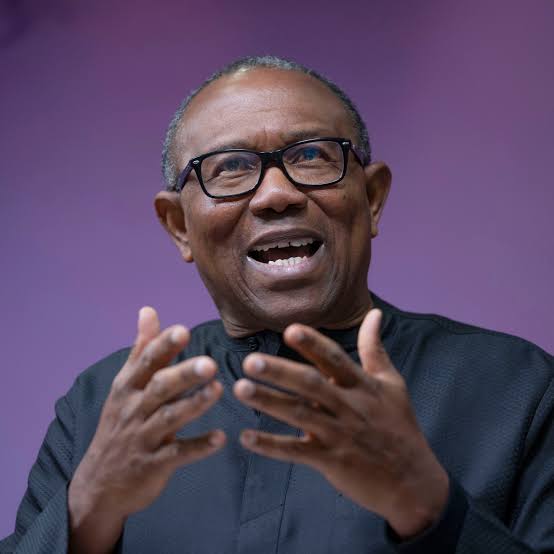
Presidential candidate of the Nigeria Democratic Congress (NDC), Mr. Peter Obi, has dismissed the President Bola Tinubu government’s announced policy of one month discount on petrol as reactive and flawed.
The Minister of Finance and Coordinating Minister of the Economy, Mr. Taiwo Oyedele, announced the policy, which he said is for one month in the first instance, stressing that the discounts will be obtainable only at NNPC Retail petrol stations across the country, with priority to public transport operators.
Mr. Obi, a former Governor of Anambra State, in an X post titled “One Month Discount on Petrol: From Reactive Policies to Flawed Outcomes!” noted that NNPC retail petrol stations in the country, where the discounts will be available are about 900 out of the about 24,000 stations nationwide.
According to him, this will mean that the discount will be available in less than 4% of retail stations, with priority to public transport operators. “Using our population of about 243 million people implies one NNPC Retail petrol station to about 243,000 Nigerians assuming that the stations are evenly distributed across Nigeria which is not the case. Imagine 243,000 Nigerians struggling for a N66.00/per litre discount in each of the NNPC petrol stations. This is certainly not how to govern a richly blessed and endowed nation!”
Full text of the X post reads:
One Month Discount on Petrol: From Reactive Policies to Flawed Outcomes!
The announcement by the APC led Federal Government offering a 30-day discount on price of petrol to relieve the acute hardship and hunger caused Nigerians by its unplanned removal of subsidy can only be described as another very reactive and confused approach to governance that is now the culture of the Tinubu Government.
I had delayed in reacting to the announcement just to give the benefit of doubt and watch the outcome of the policy. Now, having assessed the outcomes, the policy is a substitution of political optics for sound policy.
As Nigerians will recall, President Bola Tinubu on May 29, 2023, most carelessly removed fuel subsidy without any consultation or proper assessment of the negative impacts of such policies on our economy particularly on the livelihood of ordinary Nigerians.
Moreover, the careless removal of fuel subsidy was followed by other very badly sequenced policies such as the floating of the naira and tax reforms, all implemented in a very disorganized, incompetent and insensitive manner in addition to using three budgets at the same time with the attendant lack of transparency and accountability. Collectively, these policies stoked inflation in all sectors, pushing in most cases unbearable price hikes across board which placed severe shocks and other adverse consequences on Nigerians.
Expectedly, the outcomes are what they are – increasing multi-dimensional poverty, skyrocketing costs of goods and services, shrinking opportunities, exit of many businesses, mounting unemployment, disturbing insecurity, widening inequality, forced migration of our youths and general decline in the well-being of Nigerians.
Most unfortunately, rather than engage in detailed and published regulatory impact assessment of their reactive policies, the President Bola Tinubu’s led government has again demonstrated their well-known incompetence and insensitivity to governance.
With a detailed and published regulatory impact assessment of policies, a competent government would have pursued robust and sincere engagements and consultations with key stakeholders and ordinary Nigerians to recraft and implement inclusive and sustainable socio-economic growth strategies and policies.
What really does the President Bola Tinubu led government want to achieve with a one-month discount of less than 5% on fuel cost. Will it reduce poverty, unemployment, insecurity, and inequality? Will it increase productivity and exports? Is it a test to ascertain if subsidy should be restored? Is it another political gambit in the face of threats of electoral loss in the 2027 election? Too many questions, no answer!
According to the Federal Government, the discount will be obtainable at NNPC Retail petrol stations, which are estimated to be about 900 stations. With the total number of petrol stations in Nigeria estimated at about 24,000, it means that the discount will be applicable in less than 4% of our petrol stations with priority to public transport operators. Using our population of about 243 million people implies one NNPC Retail petrol station to about 243,000 Nigerians assuming that the stations are evenly distributed across Nigeria which is not the case. Imagine 243,000 Nigerians struggling for a N66.00/per litre discount in each of the NNPC petrol stations. This is certainly not how to govern a richly blessed and endowed nation!
While I prepare to provide a more detailed explanation on my current stand on subsidy and a policy roadmap on fair, transparent and affordable pricing of petroleum products, let me state that research on our current revenue and revenue potential in a productive Nigeria under an incorrupt, transparent and competent government which my leadership will enthrone affirms my position that subsidy should be restored to Nigerians not only on petrol but also in agriculture, health, education and infrastructure.
But, beyond subsidy, it is important that we have a leadership that is focused on policies that drastically reduce the cost of living through welfare-enhancing pricing policy and honest administration of same.
It is clear that President Tinubu’s October 1 policy announcement is neither of that. It is plain political optics masked as policy. Nigerians are tired of those gimmicks. It is time for real change.
A new Nigeria is POssible. Nigeria will be OK! -PO