By Isiah Christie
Once upon a time on the hardwood floor, New Jersey had bragging rights to a team worth rooting for. The New Jersey Nets, now a relic of the past, had thirty-six years of rich history in the state worth celebrating. Unfortunately uprooted in favor of a plainly capitalism-motivated move to Brooklyn, the culture is calling for its team back – and there’s plenty of rationale in why it should happen.
The Brooklyn Nets began in New Jersey a whopping fifty-eight years ago, starting up as the New Jersey Americans in the now-defunct American Basketball Association (ABA) in 1967. The ABA, then a smaller start-up league, existed alone as one of two league teams in the northeast alongside the Pennsylvania-based Pittsburgh Pipers. Coached by New York native and former NBA All-Star Max Zaslofsky, the team started rough and subsequently moved to Long Island in search of a stronger foundation and identity.
They enjoyed a successful eight-year run in New York, sprinting to three ABA Finals and winning two of the three contests. They were led by two major Hall of Famers in particular – Rick Barry, who was best-known for leading the Golden State Warriors to an NBA Championship in 1975, and Julius Erving, a transcendental phenomenon that served as basketball’s most marketable face in a not-so-smooth 1970s “dark age”. Erving most notably won two championships with the organization in a three-year span and won three Most Valuable Player (MVP) awards in a row – this feat has only otherwise been achieved by the storied Bill Russell, larger-than-life Wilt Chamberlain, and league-reviving Larry Bird in any major basketball professional league.
Following their ‘76 championship, which also happened to be the final year of the ABA before merging with the National Basketball Association (NBA), the New York Nets were forced to return to New Jersey. They were faced with a hard-hitting 4.8 million-dollar “invasion fee” by the NBA due to its already-existing New York team, the New York Knicks, and had to act swiftly to avoid deconstruction. In what is considered a historically-deflating move, owner Roy Boe was forced to trade franchise superstar Erving for cash to provide the finances, and no longer had a path to continuing their dominance. By 1977, the team was back in its hometown Jersey, but at what cost?
The shift into the 1980s was not kind to the Nets, involving four straight losing seasons from 1978 to 1981. However, the drafting of the highly-touted college prospect Buck Williams – a noteworthy skilled big man and impactful defensive player – brought New Jersey back to the spotlight, with five straight playoff appearances throughout the early-to-mid-’80s. This run also included an infamous playoff series win over the defending champion Philadelphia 76ers in 1984, which is still considered one of the greatest professional basketball upsets of all-time.
The Nets hovered around a bar of mediocrity for much of the next fifteen years. Talented players came in and out of their camp, but always with some sort of negative stipulation. Michael Ray Richardson was a two-time All-Star, but struggled with substance abuse and received a lifetime NBA ban. Derrick Coleman was a monster coming out of college, but had poor work ethic and underwhelmed. Dražen Petrović was on the rise as the second All-NBA Team member in Nets history, but was killed in an automobile accident during the 1993 off-season. And the one time they returned to the playoffs with perceived optimism in 1998, the world-famous Chicago Bulls defeated them with not a single loss taken to the Jersey club.
At this point the Nets had developed a reputation for weakness, having seen little success since their move from the ABA. Their mismanagement was just as loud as their bad luck, and it seemed impossible for the team to escape the “little brother” label New York Knicks fans had placed on them. The future was bleak.
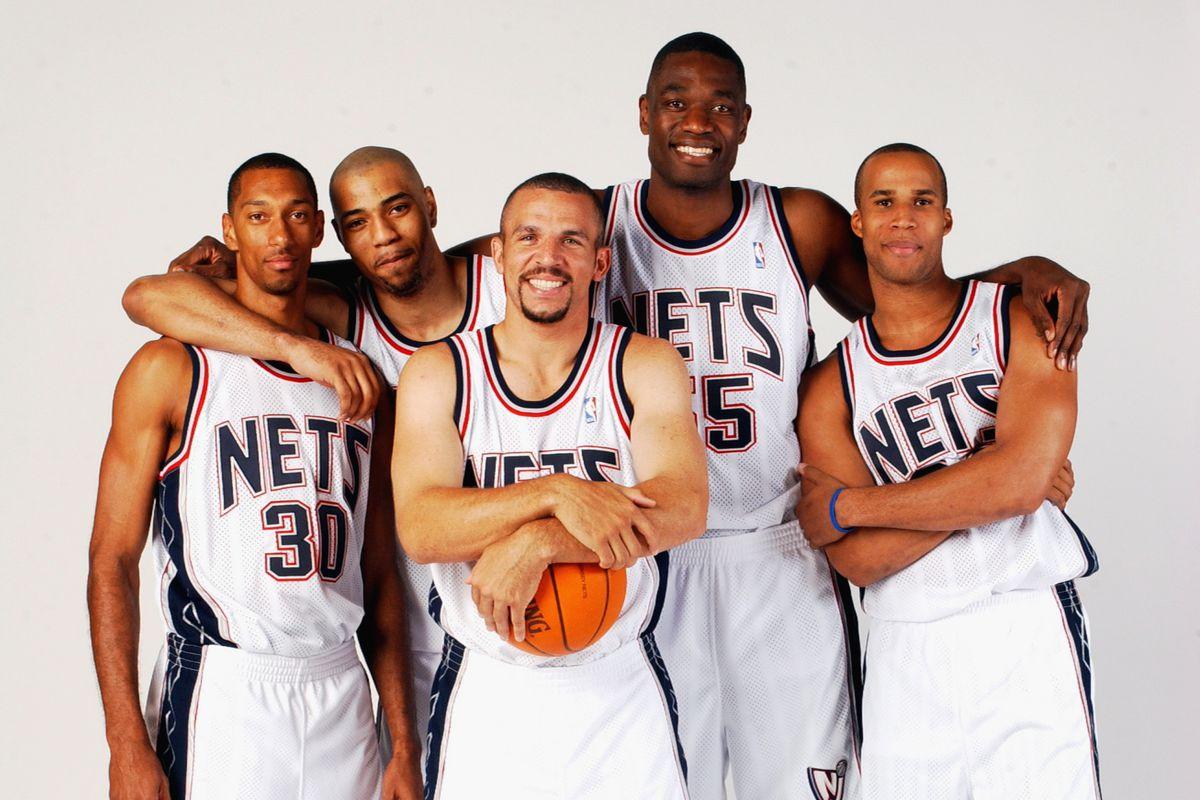
However, in 2001, the organization made what may have been the best move in their history – acquiring four-time All-Star Jason Kidd from the Phoenix Suns in exchange for their not-so-successful franchise player, Stephon Marbury. Upon arrival, Kidd immediately led New Jersey to fifty-two wins, a franchise-best since joining the NBA; and the NBA Finals, which they had not yet reached in twenty-five years of existence in the big league. While they lost to the dynastic Los Angeles Lakers, led by Newark native Shaquille O’Neal and the young Kobe Bryant, they had put the basketball world on notice. And that success was certainly sustained, considering they returned to the big stage the year after and pushed a talented San Antonio Spurs team – led by M.V.P. Tim Duncan – to six games before defeat.
After only nine more years in the state, the New Jersey Nets were uprooted due to a lack of a new arena deal. This was despite their recent residency in Newark’s Prudential Center – unfortunately, attendance rates were among the league’s worst due to the team’s poor play. They were eventually sold and moved to Brooklyn, where they have remained as they play in the borough’s Barclays Center. Since leaving New Jersey, the Nets have only enjoyed six winning seasons in thirteen years, have only won two playoff series, and have seen superstars come and go with little interest in stabilizing the organization’s culture.
And such is the issue with the Brooklyn rendition of this team – they lack grit and heart, two things the Nets embodied during their early-to-mid-’00s golden age. The franchise has essentially adopted a role of pure capitalistic existence, lacking true incentive to establish a culture and challenge the far-more-popular New York Knicks in Manhattan. Even with the opportunity to build around stars such as Kevin Durant, James Harden, and Kyrie Irving, the organization has failed again and again – and it is certainly hard to see such a sour inter-state move result in nothing but further mediocrity.
Will moving back to New Jersey make the Nets great again? Not necessarily, but there will certainly be a level of beloved character if they were to return. Unfortunately, the financial incentive is nonexistent, so it is unlikely – but with a community of basketball lovers in Newark and a fresh arena available in Prudential Center, a return is certainly sustainable. It would be charming to see professional basketball back in Newark, and the NBA should certainly do their research on that possibility’s upside.