

In the 7 June 2026 article which marked the formal unveiling of the Decoupling Sovereignty Index (DSI), I articulated a defining institutional proposition. The launch of the DSI was presented not merely as the introduction of a new analytical instrument, but as another milestone in the evolution of Sundiata Post into what I described as a dual engine architectural powerhouse. That statement marked an important transition. It signalled that Sundiata Post was no longer to be understood solely as a digital news platform, but as an institution consciously integrating journalism, strategic intelligence and scholarly research within a single operational framework.
The proposition advanced on that occasion was straightforward. On the front end, Sundiata Post would continue to function as a digital-first, high-velocity news organisation, reporting events, investigating public issues, analysing developments and informing citizens through timely, credible journalism. On the back end, the Sundiata Post Intelligence Unit (SPIU) would operate as a proprietary knowledge engine, generating original research, developing analytical frameworks, curating datasets, publishing working papers and preserving institutional knowledge through globally recognised scholarly repositories.
This series develops that proposition into a formal institutional architecture.
The first part in this series argued that the newsroom of the twenty-first century must evolve beyond the production of daily news to become a knowledge institution. The second situated that proposition within a broader intellectual tradition, demonstrating through the works of Walter Lippmann, Hannah Arendt, Nnamdi Azikiwe and Obafemi Awolowo that journalism has historically served not merely as a conveyor of information but as a builder of public reason, democratic culture and national development.
Having established the philosophical foundations, we now turn to the question of institutional design. Every enduring institution requires more than a compelling vision; it requires an architecture capable of translating principles into sustained practice. Ideas alone do not create institutions. Institutions endure because they are deliberately designed to produce consistent outcomes, preserve organisational memory, adapt to changing environments and outlive their founders.
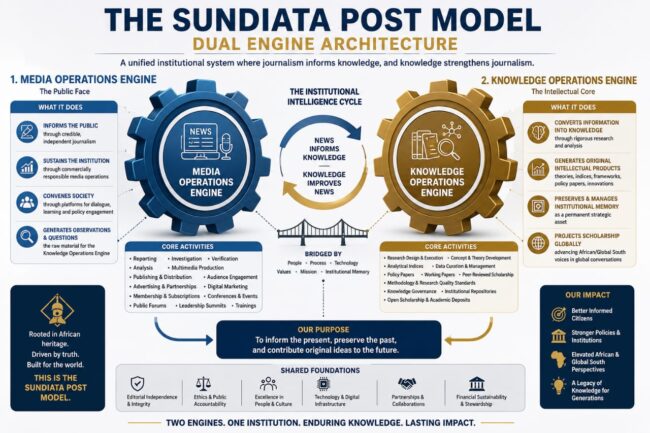
The Sundiata Post Model is therefore built upon what I call the Dual Engine Architecture. Simply stated, the Dual Engine Architecture is an institutional design in which a Media Operations Engine generates public value through journalism while a Knowledge Operations Engine transforms that journalistic enterprise into a permanent system of knowledge production.
The first engine is the Media Operations Engine—the visible newsroom that performs the essential functions of journalism through reporting, verification, investigation, editing, publication and audience engagement. The second is the Knowledge Operations Engine—the institutional infrastructure through which research is conducted, theories are formulated, datasets are curated, policy knowledge is generated and intellectual assets are systematically preserved.
These engines are neither parallel organisations nor competing departments. They are interdependent components of a single institutional system. Journalism supplies the observations, evidence and questions that shape the research agenda. Research, in turn, enriches journalism with deeper context, analytical rigour and conceptual innovation. The output of one continuously strengthens the other, creating an institutional intelligence cycle in which news informs knowledge and knowledge improves news.
The significance of this architecture extends beyond Sundiata Post itself. It offers a framework for reimagining the modern newsroom in an era defined by rapid technological change, information overload and declining public trust. Rather than treating journalism as a transient response to the daily news cycle, the Dual Engine Architecture positions the newsroom as the public-facing component of a broader knowledge enterprise—one that simultaneously informs the present, preserves the past and contributes original ideas to the future.
The Media Operations Engine
The first pillar of the Sundiata Post Model is the Media Operations Engine. This is the institution’s public-facing operational system—the visible enterprise through which Sundiata Post fulfils its journalistic, commercial and public engagement responsibilities. It represents the front end of the organisation, integrating editorial excellence with audience development, revenue generation and public-facing institutional activities.
At its core, the Media Operations Engine performs the traditional functions of a professional news organisation. It identifies stories of public importance, deploys reporters to the field, verifies facts through rigorous editorial procedures, produces multimedia content, provides analysis and commentary, and disseminates information across digital platforms. These activities remain the foundation of the institution’s commitment to informing society accurately, independently and responsibly.
Beyond the newsroom, however, the Media Operations Engine encompasses the broader business of media. It includes advertising and brand partnerships, digital marketing, audience growth strategies, subscription and membership initiatives where applicable, commercial publishing, multimedia production, and other revenue-generating activities necessary to sustain editorial independence. Within the Sundiata Post Model, commercial operations are not peripheral to journalism; they are carefully managed institutional functions that provide the financial capacity required for long-term public-interest reporting and knowledge production.
The engine also extends the institution’s public engagement beyond daily news publishing. Conferences, annual lectures, policy dialogues, public forums, media masterclasses, leadership summits and other convening platforms become integral components of the media enterprise. These engagements transform the organisation from a publisher of information into a convener of ideas, creating spaces where journalists, scholars, policymakers, business leaders and citizens can deliberate on issues of national and continental importance. In doing so, the Media Operations Engine strengthens the institution’s civic presence while simultaneously generating new networks, partnerships and editorial opportunities.
Within the Sundiata Post Model, the Media Operations Engine performs an additional function that distinguishes it from conventional news organisations. It serves as the institution’s principal observational system. Every news report, investigative assignment, interview, audience interaction, conference discussion and field observation constitutes more than a discrete media product. Collectively, they generate the empirical evidence, public conversations and emerging questions that feed the institution’s knowledge infrastructure.
In many conventional media organisations, these valuable intellectual assets dissipate with the passing of the news cycle. The Sundiata Post Model rejects this linear conception of journalism. Instead, every verified report, public engagement and editorial initiative is regarded as a potential contribution to a cumulative institutional intelligence system.
Accordingly, the Media Operations Engine performs four interconnected functions. First, it informs the public through credible journalism. Second, it sustains the institution through commercially responsible media operations. Third, it convenes society by creating platforms for dialogue, learning and policy engagement. Fourth, it continuously generates the empirical observations and strategic questions that become the raw material for the Knowledge Operations Engine.
The Media Operations Engine is therefore far more than a newsroom. It is the institution’s interface with society—observing events, engaging audiences, building relationships, generating revenue and producing the empirical foundation upon which the Sundiata Post Model‘s broader knowledge enterprise is constructed.
The Knowledge Operations Engine
If the Media Operations Engine is the public face of the Sundiata Post Model, the Knowledge Operations Engine is its intellectual core. It is the institutional infrastructure through which information is transformed into knowledge, knowledge into analytical frameworks, and analytical frameworks into enduring intellectual assets. While the front end responds to the immediacy of events, the back end seeks to understand their underlying structures, causes and long-term implications.
The Knowledge Operations Engine is anchored by the Sundiata Post Intelligence Unit (SPIU), which serves as the institution’s research and strategic intelligence hub. It is responsible for designing and executing research programmes, developing original concepts and theories, constructing analytical indices, curating datasets, producing policy papers, publishing working papers and peer-reviewed scholarship, maintaining institutional standards for methodology, research quality and knowledge governance, and preserving institutional knowledge through globally recognised academic repositories.
In this architecture, research is not an adjunct to journalism but an integral institutional function.
Unlike conventional newsroom research desks, whose work is often confined to supporting daily editorial production, the Knowledge Operations Engine pursues an independent programme of knowledge creation. It identifies recurring patterns across time, interrogates complex governance and security challenges, develops explanatory models, and subjects those models to empirical testing. The objective is not merely to explain individual events but to contribute original intellectual frameworks capable of advancing scholarly and policy debates.
The engine is also responsible for the stewardship of institutional memory. Research datasets, methodological notes, interview archives, conceptual papers, technical documentation and analytical outputs are systematically organised, preserved and made retrievable. Rather than allowing institutional knowledge to disappear with personnel changes or the passing of the news cycle, the Sundiata Post Model treats these materials as strategic assets that accumulate value over time. This commitment to preservation transforms the institution from a producer of content into a custodian of knowledge.
A defining characteristic of the Knowledge Operations Engine is its commitment to openness and scholarly engagement. Where appropriate, research outputs are deposited in recognised academic repositories, enabling scrutiny, replication, citation and further development by the global research community. By exposing its analytical frameworks and datasets to independent examination, the institution embraces the principle that durable knowledge grows stronger through critical evaluation rather than institutional isolation.
The Knowledge Operations Engine therefore performs four interconnected functions. First, it converts empirical observations into structured knowledge through rigorous research and analysis. Second, it generates original intellectual products—including theories, indices, policy frameworks and methodological innovations—that extend beyond the immediate demands of journalism. Third, it preserves and manages the institution’s intellectual capital as a permanent strategic resource. Fourth, it projects African or Global South scholarship into global academic and policy ecosystems, ensuring that ideas developed within the newsroom contribute to international conversations on governance, security, development and media innovation.
The Knowledge Operations Engine is therefore not simply a research department. It is the institutional mechanism through which journalism acquires permanence, evidence is transformed into understanding, and a media organisation evolves into a knowledge-producing institution. Together with the Media Operations Engine, it completes the Dual Engine Architecture that lies at the heart of the Sundiata Post Model.
If the preceding sections explain how the Sundiata Post Model works, an equally important question remains: Is this architecture unique to Sundiata Post, or can it become a framework for journalism more broadly?
Beyond Sundiata Post
The Sundiata Post Model is proposed as a universal institutional framework for twenty-first-century journalism. Although it originated within Sundiata Post, it is not conceived as an organisation-specific model. Rather, it offers a general institutional architecture that can be adapted by news organisations operating in diverse economic, technological, political and cultural environments.
In this formulation, Sundiata Post is not the model; it is the founding implementation and proof of concept—a living institutional demonstration that such an architecture is both practicable and sustainable. The relationship is similar to the Toyota Production System, which began inside a single company but evolved into a global management framework adopted by organisations far beyond the automotive industry. Likewise, the Sundiata Post Model is intended to transcend the organisation in which it was first developed.
Its long-term significance will therefore be determined not solely by its success at Sundiata Post, but by its capacity to be tested, adapted, replicated and refined by media organisations across different societies. The true measure of any institutional model is not that it works for its originator, but that it enables others to build stronger institutions of their own. If the Sundiata Post Model ultimately proves capable of helping news organisations across Africa, the Global South and beyond become enduring knowledge institutions, then its greatest contribution will not be what it achieved for Sundiata Post, but what it made possible for journalism itself.
Trust is sacred. Stay seasoned
- Dr. Max Amuchie is a Scholar-Journalist, Media CEO, Lead Researcher at the Sundiata Post Intelligence Unit(SPIU), and an Expert Member and Peer Reviewer at ScienceOpen. He is the architect of The Insecurity Triadframework for African security analysis as well as the Trinity of Sovereignty Decay (formerly Trinity of State Decay) theory, and the Decoupling Sovereignty Index (DSI)—original frameworks for understanding, categorising, and measuring conflict, state decay, and sovereignty in the Global South.
X: @MaxAmuchie | Email: max.a@sundiatapost.com