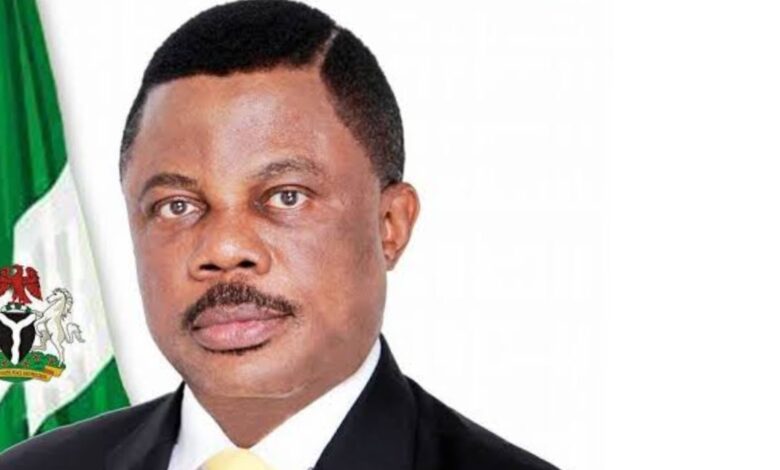
It was by no means fortuitous that when Willie Obiano, Anambra State governor from 2014 to 2022, marked his 71st birthday on Saturday, August 8, 2026, it was a significant media event, even though he holds no public position and has been in faraway United States since he left the public office. Chief Obafemi Awolowo once stated that the most important function of a leader is to letch their name in the hearts and minds of the followers. Obiano’s numerous supporters, as expected, wrote excitedly about such physical infrastructure he built as Chinua Achebe Airport, the Anambra State International Convention Centre and the Awka City Stadium, in addition to bridges, etc.
The panegyrics, in keeping with our political tradition, paid little attention to the values that define his administration. Yet, as contemporary leadership researchers increasingly acknowledge, values are actually the essence of leadership. Values are akin to blood: they are not often visible, but without them there would be no life. The Great Zik of Africa through his love of education– as demonstrated by the high education he acquired in the United States, his voracious reading, his uncanny rhetorical style, his prodigious newspaper publishing, his column writing, his numerous public lectures, speeches, and books, and his establishment of the University of Nigeria at Nsukka– profoundly altered the Igbo civilizational trajectory.
Though the Igbo were relatively late comers to formal education because of their living in the interior, they were by 1966 competing effectively with the Yoruba in higher education; the Yoruba have an educational headstart owing to their direct access to the ocean through which the European came to Nigeria with modern education and his way of life. In Chinua Achebe’s inimitable language, the Igbo, within a mere two decades starting in 1945 when the Second World War ended, “wiped out their educational handicap in one fantastic burst of energy”.
Obiano is humane, and his most enduring values arguably lie in making Anambra State a caring society when he was the governor. Contrary to the assumption of most African rulers who regard heartlessness as a mark of tough and decisive leadership, compassion is a pillar of effective and successful leadership. If a soldier doesn’t regard his commander or country as caring enough for them, why should they gleefully go to the battlefield and risk their lives? Soldiers who fight with passion win wars. The global media was awash last April with detailed reports of how an armada of planes and troops was deployed to rescue just one American Air Force officer whose plane was shot down while on a mission in Iran.
When I joined the Obiano administration in his second term in early 2018, I frequently approached him for assistance anytime I found Anambra people in acute need. He most often obliged my requests. The requests were made on behalf of traditional rulers, journalists, writers, doctors, beggars, the physically challenged, etc. The continuous assistance created the kind of culture Pope John Paul the Second would describe as “respect for the dignity of the human person” and “solidarity with the human family”.
In December 2020, for example, I was in my office when a group of Anambra indigenes at the Federal School for the Handicapped in Oji River, Enugu State, came to solicit for money for transport to their various hometowns for Christmas. Since I had not even a kobo impress account – which was a failure of the administration—I had to look for personal money to give them. When I reported the encounter to the governor and asked for a refund, he approved it instantly. On another occasion, about seven physically challenged indigenes of Enugu State living in their home state came to my office to request for assistance to eat “because we hear that Governor Obiano is a good man, even though we don’t know him”. I obliged them. I got reimbursed.
There was a fairly elderly woman who worked as a farmhand in Igbariam in Anambra East Local Government Area with the husband, but returned to their village in Enugu State when the husband took ill. The prolonged illness drained the family of the little resource they ever had. When the man died, the wife came to my office to seek help because she was informed “that one big man who can come to the family’s assistance is Governor Obiano”. I gave her some money which lifted her spirits. Obiano approved my request for reimbursement.
Obiano displayed an infectious passion for all Anambra people throughout the four years I was his commissioner. When Covid-19 outbreak was reported in Wahum, China, in 2020, I told him of the grave implications for our people who are itinerant businesspeople and travel to China daily in large numbers for imports. He immediately authorized my proposal to start a frenetic enlightenment campaign tour of radio stations and markets, as well as motor parks. At the New Tyres Market at Nkpor in Idemili LGA, the impressed union leaders informed us that “this is the first time that government officials have visited us not to ask for tax but how to protect ourselves from a strange dangerous virus”. They fiercely insisted we accept the 15,000-Naira kolanut money they presented “because we are giving it from the bottom of our hearts”. Anambra, by the way, launched the Covid-19 campaign before the American and United Kingdom governments, hence the minimum Covid-related deaths in our state despite the peripatetic nature of our people.
Obiano demonstrated child-like joy anytime an Anambra person did anything outstanding in any field, whether in the common entrance into Federal Government Colleges, in a global science education competition for girls, in a national competition for states with unique strategies for small and medium businesses, the appointment of the first African as vice chancellor of a UK university, the emergence of an Anambra person as the person with the highest score in a common entrance examination into universities, the emergence of his press secretary as a winner of a major poetry award, or the announcement of a person from Anambra State as the best student of a medical school in Russia. He would seek to host the people, or reward them, as Governor Alex Otti of Abia State is doing now.
Unknown to even well-educated African rulers, leadership goes far beyond bricks and mortar like building roads. Leadership has a lot to do with values. King Ahab of ancient Israel and husband of Jezebel built a lot of history-changing infrastructure for the people; still biblical chroniclers wrote him off as a grand failure. As modern religious historians like the late Kwesi Dickson of the University of Ghana have noted, this was because there was no synchronization between his values and those of the people. To repeat the obvious, leadership has plenty to do with Pope John Paul’s famous “respect for human dignity” and “solidarity with the human family”.
Adinuba was the Anambra State Commissioner for Information and Public Enlightenment from 2018 to 2022.