
There is a profound sadness, and, frankly, a deep sense of disappointment, in confronting how little institutional recognition has been accorded to Kaiama and to the enduring legacy of Major Isaac Adaka Boro. One would have expected that, after decades of political leadership in Bayelsa State, a university would have been established in Kaiama in his honor, perhaps as Isaac Adaka Boro University, or that one of the state’s existing universities would have been named after him. Institutions such as Federal University Otuoke, Niger Delta University, Federal University of Agriculture, African University, or Bayelsa Medical University could have provided an appropriate platform for preserving and advancing the intellectual legacy of a man whose name remains inseparable from the history of the Ijaw Nation and Niger Delta.
Yet successive Governors of Bayelsa State, as well as Senators and Ministers who have represented or continue to represent the state at the federal level, have largely failed to translate Boro’s celebrated status into commensurate institutional recognition. The irony is painful: a man remembered as a pioneer of Niger Delta self-determination has not been adequately honored through the most enduring instrument of knowledge, education, and generational memory, a university bearing his name.
Kaiama’s significance in Major Isaac Adaka Boro’s early life rests on the convergence of education, spirituality, healthcare, family, and community. Proctor Memorial Primary School, where Pepple Boro served as headmaster, formed part of the educational environment surrounding Boro’s formative years. Likewise, Mrs. Christiana Virginia Ayibamieigha Koripamo’s maternity home within the St. Mark’s Church compound brought together healthcare, faith, and community service. These institutions were not simply physical locations; they were part of the social environment through which knowledge, values, identity, and communal responsibility were transmitted.
Establishing Kaiama as Boro’s birthplace is therefore more than correcting a geographical detail. It is an act of historical responsibility. The testimonies of David Boro and Phillip Timitimi, together with the evidence concerning Mrs. Koripamo and the maternity facility, provide important testimony in reconstructing the circumstances of Boro’s birth and early life. The principle is captured by an ancient Chinese maxim traditionally associated with the Book of Han: “Hearing something a hundred times is not as good as seeing it once.” In the context of historical inquiry, the lesson is clear: repetition does not transform an assertion into evidence. What matters is the careful examination of testimony, records, chronology, geography, and corroborating evidence.
The distinction between Olobiri, Kaiama and Oloibiri is therefore historically consequential. Oloibiri occupies an important place in Nigeria’s petroleum history, but that significance should not lead to the conflation of two distinct communities. Recognizing Kaiama’s connection to Boro does not diminish Oloibiri; it restores geographical precision and gives each community its proper place in the historical record.
More importantly, acknowledging Kaiama means recognizing the people and institutions that formed the environment surrounding Boro’s earliest years. His story cannot be reduced to the Twelve-Day Revolution of 1966 or to his later military service. Before he became a revolutionary, he was a child born into a particular family, community, educational environment, and cultural landscape. The people who taught, cared for, guided, and nurtured him were part of the foundation upon which his later convictions developed.
The failure to establish a major educational institution in Boro’s name is therefore not simply a missed naming opportunity. It represents a broader failure to convert historical memory into intellectual legacy. A university bearing his name could have become a living institution dedicated to the study of Niger Delta history, Ijaw culture, resource governance, minority rights, federalism, environmental justice, peacebuilding, and African leadership. Such an institution would not merely commemorate Boro; it would continue the work of turning his unfinished project and unanswered questions into scholarship, innovation, and public service.
Major Isaac Adaka Boro’s birthplace in Kaiama is consequently not a peripheral detail but a foundational element of his historical narrative. To preserve that truth is to honor the community that welcomed him into the world, the people who surrounded his formative years, and the institutions that helped shape his generation. The greater obligation, however, is to ensure that remembrance does not end with monuments, anniversaries, speeches, or ceremonial references. The most enduring tribute to a revolutionary is not simply to remember his name, but to build institutions capable of carrying his unfinished ideals into the future.
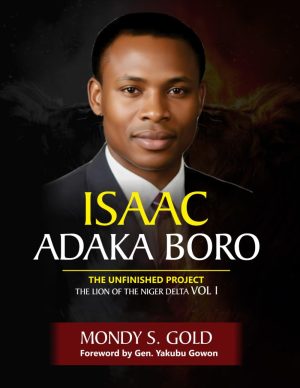
Professor Gold, PhD, CFP, is the author of Isaac Adaka Boro: The Unfinished Project