
There are many possible configurations, permutations, and cartographic expressions through which Nigerians may envision and construct a better Nigeria. While I deeply appreciate the intellectual contributions, intentions, and perspectives underlying these various proposals, I respectfully but firmly disagree with the proposition that Nigeria’s six geopolitical zones should be constitutionally recognized as “sub-nations” on the basis of tribal or ethnic affinity. I would further argue that any regional cartographic framework constructed primarily along ethnic lines risks taking us back to the divisions of the past and should therefore be rejected wholeheartedly by all well-meaning Nigerians. The six-zone arrangement has undeniable historical and administrative utility; however, transforming these zones into constitutionally entrenched ethnic or quasi-national territories could inadvertently institutionalize the very divisions that have impeded Nigeria’s quest for enduring national integration.
The Nigeria I envision is not one in which geography becomes a constitutional reflection of ethnicity, but one in which geography becomes an instrument for transcending ethnicity. My concern, therefore, is not with the existence, preservation, or celebration of Nigeria’s rich cultural diversity; that diversity is one of the nation’s greatest assets. Rather, my concern is with the political consequences of making ethnicity the principal organizing principle of territory, representation, political identity, and belonging. We should not constitutionalize the boundaries of yesterday and thereby reproduce the divisions of yesterday. We should design a political geography capable of cultivating the Nigeria of tomorrow, a Nigeria in which citizens are encouraged to live, work, govern, prosper, and build together not primarily as members of tribes, but as equal Nigerians.
In my view, genuine restructuring should not confine itself to rearranging Nigeria’s territories; it must fundamentally reshape the political incentives and relationships that determine how Nigerians live, govern, and participate in the affairs of the nation. My proposed approach rests on a fundamentally different philosophy: Nigeria should protect and celebrate its extraordinary cultural diversity without allowing ethnicity to determine territorial ownership, political representation, governance, or the boundaries of citizenship. The purpose of my proposed map is therefore not to erase Nigeria’s histories, languages, traditions, identities, or cultural institutions, but to establish a political framework in which they can flourish within an overarching and genuinely shared Nigerian citizenship. The ultimate objective is a constitutional order that transforms diversity from a source of political fragmentation into a foundation for national unity, equitable development, and a stronger, more inclusive Nigerian identity.
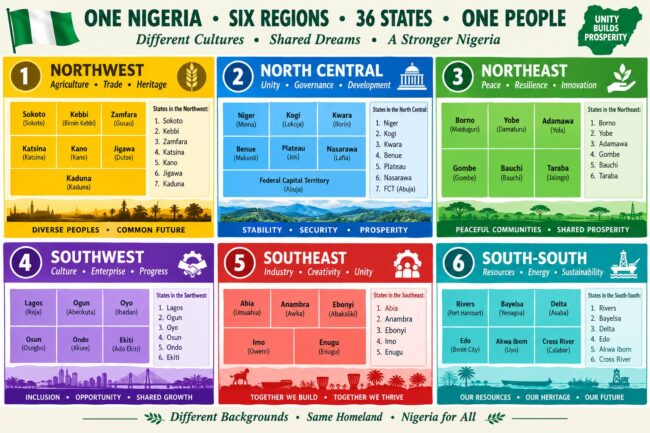
The central idea should be expressed simply:
One Nigeria • Six Regions • 36 States • One People • Citizenship.
Different Cultures • Shared Dreams • A Stronger Nigeria
This distinction is fundamental to understanding the philosophy behind my proposal.
From Ethnic Territories to Shared Civic Space
My model envisions the six regions primarily as geographical, administrative, economic, and developmental frameworks, rather than as constitutional expressions of ETHNIC OWNERSHIP. The 36 states would remain constituent units of the federation, but neither the regions nor the states should be regarded as the exclusive political possessions of particular ethnic nationalities.
That distinction matters because political geography influences political psychology. When particular territories are consistently described as belonging to specific ethnic groups, citizens can gradually internalize the idea that some Nigerians are “owners” while others are “settlers”; that some citizens possess a greater claim to political authority while others are permanent outsiders; or that “our people” should control “our government.” Such thinking can reinforce suspicion, exclusion, discrimination, and, ultimately, the political instability and social fragmentation that Nigeria has experienced over the past seven decades. Rather than strengthening our sense of shared nationhood, the persistent tendency to view Nigeria through the lens of ethnic ownership and division has contributed to recurring tensions, distrust, political competition along communal lines, and a weakened sense of common citizenship.
My proposal seeks to reverse that psychology. The principle is straightforward: Culture can remain diverse; citizenship must remain equal. A Nigerian should not have to surrender his or her cultural identity in order to embrace a common national identity. Equally, cultural identity should never become a justification for denying another Nigerian the opportunity to belong, participate, compete, serve, or lead.
Citizenship Before Ethnicity
I believe Nigeria needs a stronger hierarchy of civic identity: I am Nigerian first in my citizenship, while my ethnic, linguistic, cultural, religious, and regional identities remain meaningful parts of who I am. This is not a demand for cultural uniformity. It is a call for civic equality.
An Ijaw person can remain proudly Ijaw. An Igbo person can remain proudly Igbo. A Yoruba person can remain proudly Yoruba. A Hausa person can remain proudly Hausa. The same principle applies to every one of Nigeria’s many ethnic and cultural communities. Nigerians should be free to preserve their indigenous languages, celebrate traditional festivals, practice their customs, maintain ancestral institutions, and transmit their histories to future generations.
But alongside those identities must exist an equally powerful understanding that another Nigerian from a completely different cultural background is not a foreigner simply because he or she comes from another part of the country. That is the Nigeria I want to help build. The Right to Belong, Live, Work, and Lead Anywhere in Nigeria. This is why I place such importance on encouraging Nigerians to live together rather than organizing political life primarily around tribal affiliation.
A functioning federation should create meaningful opportunities for Nigerians from different backgrounds to live, study, work, trade, establish businesses, raise families, own legitimate interests, participate in public life, and contribute to government across regional and cultural boundaries.
We should aspire to a Nigeria in which an Ijaw Nigerian can legitimately aspire to become governor of Kaduna State; an Igbo Nigerian can aspire to become governor of Bayelsa State; a Hausa Nigerian can aspire to become governor of Ogun State; and a Yoruba Nigerian can aspire to become governor of a state anywhere else in the federation, provided, of course, that the person satisfies the applicable constitutional, legal, and residency requirements. The principle must work in every direction and for every Nigerian.
If a Nigerian is legally qualified to seek public office, his or her ethnic origin should not be treated as a disqualifying factor. Anything less risks legitimizing the very tribalism and ethnic exclusion that we repeatedly condemn. It should be noted that the ultimate test of Nigerian unity is not whether people from different ethnic groups tolerate one another in separate territories. It is whether they can live together, compete fairly, serve one another, and lead one another as equal citizens.
Why Everyday Interaction Matters
Constitutional language alone cannot manufacture national unity. People develop a sense of common belonging through everyday experiences.
When children from different backgrounds attend the same schools, when young people work together, when entrepreneurs build businesses across state and regional boundaries, when families establish homes outside their ancestral communities, and when citizens participate in one another’s communities without discrimination, something important begins to happen: Nigerians cease to encounter one another principally as representatives of ethnic groups and increasingly encounter one another as fellow citizens.
That kind of social interaction can accomplish something that political declarations alone cannot. It can gradually transform Nigerians from people who simply coexist within the same country into people who genuinely share a national experience.
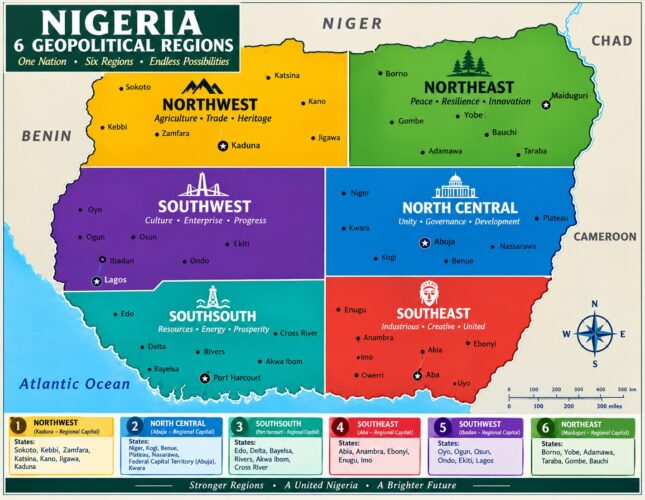
This is one reason the physical character of my proposed map is so important to me. The rectangular and square regional concept is not simply an exercise in cartography; it symbolizes a broader political philosophy: territory should facilitate interaction and national integration, not reinforce ethnic separation.
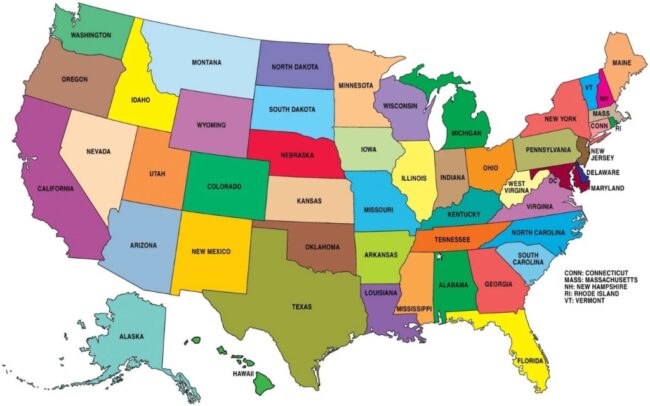
In this regard, the relatively straight and clearly defined state boundaries seen between Utah and Colorado, Kansas and Oklahoma, and Arizona and New Mexico provide an important source of inspiration for the proposed regional framework. While Nigeria’s geography, history, and political realities are fundamentally different from those of the United States, the underlying principle of drawing administrative boundaries without making ethnic identity the primary determinant is worth considering. Such boundaries can help communicate the idea that political territory is a shared civic and administrative space rather than the exclusive possession of a particular ethnic group.
Therefore, my proposed rectangular and square regional boundaries are intentionally designed to challenge the conventional tendency to associate political geography primarily with tribal or ethnic ownership. The objective is not to ignore Nigeria’s cultural realities or erase the historical identities of its peoples. Rather, it is to encourage a future in which administrative boundaries promote mobility, shared development, and a stronger sense of common citizenship.
Different Backgrounds, Same Homeland
The phrase at the bottom of the map captures this philosophy: Different Backgrounds • Same Homeland • Nigeria for All
Those words express what I believe should become one of the foundational principles of Nigeria’s next political chapter. We do not need to destroy diversity to achieve unity. We need to prevent diversity from becoming division.
Nigeria does not become stronger when an Igbo person is told that certain parts of Nigeria are not truly his or her home; when an Ijaw person is treated as though citizenship ends at the boundaries of the Niger Delta; when a Hausa person is viewed as an outsider in the South; or when a Yoruba person is regarded as a stranger in another region.
A Nigerian passport should not become geographically or ethnically conditional. Our homeland is Nigeria.
Addressing Genuine Injustice Without Collective Blame
This position does not require us to ignore Nigeria’s profound political and economic problems. There are legitimate and serious questions concerning elite domination, unequal representation, excessive centralization, historical exclusion, resource distribution, institutional weakness, constitutional design, fiscal federalism, and unequal access to opportunity. These issues deserve serious examination and structural reform.
However, I believe we must be careful not to attribute the failures of political systems collectively to entire ethnic or religious populations. The problem is not that one ethnic group exists. Nor is the problem simply that a particular ethnic group has political influence.
The deeper problem is a political system that can permit power, resources, opportunities, and national institutions to become concentrated in the hands of narrow elites at the expense of equal citizenship. That distinction is essential. If we replace one ethnic grievance with another, we have not solved Nigeria’s problem. We have simply changed its direction.
My argument must therefore apply equally to every Nigerian, regardless of ethnicity, religion, region, language, or historical background. Justice cannot be selective, and citizenship cannot have ethnic gradations.
A Federation Organized Around Citizens, Not Ethnic Ownership
The deeper constitutional philosophy behind my proposed map is therefore this: Nigeria should be organized around citizens and communities, not ethnic ownership of territory.
The six regions can provide a practical framework for regional planning, infrastructure, economic development, transportation, environmental management, educational coordination, and other areas of shared interest. The 36 states can continue to serve as constituent units of the federation, with appropriate constitutional reforms where necessary.
But neither the regions nor the states should become political fortresses in which ethnicity determines entitlement. A truly federal Nigeria should enable Nigerians to belong everywhere within the constitutional framework of the federation.
This does not mean ignoring local communities or dismantling traditional institutions. It means ensuring that local identity and national citizenship reinforce rather than undermine one another. Local identity should enrich Nigerian identity, not compete with it.
The Nigeria We Should Be Building
My vision is therefore not simply about redrawing lines on a map. It is about changing the meaning attached to those lines.
I want a Nigeria in which a child born in Delta can dream of leading Kaduna; a child born in Kano can dream of leading Cross River; a child born in Anambra can build a life in Lagos; a child born in Ekiti can establish a business in Adamawa; and every one of them can say, without qualification: “This is my country. I belong here.”
That is the kind of national consciousness capable of moving Nigeria beyond the inherited psychology of suspicion, territorial ownership, and ethnic-centered competition for political appointments and the distribution of federal infrastructure. It is a consciousness that demands a more statesmanlike vision of governance, one in which public institutions, national appointments, and developmental priorities are guided primarily by competence, equity, national interest, and the collective good rather than by ethnic calculations or geographical entitlement.
- We should not ask first, “What tribe are you?”
- We should increasingly ask, “What can we build together?”
- We should not teach the next generation that Nigeria consists of competing ethnic possessions.
- We should teach them that Nigeria is a common homeland in which many cultures have a legitimate place.
- We should not measure national unity by the absence of differences.
- We should measure it by our capacity to live with those differences without turning them into barriers to citizenship, opportunity, leadership, or human dignity.
My Fundamental Proposition
Nigeria does not need less diversity. Nigeria needs less ethnic exclusion. The objective is not to make Nigerians culturally identical. That would neither be possible nor desirable. The objective is to create a political and constitutional environment in which Nigerians can remain proudly different while standing equally within one national community.
- That is why I believe the six regions should function as instruments of administration and development, not as constitutionally entrenched ethnic “sub-nations.”
- That is why I believe the 36 states should belong to their citizens collectively, rather than to particular ethnic nationalities.
- That is why I believe Nigerians should have the opportunity to live, work, establish businesses, participate in civic life, and, subject to constitutional and legal requirements, seek public office anywhere in the federation.
And that is why the map I have proposed represents more than a different way of drawing Nigeria. It represents a different way of imagining Nigeria.
- A Nigeria where our cultures remain vibrant.
- A Nigeria where our histories are respected.
- A Nigeria where our languages survive.
- A Nigeria where our communities retain their identities.
- But above all, a Nigeria where citizenship is equal, opportunity is open, territory is shared, and no Nigerian is treated as a stranger in his or her own country.
One Nigeria. Six Regions. Thirty-Six States. One People.
Different Backgrounds. Same Homeland. Nigeria for All.
That is the Nigeria I believe we should have the courage to imagine, and the determination to build.
Professor Gold, PhD, CFP, MPA, FCILG, FEBS, FCECFI, FHIBC
- Recipient, United States President’s Lifetime Achievement Award
- Nigerian Peace Ambassador
- Inducted into the Nigeria Hall of Fame


