
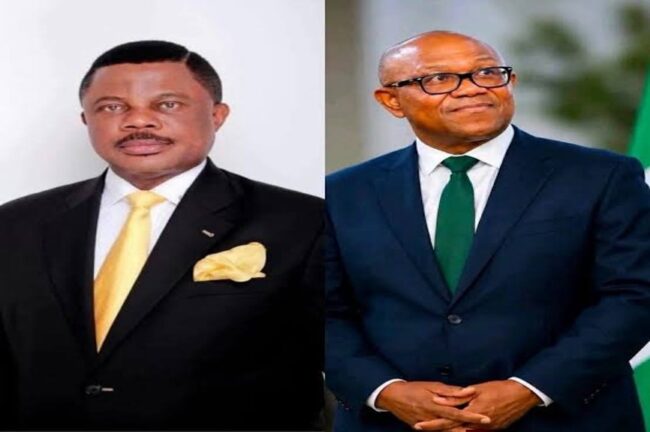
The streaming controversy between the current Anambra state governor, Professor Charles Soludo and the Nigeria Democratic Congress, NDC, presidential candidate and former Anambra state governor, Mr. Peter Obi, is absolutely unnecessary and uncalled for. That calumnious exercise simply put the Igbo in a very bad light at home and at the global level. It could have perhaps been better managed if Soludo was in the ruling All Progressives Congress, APC. In that case, his party would have covered him up since the President, Alhaji Ahmed Tinubu has indicated his intention to run for a second tenure. But Soludo is in All Progressives Grand Alliance, APGA, not in APC. So, the crucial question has become: ‘why should the authorities in APGA, noted as an Igbo party formed with Dim Chukwuemeka Odumegwu-Ojukwu as presidential candidate, find it incumbent to cross paths with the only Igbo man who has the credibility to restore the dignity of the Igbo nation and at the same time, bring true national unity to the Nigerian Confederation. Viewed against the fact that since independence in 1960 the Igbo are the only major ethnic group that has not produced an executive president in the country, Soludo’s unrelenting attempts to discredit Peter is absolutely unnecessary. The role Soludo played in the entire saga has been widely condemned by easterners, northerners and westerners alike. Some carried their anger too far by abusing him publicly or as is the norm in Igbo culture, covering face with a basket to talk to an influential man. But even at that, there is the grey area of what former governor Willie Obiano who took over from Peter Obi had to say about how much he inherited from his predecessor.
When Peter Obi handed over the administration of Anambra State to Willie Obiano in March 2014, one of the most crucial concerns of the transition was the financial position of the state. More than a decade later, that handover remains the subject of competing interpretations, particularly over how much money was actually left behind, what form those funds took, and what liabilities accompanied them. In politics, things like this do happen and that should not take anyone by surprise. What should surprise anyone is whether during the handover, both governors did not sign the document that summarized how much was being transferred to the new government. If they signed it, what is anyone saying differently? If they did not, that might give an insight into the nature of politics in that part of Nigeria.
So, we should first be considering the financial statement contained in the 2014 handover document from Peter Obi to Willie Obiano. That document should be at the centre of the controversy between Professor Soludo and Peter Obi. The document, dated March 17, 2014, was a summary of Anambra State’s financial position as at the close of business on March 14, the final working day of Peter Obi’s administration.
The figures contained in it are clear: ₦27 billion in local investments, ₦26.5 billion representing foreign-currency investments valued at US$156 million, ₦28.166 billion in certified balances belonging to the state, its ministries, departments and agencies, and a further ₦10 billion described as an approved Federal Government refund. Together, these amounted to ₦91.666 billion. However, the document did not showcase the entire amount as freely available funds. It identified estimated liabilities of ₦5 billion, covering March salaries, pensions and gratuities, as well as approved certificates for projects that had already been executed. After this deduction, the document recorded a “net balance” of ₦86.666 billion. And this figure is important because it represents what the handover document itself recorded.
This is different from the frequently quoted figure of “over ₦75 billion” associated with Peter Obi’s administration, and it is substantially higher than the ₦35.5 billion that Willie Obiano later said he inherited in cash and near-cash assets.
Understanding the difference requires looking beyond the headline figures. The ₦27 billion classified as local investments was not simply money sitting idly in a government bank account. It represented investments made by the state. By the same token, the US$156 million foreign-currency investment was an investment portfolio rather than ordinary naira cash. The handover documentation placed its naira value at ₦26.5 billion.
Contemporary and subsequent examination of the documents indicates that the foreign-currency investments included holdings connected to sovereign and other investment instruments. Some of these investments could generate income, but their existence did not necessarily mean that an incoming governor could immediately spend the entire amount on recurrent government expenditure.
The third major component was the ₦28.166 billion in certified State and MDAs balances. This figure is especially significant because it is sometimes presented in public debate simply as “Cash left by Peter Obi.” The underlying schedule, however, shows a more complicated picture. The balances were spread across a number of accounts and purposes. They included the State Cash Book, State Subsidy, Ecological Funds, Special Projects, Local Government SURE-P, JAAC, Fidelity balances, Set-Aside Accounts, Works, Youth and Sports and other specified accounts. There was also approximately ₦2.1 billion in unutilized Universal Basic Education-related funds. The existence of these balances demonstrated that the state had substantial financial resources, but some of the money was earmarked for particular programmes and purposes.
This distinction is essential in understanding the later dispute. A government can possess substantial assets without having an equivalent amount of unrestricted cash available for any purpose its successor chooses. For example, money invested in securities is different from money in a current account. A Federal Government refund is different from internally generated revenue. Funds earmarked for education, ecological programmes or other statutory purposes cannot necessarily be treated as though they were unrestricted operating cash. It was against this background that Obiano’s administration challenged the widely circulated claim that Obi had handed over more than ₦75 billion in readily usable funds.
In 2015, the Obiano administration had said that the “actual and voluntary cash investments” inherited from the previous administration amounted to approximately ₦35.5 billion. Its explanation put about ₦9 billion in cash and roughly ₦26 billion in investments or near-cash assets. It classified another approximately ₦39.5 billion differently, describing portions of that amount as illiquid investments, Federal Government receivables and what it called involuntary investments. Chief Willie Obiano himself subsequently gave a similar account. He said he inherited ₦9 billion in cash and ₦25.6 billion in “script issues”, putting the combined figure at approximately ₦35.5 billion. He also alleged that cheques amounting to more than ₦15 billion had been issued before Obi left office.
This is the origin of one of the most persistent numerical contradictions in the Anambra debate. On one side is the ₦86.666 billion net figure contained in Obi’s handover document. On the other is Obiano’s ₦35.5 billion figure. Yet the two figures are not necessarily describing exactly the same thing.
Obi’s figure envelopes investments, certified balances and the Federal Government refund. Obiano’s figure attempts to isolate what his administration regarded as actual cash and near-cash resources available to it. Consequently, it would be inaccurate to say simply that one figure is the “real” figure and the other is necessarily false without first defining what is being measured.
The “over ₦75 billion” figure associated with Obi’s camp adds another layer to the story. When the ₦27 billion local investments, ₦26.5 billion foreign-currency investments and approximately ₦28.1 billion certified State and MDA balances are combined, the total is about ₦81.6 billion. Deducting the approximately ₦5 billion in liabilities produces roughly ₦76.6 billion. This is the basis for the frequently cited description of “over ₦75 billion.”
But the later-publicized handover document included another ₦10 billion — the Federal Government-approved refund, bringing the gross total to ₦91.666 billion and the net figure to ₦86.666 billion. The difference, therefore, is not simply a matter of somebody getting their arithmetic wrong. It reflects different presentations and classifications of the same broad financial position. The ₦75 billion-plus figure and the ₦86.666 billion figure both derive from the financial items associated with the handover, but the latter explicitly incorporates the ₦10 billion Federal Government refund.
There is another important limitation to the document. The financial page is described as a summary of the full financial statement. It does not, on its face, provide a comprehensive debt schedule detailing every domestic and external obligation, every outstanding loan principal, undisbursed facility, guarantee or contingent liability. Consequently, the ₦86.666 billion should not automatically be interpreted as proof that Anambra State had no other financial obligations whatsoever. This distinction became particularly important when the Obiano administration spoke of inherited liabilities running into approximately ₦185 billion. That figure was not simply a conventional bank-debt figure. The administration’s explanation included obligations associated with ongoing projects and contracts inherited from the previous government. In other words, current and contingent obligations were being discussed alongside conventional financial liabilities.
That is why it would be misleading to take ₦86.666 billion in reported assets, subtract ₦185 billion in alleged inherited obligations and declare that Obi therefore handed over a negative balance of about ₦98 billion. The two figures were constructed on different accounting and policy bases. There is also evidence that the outgoing and incoming administrations did not jointly verify every component of the financial records at the point of transition. The fact that a handover document was received did not, by itself, establish that every listed asset was immediately accessible as unrestricted cash or that every figure had been independently audited and jointly certified by the incoming administration – which gives an insight into how politics can be played in a developing country like Nigeria.
This is perhaps the most important point for anyone trying to understand the controversy without becoming trapped in the political rhetoric surrounding it.
Peter Obi’s administration unquestionably presented a substantial financial position at handover. Its own document listed ₦91.666 billion in assets and balances and, after provision for ₦5 billion in estimated liabilities, and recorded ₦86.666 billion as the net balance. That is a documentary fact.
It is equally a documented fact that Willie Obiano subsequently said the amount of cash and near-cash assets he regarded as actually inherited was about ₦35.5 billion. That was a different characterization of the resources listed in the handover statement, not simply a competing piece of arithmetic. The disagreement, therefore, is fundamentally about classification, availability and liabilities as much as it is about the headline number. The controversy also illustrated a broader problem with political arguments about public finances. A government can leave behind large investments and substantial balances while simultaneously leaving commitments that future administrations must honour. Conversely, describing every investment, receivable or restricted fund as though it were immediately spendable cash can exaggerate the resources actually available to a successor.
For Anambra, the cleanest reading of the available evidence is that Peter Obi handed over a state with substantial financial assets and balances, including local and foreign investments and certified government-account balances. The handover statement put the gross value of those listed resources at ₦91.666 billion and the net figure, after the specified ₦5 billion provision, at ₦86.666 billion. However, Willie Obiano did not regard the whole amount as equivalent to free cash. His administration identified approximately ₦35.5 billion as actual cash and near-cash resources and classified other components differently. Thus, the most accurate description is neither that Obi simply “left ₦86.7 billion in cash” nor that he left only ₦35.5 billion in total assets. The documentary record indicates that he handed over financial assets and balances with a stated net value of ₦86.666 billion, while the succeeding administration’s interpretation of how much of that amount was immediately usable produced the much lower ₦35.5 billion figure.
More than twelve years after the transition, that distinction remains central to the argument over Anambra’s finances. The figures themselves are no longer difficult to identify. What remains contested is what each figure represented in practical financial terms, unrestricted cash, investment assets, earmarked balances, receivables and liabilities, and whether all of those components were independently verified at the point of handover. That is why the March 2014 handover document remains so important. It provided a contemporaneous snapshot of what Peter Obi’s administration said it was leaving behind. It did not, by itself, settle every subsequent dispute about the state’s debts, commitments or the actual liquidity of each asset.
The evidence therefore supports a more measured conclusion: Peter Obi’s administration reported a substantial financial position at the point of handover, valued at ₦91.666 billion before the specified ₦5 billion provision for liabilities and ₦86.666 billion after that provision. Willie Obiano’s administration subsequently placed the immediately relevant cash and near-cash component at about ₦35.5 billion. The difference between the figures is rooted largely in what was counted as an available financial resource and how investments, earmarked funds, receivables and obligations were classified.
For a state whose financial history continues to be debated in political and public circles, that distinction is not a minor accounting detail. It is the key to understanding what Peter Obi actually documented as he handed Anambra State to Willie Obiano — and why the argument over the meaning of those numbers has lasted far longer than the administration that produced them. Beyond that is why Soludo refused to talk about how much he inherited from Obiano and instead lavished so much time on trying to demonize Peter Obi’s presidential ambition. Ndi beanyi, biko nu. Enough of embarrassing Ndigbo.
Chief Asinugo, PhD., M.A., KSC, is a UK-based veteran journalist and author.