


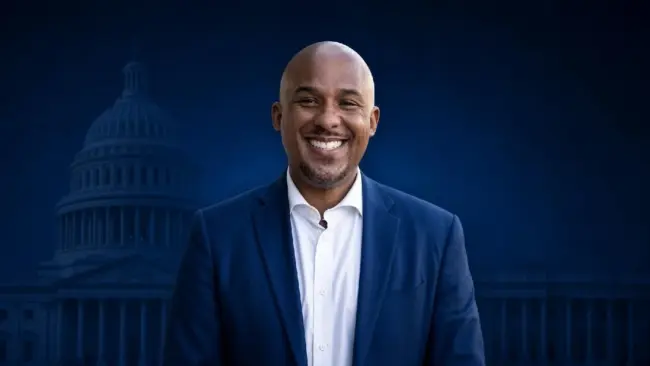
Scott Colom’s historic victory in Mississippi’s U.S. Senate race, after more than a week of suspense and a razor-thin margin, brings to mind Fannie Lou Hamer, Medgar Evers, Amzie Moore, Emmett Till, and countless Mississippians who struggled, suffered, and sometimes died in the fight for freedom and equal citizenship.
The road to this moment has been as long and winding as the mighty Mississippi River itself, flowing through generations of struggle, sacrifice, resistance, and hope.
I lived in Mississippi for five years, and some of my most memorable experiences came from traveling through the Mississippi Delta while planning a domestic study-away program centered on the Blues Trail and the civil rights movement. Those journeys taught me much about the intertwined histories of race, land, music, poverty, and freedom.
The Delta’s extraordinarily fertile soils generated immense agricultural wealth, much of it built on slavery, sharecropping, and exploited Black labor. Yet I was struck by the contrast between the richness of the land and the poverty of its communities. I saw depopulating rural towns, abandoned buildings, and places where basic services were painfully scarce. The land was rich, but many of those who worked it remained poor.
And everywhere, there was the Blues!
I followed the Mississippi Blues Trail, visited one of the sites associated with Robert Johnson’s burial, and stopped at Clarksdale’s legendary Blues Crossroads, marked by three giant blue guitars, where folklore tells us Johnson sold his soul to the devil for extraordinary musical talent. I enjoyed live music at Ground Zero Blues Club, co-owned by Morgan Freeman, and stayed at the Blues Shack.
At the B.B. King Museum in Indianola, I learned about the hardships Black musicians faced traveling through the segregated South. I was particularly struck by the difficulties King and his band encountered finding gas stations, restaurants, and accommodations that would serve them. The Blues, I came to appreciate, was not simply music born of suffering, but an expression of creativity, endurance, and freedom.
My travels also took me to Leland, associated with Jim Henson’s childhood and the world that gave us the Muppets and Sesame Street. But one of my most haunting visits was to Money, Mississippi, where I saw the remains of Bryant’s Grocery, associated with the events preceding fourteen-year-old Emmett Till’s brutal murder in 1955. I also visited the courthouse in nearby Sumner, where an all-white jury acquitted the men accused of killing him.
Standing in those places, the civil rights movement ceased to be an abstract chapter in history. It became a landscape of violence, memory, and extraordinary courage.
Another unforgettable experience was attending a community theater performance about Fannie Lou Hamer on Main Street in Starkville. I was deeply moved by this remarkable woman from the Delta, who lost her livelihood for attempting to register to vote in 1962 and became one of the civil rights movement’s most powerful voices.
She understood that political freedom and economic dignity were inseparable.
I also think of Amzie Moore, whose grassroots voter-registration efforts helped lay the foundations of Mississippi’s freedom movement, and Medgar Evers, assassinated in Jackson in 1963. James Chaney, Andrew Goodman, and Michael Schwerner were murdered during Freedom Summer in 1964. Their sacrifices remind us that voting rights were not simply granted. They were fought for, often at an unimaginable human cost.
Colom’s election invites us to remember that history. In a state where Black citizens were once systematically denied the ballot, a Senate race decided by a few thousand votes carries profound historical significance. Yet the poverty I witnessed in the Delta reminds me that the struggle for economic justice remains unfinished.
My thoughts return to the cotton fields, the Blues Crossroads of Clarksdale, the courthouse in Sumner, the store in Money, and that unforgettable evening watching Fannie Lou Hamer’s story unfold on a small stage in Starkville.
I can still hear her words: “I’m sick and tired of being sick and tired.”
More than sixty years later, something of the future she struggled to make possible has materialized in Scott Colom’s victory. It is not the fulfillment of her entire dream, but a reminder that the struggles of one generation can open doors for those who follow.
From Fannie Lou Hamer’s defiant voice and Amzie Moore’s grassroots organizing in the Delta to Scott Colom’s election to the U.S. Senate, the road has been as long and winding as the mighty Mississippi River itself, carrying the memories of past struggles and the unfinished promise of a more just and inclusive democracy.


