
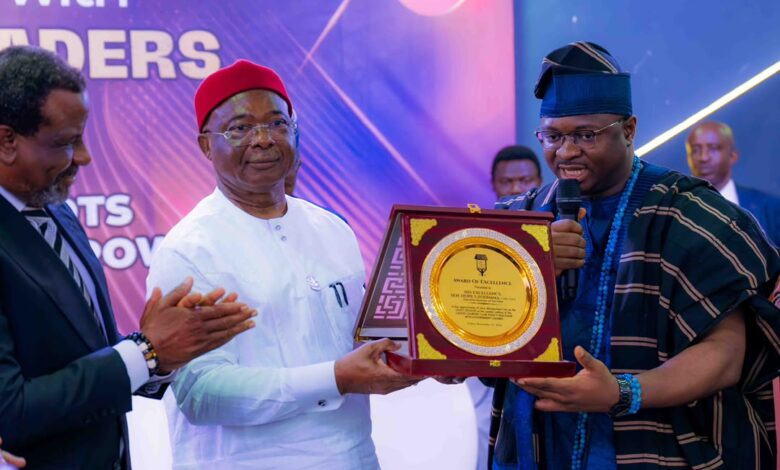
Governor Hope Uzodimma of Imo State has said his administration makes local economies to work in Imo State with different initiatives that are people – centred, even as he canvassed greater government partnership with the locals to depeen development.
Uzodimma made the disclosure in Lagos as Keynote Speaker at the Maiden Lecture of the 77 year old Lagos Country Club on Policy Dialogue with Government Leaders.
The Governor spoke, according to a statement by Oguwike Nwachuku, his Chief Press Secretary/Special Adviser, on: “THE FUTURE IS LOCAL: STIMULATING GRASSROOTS ECONOMIES FOR INCLUSIVE GROWTH.”
According to the Governor, the topic “challenges us to look beyond the familiar centres of commercial activity to the possibilities in our towns and communities across Nigeria.”
Uzodimma noted the incredible inherent strength in the people who inhabit the localities, insisting that if more attention was paid to the diverse talents of the rural people our society would be better for it.
His words: “Many people who drive the Lagos economy have roots in the South-West, South-East, South-South, North and Middle Belt. They carry with them knowledge, values, relationships and ambitions shaped by their origins. What would happen if the communities they come from became stronger centres of production, enterprise and opportunity?
Our concern is about national productivity, economic resilience and shared prosperity. My central argument is straightforward.
“Nigeria’s growth will be sustainable only when it is built on the strength of its many local economies. Government must lay the foundations, and private capital, much of which is represented here, must turn them into productive enterprises, jobs and prosperity. Neither can do this alone.”
The Governor explained that it is difficult to separate the cities from the communities where those who live in such cities reside in their quest to seek better ways of living.
“Lagos has become a symbol of enterprise, ambition, innovation and resilience. It attracts people, businesses, capital and ideas from across the country and beyond, yet its story is inseparable from the communities that supply its workforce, food, entrepreneurs and investment capital.
“This Club began in an aircraft hangar with about a hundred members and has grown into a family of more than two thousand. Many of you came from towns and villages across the federation, yet few have ever really left home. A good part of what is earned here flows back through social investments: the house in the hometown, the school fees paid and the community projects funded. That flow of money and loyalty is one of the most enduring economic links in this country.
“It also brings me back to the question I asked two years ago. In a survey my research team conducted for my lecture at the Yoruba Tennis Club, 85 per cent of respondents did not believe Nigeria offers its citizens an equal opportunity to thrive. Closing that gap is what inclusive growth is about. Many Nigerians live far from the commercial centres, and whether they prosper depends on the economies of those places. That is where Nigeria’s next phase of growth must come from,” he explained.
Uzodimma brought to the fore what his administration had been able to do in Imo since inception in 2020, insisting that his policies were designed to ensure that the local economies worked.
He said whether in the area of road infrastructure, improvement in internally generated revenue, increment in the salary pay of the Imo workers, job opportunities, investment in sectors like agriculture, education, transportation, youth empowerment, all had worked together to enhance the standard of living in the local communities in Imo.
Uzodimma told the management of Lagos Country Club that there is something to take away, for instance, from the OKOBI
(One Kindred, One Business) initiative of his Government where communities in Imo State choose, nurture and are supported by government on any business idea of their choice, as well as the SkillUp initiative that has taken thousands of youths out of the labour market.
He said through such ventures and others the economy of the locals are boosted and consequently, crimes are reduced.
The Governor’s lecture read in full: “A local or grassroots economy is the economic life of a place below the level of national figures: the farms, markets, workshops, small firms and services through which most Nigerians earn a living. The World Bank describes local economic development as public, business and non-governmental partners working together to create better conditions for growth and employment.
“No single actor can do this work alone, and government least of all. By inclusive growth, I mean growth distributed fairly across society and creating opportunities for all, in the words of the Organisation for Economic Co-operation and Development (OECD). Growth can be fast without being inclusive. Headline figures have risen before while most Nigerians’ lives barely changed. The test is whether the benefits reach the communities furthest from the commercial centres, and that is the standard I would like us to apply today.
“Consider how concentrated our economy has become. According to a Daily Trust analysis of Federation Account records, Lagos generated about 52 per cent of all non-import VAT collected in Nigeria last year, and Rivers, the next state, produced roughly a quarter of that. I say this with admiration for what Lagos has achieved, to which this Club has contributed greatly. But a country of more than two hundred million people cannot rest its fortunes on so narrow a base.
“Sir Arthur Lewis, the Nobel laureate who advised Ghana at independence, explained in 1954 that developing economies tend to grow by drawing surplus labour from low-productivity agriculture into a modern urban sector. Firms also cluster in large cities because they are more productive, close to customers, suppliers and skilled workers. Lagos is the great example of both forces. Things get complicated when people move faster than cities can create jobs, and when the places they leave are abandoned rather than developed.
“Lagos itself pays a price. The State of Lagos Housing Market Report estimates that the city receives about 600,000 new residents a year and that its housing deficit has reached some 3.4 million units. Many arrived because there was too little for them at home. The National Bureau of Statistics shows the other side: 72 per cent of rural Nigerians are poor, compared with 42 per cent in cities.
“Rural areas hold 80 per cent of the country’s poor. When local economies sit idle, the consequences do not stay local. Young people leave for the big cities or stay behind with nothing productive to do. That idleness has a way of finding the wrong employers. Crime and insecurity feed on it.
“A poor State has little to tax, so it leans ever more heavily on allocations from Abuja and on the few cities that can pay their own way.
“Professor Andrés Rodríguez-Pose of the London School of Economics has written about what he calls the revenge of the places that don’t matter. His research found that regions left behind by long decline, in Europe and America as elsewhere, eventually turned their frustration against the political and economic system. His prescription was to help every place realise its own potential, rather than pouring money into declining areas or simply telling people to move. That argument has aged well. In our own country, neglected places have expressed their frustration at the ballot box and through far more dangerous means. A local economy that gives young people a stake in peace is among the best security investments a government can make.
“In Imo State, we have tried to make local economies work by laying the foundations, backing local enterprise and investing in our people. I will be candid about where the work is unfinished.
“Private capital will not go where the basics are missing, so the first duty of a state seeking grassroots growth is to provide them. When we came into office in 2020, the road network in many parts of Imo had collapsed, and whole communities were cut off from the markets that should sustain them. We have since built more than 130 roads, including the Owerri–Orlu, Owerri–Okigwe, Owerri–Onitsha, Owerri–Port Harcourt, Owerri–Umuahia and Orlu–Mgbee–Akokwa–Uga roads, and the effect on trade between our towns has been immediate.
“Power is the constraint every business in Nigeria knows best. The constitutional and legal reforms of 2023 allowed states to regulate their own electricity markets, and we decided not to wait. In February, as part of our Imo State at 50 celebrations, we commissioned the first phase of the Orashi Power Project under our Light Up Imo programme. It is run by our indigenous Orashi Electricity Company with its technical partner, Madkour Holding of Egypt, and includes a 15 MVA injection substation and a new distribution network on the Owerri axis. The Orashi Electricity Company has a 15 year agreement; memorandum of understanding(MOU) with the Madkor Group, which is renewable.
“A hotel in Imo recently told journalists its operating expenses had fallen by over 70 per cent thanks to Orashi power. Our aim is to take the generator out of the cost of doing business in Imo. We are only at the first phase, but the progress has been tremendous.
“Digital infrastructure forms part of the same foundation. Land in Imo is now administered through the Imo State Land Information System, which replaced a paper process that was slow and open to fraud, and residents can search records and pay their taxes through MyImoApp. Twenty-six years ago, in The Mystery of Capital, the Peruvian economist Hernando de Soto argued that the poor in developing countries hold enormous wealth in land and houses that they cannot put to work. Without clear title, that property cannot be borrowed against, sold with confidence or invested. He called it dead capital. Much of our communities’ wealth is held in that form, and every title we register brings some of it back to life. That is why we treat land administration as economic policy.
“These reforms recently earned awards from the National Information Technology Development Agency (NITDA) and Cisco. We are now working towards fibre and 5G coverage across all 27 local government areas, with Imo Digital City as the flagship. At the Sam Mbakwe International Cargo Airport, May last year brought the first international flight in its history, and we intend it to become a cargo gateway for the South-East.
“The scale of what is at stake is larger than many assume. The most recent national survey of micro, small and medium enterprises, carried out by the Small and Medium Enterprises Development Agency of Nigeria (SMEDAN) and the National Bureau of Statistics (NBS), found close to 40 million such businesses. Together they account for nearly half of GDP and create close to nine in every ten jobs. Most are small, informal and far from Lagos, held back by unreliable power, scarce and expensive finance, poor roads, multiple taxation and the high cost of dealing with government. Every improvement to the foundations goes straight to their bottom line.
“Foundations matter only when someone builds on them, and in a market economy that someone is the private investor. Government should not try to pick winners. It should lower the cost and risk of doing business and then make it easy for capital to find opportunities that already exist. That is the purpose of the Orashi Special Energy Free Zone in the state, which holds a ten-year operating licence from the Oil and Gas Free Zones Authority and an approved master plan, so that investors in gas and energy can process and add value close to the resource.
“Agriculture remains the largest employer in our local economies, and the value lies in processing what we grow. Imo has the land, and the palm value chain, from plantation to refining, offers investors a market of national scale. The former Concorde Hotel in Owerri now operates as a DoubleTree by Hilton, meeting the standard business visitors expect.
“Last December, with Federal Government backing, we hosted the first Imo Economic and Investment Summit for investors from Nigeria and abroad.
“I should acknowledge President Bola Ahmed Tinubu’s reforms. By ending the petrol subsidy and unifying the exchange rate, the President has substantially increased the resources reaching the states through the Federation Account. We have also added to these through our own efforts.
“Imo’s internally generated revenue reached N43.6 billion in 2025, according to the National Bureau of Statistics, above our target. Lagos raised about N1.77 trillion by the same measure, but for a state like ours, how far we have come matters more. When we took office, Imo’s revenue averaged around N500 million a month in 2019, according to revised Bureau figures. Collections now run above N4.5 billion a month, and BudgIT ranks Imo third nationally for revenue growth between 2019 and 2025, with an increase of more than 600 per cent. Part of that growth reflects a local economy doing more business.
“We also pay a minimum wage of N104,000, the highest in the country. I mention it because wages paid in Owerri, Orlu and Okigwe are spent in the markets and shops of those towns.
“A well-paid public workforce is one of the quickest ways to put money into circulation at the grassroots. The third part of our approach concerns people and decides whether growth is inclusive. Through Skill-Up Imo, more than 65,000 young people have been trained in software development, cybersecurity, artificial intelligence and related fields, with digital skills centres in all 27 local government areas.
“Through Skill-Up Imo and our wider digital economy programmes, we have created more than 80,000 jobs and income-earning opportunities. These include salaried work, remote work, freelancing and businesses started by our graduates, some of whom now employ others. More than 1,000 graduates have found work through our freelance platform, and more than 30 startups have emerged from the programme. ImoTalentHub connects graduates with remote work for firms anywhere in the world. Our young people do not need to move to Lagos to earn a Lagos salary, and many no longer do.
“A family that cannot afford medical care can lose its livelihood to a single illness, so we have expanded access through the Imo State Health Insurance Scheme, which aims to cover 2.5 million residents.
“In August last year, we established by law the University of Innovation, Science and Technology at Omuma, to build the technical capacity local industry will need.
“Government must also come closer to where economic life happens, often below local government level in our part of the country. These include the kindred, the town union, the age grade and the cooperative, institutions our people already trust.
“Our own traditions point the same way. The Igbo apprenticeship system, Igba Boi, has for generations taken young people into a master’s business, trained them for years and then set them up on their own, often with capital from the very person who trained them. It has been widely acknowledged as one of the most effective systems of enterprise development this country has produced. Built entirely by communities, it has seeded businesses in every major city in Nigeria, including Lagos.
“When government designs programmes for the grassroots, it should build on institutions of this kind, which already enjoy the trust of the people, instead of inventing new ones and hoping that trust will follow. There is serious scholarship behind that approach. Elinor Ostrom, who won the Nobel Prize in Economics in 2009, spent her career showing that communities are often better at managing shared resources than either the state or the market assumes, provided they have clear rules, fair ways of sharing the benefits and a voice in how they are governed.
“We launched OKOBI—our One Kindred, One Business Initiative—in 2022. Under OKOBI, a kindred, social group or student club establishes a registered business that it owns collectively, governs properly and runs for profit, with training, technical support and access to finance through the Office of the Chief Economic Adviser. Members share in the profits, and because the business belongs to the group rather than to any one person, it can outlive the enthusiasm of its founders. By the end of 2025, more than 600 OKOBI businesses had been registered, with close to 20,000 members across all 27 local government areas. The model has been studied by the London School of Economics, and earlier this year the Federal Government approved its adoption across the country.
“Local governments have a part to play beyond their traditional duties. Councils control markets, motor parks and feeder roads, and they sit closest to the permits and levies small businesses pay. When they treat those powers as instruments of economic development, the local economy breathes more easily. The Renewed Hope Ward Development Programme, adopted by the National Economic Council in July last year to create jobs in each of Nigeria’s 8,809 wards, rests on the same conviction, and OKOBI gives it a ready route to people.
“Ladies and Gentlemen, seven years in office have taught us some lessons the hard way. The first is that security comes before every other economic policy. When we took office, Imo was among the most troubled states, and no incentive would have drawn an investor in. In January this year, we established the Imo State Vigilance Services Organisation, with 7,000 operatives working alongside the federal security agencies. The South-East has not yet put this problem fully behind it, but the situation has improved tremendously.
“The second is that the largest projects take longer than we would like, and they rarely succeed without private partners. The revival of Adapalm, once one of the great plantations of the region, has been slower than we hoped. The Orashi waterway, which would give our part of the country access to the Atlantic, still awaits dredging. Both remain open to investors with the patience and capital to see them through.
“The third is that government should build platforms and leave businesses to those who know how to run them. OKOBI works because the state trains, supports and then steps back. Where government has tried to do more, the results have usually been disappointing. I hope we can take up these questions when the dialogue begins, as many of you know more than I do about what makes an investor say yes.
“My invitation follows from all of this. There is an opportunity in gas and energy processing in the Orashi free zone, and in the palm value chain and agro-processing more widely. Lagos firms can draw on a growing pool of trained young people in Imo for digital services without asking them to relocate. There is room in hospitality and in services that follow a fast-growing state capital. And for any firm that wants to reach communities credibly and accountably, OKOBI offers a ready-made route, as a supplier or social investment partner.
“Many of you already invest in places like Imo through the houses you build and the projects you fund. I ask you to bring that same loyalty to these places, backed by the discipline of a business case. The Imo State Investment Promotion Agency runs a one-stop shop for investors at the Imo Trade and Investment Centre in Owerri. I will ask the agency to follow up with the Club’s secretariat after today, so that any interested member has someone to call.
The Club began in 1949 with about a hundred members and is now one of the city’s oldest institutions. They built it one member at a time, much as local economies grow. There is, therefore, no better place to begin that conversation.”
Earlier, the President of the Lagos Country Club, Mr. Seyi Adewunmi took Governor Uzodimma round the premises of the Club to enable him have first hand knowledge of what goes on at the 11 sections of the Club.
In his opening remarks, the Chairman of the occasion, Mr. Alex Goma appreciated the Governor for accepting to honour the members with his presence and for the giant stride his administration is associated with in Imo State.


