
Last time, this column dressed the researcher for the street.
It described the Visual Assimilation Protocol, the wardrobe of the worn and unremarkable, and the deep immersion through which a scholar-journalist or researcher may, for a time, become less conspicuous inside a decoupled zone.
That idea deserves more than a cliffhanger.
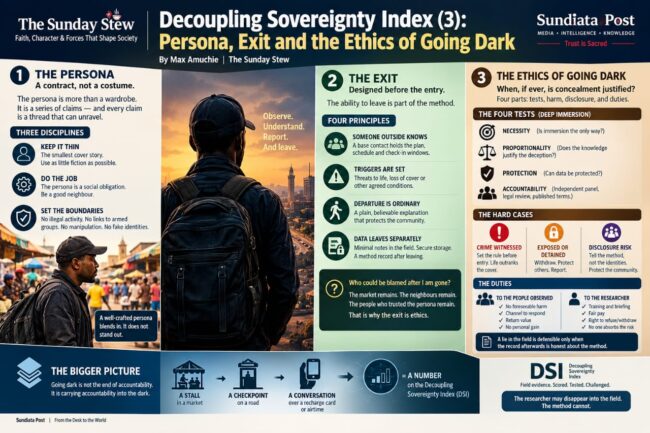
A methodology that asks a researcher to live under a borrowed role creates three obligations that cannot be avoided: the role must be disciplined, the researcher must be able to leave, and the deception must be ethically justified.
The third is the hardest.
I take them in that order.
The Persona Is a Contract, Not a Costume
A wardrobe is the easy part of a persona.
The hard part is everything that comes after it.
Where are you from? Who do you know here? Why did you leave your last job? How long have you been doing this? Who taught you?
Every answer is a claim. And every claim is a thread that can unravel the persona.
Three disciplines follow.
Keep the persona thin. The best cover story is the smallest one. Every invented detail is another fact that must be remembered, and every additional fact creates another opportunity for contradiction. A persona should remain as close to the researcher’s real experience as safety permits, with as little fiction as possible.
Do the job properly. A researcher who takes a stall, an apprenticeship or a market post must actually work it. The persona is not merely an explanation for being there. It is a social obligation to the people around it. A researcher who plays a vulcanizer’s assistant badly, or works half-heartedly, is not simply compromising the research. The researcher is becoming a bad neighbour.
Set the boundaries before entering the field. There are things the persona must never do, regardless of what circumstances appear to demand.
It must not participate in illegal activity.
It must not pass information to an armed group or other violent actor.
It must not manipulate friendships or intimate relationships simply to extract information.
And it must never assume the identity of a real person by borrowing that person’s name, documents or reputation.
These limits matter more than the sophistication of the technique.
The moment the persona begins making decisions for the researcher, the method has become a risk.
The Exit Is Designed Before the Entry
In Part 2, I described a researcher who could blend in.
What I did not say clearly enough is that the ability to leave is itself part of the method.
At the Sundiata Post Knowledge Lab (SPKL), the governing principle is straightforward:
No researcher enters a zone before the exit has been written down.
In practice, that means four things.
Someone outside knows the plan. A base contact holds the schedule, the check-in windows and the agreed procedure if a check-in is missed. Immersion is not a solo act.
Triggers are decided in advance. The point at which an assignment ends must be established before the researcher becomes emotionally or intellectually invested in completing it. These include any imminent threat to life, which the rules below treat as overriding the persona. The conditions that terminate the assignment are agreed in a calm room because they may not be assessable calmly in the field.
The departure is ordinary. A sudden disappearance can draw attention not only to the researcher but also to the people who worked beside the persona. The best exit therefore has a plain, believable explanation and leaves the community with as little exposure as possible. That ordinary explanation is itself a second, quieter lie, and it must stay consistent for as long as the people who trusted the persona remain.
The data leaves separately from the person. Field notes should be minimal. Where circumstances permit, they should be written after leaving the site rather than in it. Information should be stored so that the loss or search of the researcher’s device does not expose other people, and whatever is recorded should be safe if it is lost. On leaving, the researcher writes a method record covering what was done, how, and at what cost, without identities, for the panel to review.
Behind all four principles sits one question:
Who could be blamed after I am gone?
The researcher leaves. The market remains. The neighbours remain.
The people who trusted the persona remain. That is why the exit is not logistics. It is ethics.
The Ethics of Research in the Dark
Now to the third obligation.
By the ethics of going dark, I mean the obligations that bind a researcher who works under a borrowed identity, without the knowledge of the people observed, in places where openness would be unsafe or would defeat the research.
It asks two questions. When, if ever, is concealment justified? And what is owed to the people it touches?
The answer here has four parts: tests that decide whether to go dark at all, rules for harm witnessed or suffered, honest disclosure of the method afterwards, and duties to both the people observed and the researcher.
None of this is new ground. Research ethics has argued about covert methods for decades, and this column builds on that work rather than replacing it. Journalism has argued about it for generations. Neither has concluded that deception is never permissible. Both have established that it is never automatic.
Deep immersion is the gold standard but a gold standard is only as good as the ethics that justify it.
Deep immersion may produce the richest data. That is precisely why it faces the strictest test. Four tests apply.
Necessity. Immersion comes last in the Tri-Tiered Approach. Remote tracking comes first, rapid intercept next. If either can answer the question, immersion is not justified.
Proportionality. The knowledge gained must justify the deception used to obtain it. The bar rises with the vulnerability of the people observed. Studying a market stallholder is harder to justify than studying an official or an institution. Foreseeable harm means any harm someone who knows the community could anticipate: reprisal, stigma, lost livelihood or legal jeopardy. No one observed may face it so that the researcher can have better data.
Protection. Names, precise locations and identifying details stay out of the record unless essential. Data that cannot be protected should not be collected merely because it is interesting.
Accountability. No institution approves its own covert research. Before any immersion, a panel of outside advisers, appointed independently of the unit, reviews the case in writing. The panel’s terms are published. It can veto. Its decision is reported in the method account. And no researcher enters a jurisdiction without a legal review for that jurisdiction.
Three hard cases test these principles harder than any others.
What if the persona witnesses a crime?
The rule that the persona must not participate in illegal activity covers what the researcher does. It does not cover what the researcher sees.
Reporting may endanger the people the researcher is protecting. Silence may make the researcher complicit. The rule must therefore be set before entry, not in the moment.
Life outranks the cover. Where a life is in imminent danger, meaning likely to be lost before help or withdrawal could prevent it, the researcher warns or withdraws, even at the cost of the persona. Everything else is recorded, and the panel decides what follows.
A researcher who has not settled this in advance will settle it under pressure. That is the worst time to do so.
What if the persona is exposed?
Exposure, detention and compromise are not remote possibilities. They are possibilities the protocol plans for.
The researcher withdraws. The base contact informs the panel. The unit’s first act is to protect those who worked beside the persona. The failure is reported in the method account like any other outcome.
What if disclosure itself exposes people?
I have said the deception should end, at the latest, when the findings become public. But publication can expose the very neighbours the method was designed to protect.
So disclosure has two parts. The method is disclosed in full: what was done, how, why and at what cost. The identities are not. Details that could trace a finding back to a stall, a street or a person are altered or withheld, and the account says so openly.
The community’s consent cannot be obtained in advance, because asking would defeat the research. That is exactly why the other safeguards must be strict. Where consent is impossible, restraint must carry the weight.
The duty to the people observed.
The researcher’s protection is only half of the duty. The people observed carry risk too: reprisal, stigma, broken trust and legal exposure. They receive none of the salary, the training or the byline.
So no one observed may pay a foreseeable price for the findings. If they discover the research, they have a channel to respond, answered by someone outside the unit. Findings are returned to the community in a form it can use. And no benefit is taken from the research without sharing it.
The duty to the researcher.
An institution should never ask an individual to accept a risk it would not bear itself. Field researchers must be trained, briefed, fairly paid and free to refuse or withdraw without penalty.
A methodology that works only because someone else absorbs the danger is not a methodology.
It is an outsourcing of risk.
That is true of the researcher. It is equally true of the community.
SPKL will publish its field ethics protocol, covering legal review, data handling and the panel’s terms, so that every commitment here can be checked.
The Lie Must End. The Record Must Not.
Part 2 closed with the researcher living “a quiet lie” in order to find the truth.
I stand by the phrase. But the tests, the panel and the rules for the hard cases all lead to one condition: a lie in the field is defensible, if at all, only when the account afterwards is honest about the method.
That means being honest about what was done, how it was done, why it was done, and what it cost.
The people may be protected. The method may not.
That is the distinction between a researcher who deceives and a fraud who happens to write notes. The first accounts for the deception. The second conceals it.
The wardrobe was never the point. It was only the first layer of a much larger discipline.
The researcher must master the persona. The researcher must design the exit. The researcher must submit to the tests. And, finally, the researcher must be prepared to account for the entire exercise.
Going dark does not mean abandoning accountability. It means carrying accountability into the dark.
Part 4 turns to the question that gives this entire exercise its purpose: how does a stall in a market, a checkpoint on a road and a conversation over a recharge card or airtime become a number on the Decoupling Sovereignty Index?
Field evidence is only useful if it can be translated into a system that can be scored, tested and challenged.
The researcher may disappear into the field. The method cannot.
From the Desk to the World
Dr. Max Nwabueze Amuchie is CEO & Theorist-In-Chief of Sundiata Post, Lead Researcher at the Sundiata Post Knowledge Lab (SPKL), and an Expert Member and Peer Reviewer in Behavioural and Social Sciences at ScienceOpen. He is the formulator of three frameworks—the Sundiata Post Model (SPM), The Insecurity Triad framework, and the Trinity of Sovereignty Decay (TSD) theory—and the creator of the Decoupling Sovereignty Index (DSI), the quantitative extension of TSD. His work develops original frameworks for understanding, explaining, and measuring insecurity, conflict, state decay, and sovereignty, with particular relevance to the Global South.
Email: max.a@sundiatapost.com
X: @MaxAmuchie