

By Isiah Christie
In the light of New Jersey Democratic representative Mikie Sherrill winning the nomination of her party for the November governorship election, certain policies within her interest have received increased exposure.
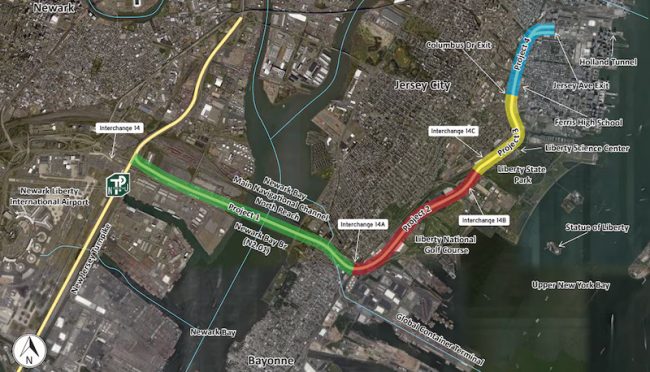
Among these is the aggressive suggestion of expanding Hudson County’s turnpike, proposed by the New Jersey Turnpike Authority (NJTA). The agency’s goal is to replace local bridges and expand roadways to four lanes, with standard shoulders attached. While this is an enticing and marketable plan on paper, it is in fact immensely dangerous to the welfare of Hudson County residents and a change that will hurt the area long-term.
Road Expansion Is Good on Paper – But It Has Consequences
The expansion of a turnpike is, theoretically, done with one goal in mind – reducing traffic and preventing congestion. However, it in fact does the opposite – traffic-induced demand, which occurs upon expanding roads, ushers in greater bouts of traffic. Scientific studies show that cities that increase their road capacity by 10 percent also saw a 10 percent increase in driving – there is an exact numerical correlation, which makes it impossible to counter traffic with more driving space. It simply encourages more people to drive, often to the detriment of the city. A commuter that once avoided rush hour may attempt to travel during that time now, or a public transit customer may opt to drive with more space to. It invites a crowd that cannot be sustained, and Hudson County will suffer economically and environmentally.
A big part of this issue is that New York City and Jersey City have shown no interest in expanding the target exit Holland Tunnel or local Jersey City roads, meaning they cannot hold the newfound capacity that an expanded highway will generate. This renders the project a financial expense with no “point B” and the ultimate result of amplifying an already-awful traffic congestion situation in North Jersey.
Hudson County is considered one of the worst counties in the nation regarding air pollution quality and activism to stifle such issues.
Terrible Climate Ramifications
The turnpike expansion, as with any industrial project, will also hurt the environment in unforeseen ways. New Jersey already ranks bottom ten nationwide in pollution issues. According to US News – the North Jersey population and industry has a large influence on that statistic. Hudson County, which will bear the brunt of this turnpike expansion project, is also notoriously low-quality environmentally. It received poor grades from the American Lung Association’s annual reports, including “D”-level grades for short-term particle pollution and ozone smog. It was reported that 46% of residents are living among dangerous levels of air pollution, and Hudson also received a worst-possible “F” grade for the percentage of days where air quality policies were violated.
Air pollution has a wide range of potential negative effects on human health, including a greater risk of heart attack, dementia, cardiovascular dysfunction, pneumonia, and lung and heart diseases. It is also dangerous for children and pregnant mothers, who rely on oxygen to develop and a stable environment for fetal development, respectively. These unfortunate circumstances are amplified among marginalized communities, namely people of color – due to economic discrimination that results in the displacement and silent segregation of minority groups, they are exposed to pollution at a higher rate than the privileged. This disproportionate inequity will be on full display should the turnpike expansion occur – it runs directly through a number of underprivileged communities, including Greenville, Communipaw, and West Bergen.
What Can We Do?
With Mikie Sherrill’s intention aligning strongly with the turnpike expansion, it is hard to say that protesting will have much more influence on the project’s cancellation – a compromise may be necessary. North Jersey communities need to mobilize and vocalize their concerns to raise awareness of the negative effects this undertaking will cause, perhaps forcing NJTA to reconsider their approach. The primary goal should be to encourage abandonment of the project past exit 14A, which would stop the expanded highway at the middle point between Jersey City and Bayonne. This will still result in the re-building of the Newark Bay Bridge and restructuring of other bridges connecting from Newark, but will not hurt the welfare of Jersey City communities that cannot handle the project’s magnitude.
Other options are to fight for a less extreme outcome – such as a three-lane expansion as opposed to four lanes – or incorporating other means of public transit to compensate for the increase in drivers. NJ Transit should be involved in this initiative and consider a light rail expansion from Jersey City to Newark, which would balance out traffic among different types of commuters. NJTA should also be active in deterring the use of Jersey City as a buffer for the extension’s congestion – likely through plate readers or rerouting traffic paths to avoid downtown – but it would require a great deal of pro-activity from the agency, which is unfortunately an optimistic vision.
Regardless, raising awareness of the issue is the number-one goal with Sherrill’s nomination. Once the project is underway, it will be difficult to halt or protest its completion and subsequent long-term issues. Hudson County cannot fall into a further abyss of environmental disarray and communal divide, and the turnpike expansion is a project capable of manifesting those nightmarish possibilities.