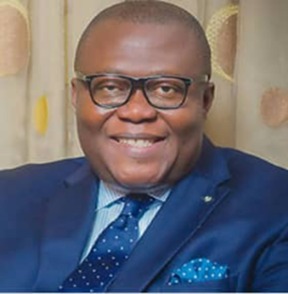
From November 10 – 17, the West African Project Fair hosted by Rotary International District 9111 and District 9112 will hold at the Balmoral Convention Centre at Sheraton Hotel, Ikeja, Lagos. Past District Governor Omotunde Lawson and Past District Governor Olufemi Adenekan are the Chair and Co-Chair respectively of the Host Organising Committee (HOC).
These Rotary leaders and other members of the committee have been working round the clock since last year for a successful Fair involving nine districts across West Africa which will be flagged off by Rotary International President Olayinka Babalola.
In his call-to-action message to Rotarians in West Africa and beyond, Babalola said a Project Fair is more than an exhibition of projects. “It is a platform to connect, collaborate and build partnerships that can transform great ideas into sustainable solutions,” Babalola explained.
The Fair will attract Rotary clubs, Rotarians, Rotaractors, international partners, and other participants while the keynote speaker at the opening plenary will be Dr. Goodie Ibru, Chairman of Ikeja Hotel Plc. The Governor of Lagos State, Babajide Sanwo-Olu and Trustee of The Rotary Foundation, Pearl Ijeoma Okoro, are also expected to attend the Fair.
In development work, good intentions are important, but they are rarely enough. Communities do not become healthier, better educated or more prosperous simply because a project has been conceived, launched and commissioned. The real test is what happens afterwards, especially whether the intervention will endure and continue to serve the people for whom it was designed. In terms of impact, a sustainability framework is essential for the project to create ripple effects beyond its original boundaries.
As Rotary International President Olayinka Babalola says, project outcomes are good, but impact that endures is better. Impact and sustainability of Rotary projects are at the heart of the 2026 West Africa Project Fair and its proposed theme: “Partnerships for Lasting Impact.”
The theme is particularly relevant in a region where development challenges frequently transcend national boundaries. From healthcare and education to water, sanitation, food security, economic empowerment and environmental sustainability, many of West Africa’s most pressing problems require collaboration rather than isolated efforts.
Rotary clubs have always been rooted in communities, making it possible for them to identify needs, mobilise volunteers, raise resources and implement projects that respond to local realities. Rotary’s greatest strength lies in its ability to deliver projects through the extraordinary network of clubs, districts and partners spread across countries and continents.
The West Africa Project Fair provides a platform to turn that network into a development resource. At its core, the Fair is about connecting Rotary clubs and districts seeking partners for their service projects with clubs, districts, organisations and individuals willing to provide financial, technical, professional or institutional support.
In other words, it transforms Rotary’s global network into a mechanism for development cooperation. That is why “Partnerships for Lasting Impact” is more than an attractive event slogan – it captures the essence of a development philosophy.
Beyond the project mentality
One of the challenges confronting development initiatives is what might be called the “project mentality”: the tendency to focus on starting and completing projects rather than asking whether those projects will remain useful and sustainable.
A borehole can be commissioned with great fanfare, but who will maintain it when the pump breaks down? A health centre can be equipped with modern facilities, but who will provide the personnel and ensure that the equipment continues to function? A school can receive new infrastructure, but what happens if teacher quality and learning outcomes remain unchanged?
Beyond the ribbon-cutting ceremony, projects that deliver lasting impact require partnerships that bring together different forms of expertise, resources and ownership. The local Rotary club understands the community’s needs but needs a partner club in another country that has access to funding. Through the collaboration, corporate organisations provide technology or professional expertise; government provides policy support or integrate the intervention into an existing public programme, while a development organisation may contribute technical knowledge.
When these capabilities are brought together, a project can become much more than the sum of its parts and that is the real promise of partnership.
Why West Africa needs collaboration
West Africa is a region of enormous potential, but it also faces interconnected development challenges. Poverty, youth unemployment, public health pressures, educational inequalities, climate change, food insecurity and inadequate infrastructure do not stop at national borders, neither should solutions.
A community in Nigeria may face challenges that resemble those in Ghana, Sierra Leone, Liberia, The Gambia or Côte d’Ivoire. It means a successful intervention in one country can potentially be adapted elsewhere, and knowledge gained from one project can become a resource for another. This is where a regional project fair becomes particularly significant.
The West Africa Project Fair is a marketplace of ideas, resources and solutions. Clubs can present projects that require funding or technical assistance; potential partners can identify initiatives that align with their own priorities, while districts are required to build relationships across national boundaries. The result is a more connected Rotary ecosystem in West Africa where organisations can discover opportunities and contribute their expertise.
Partnership is not sponsorship
There is an important distinction between partnership and sponsorship. A sponsor may provide money for a project, but a partner brings something more: shared responsibility for achieving an outcome. Partnerships involve finance, knowledge, technology, advocacy, volunteers, institutional relationships, monitoring, evaluation and long-term support.
A successful partnership therefore begins with alignment. What problem are we trying to solve? Who owns the problem? What will success look like? What resources are required? Who will maintain the intervention after Rotary leaves? How will impact be measured? Can the model be replicated?
These questions would ultimately determine whether an intervention becomes a lasting solution or another short-lived project. The West Africa Project Fair can help embed this culture of partnership into Rotary’s approach to service on a sustainable basis.
From connections to collaboration
Rotary is fundamentally a relationship organisation. Its members meet, network, exchange ideas and build friendships. But relationships become particularly powerful when they are converted into purposeful collaboration.
The Project Fair creates the opportunity for these relationships to move from conversation to action. This is why the word “partnerships” in the theme is so important. It recognises that lasting impact is rarely created by one organisation acting alone.
The importance of sustainability
Apart from the money spent on a project and the number of people that attended the commissioning ceremony, the impact of a service project is the improvement in the lives of the beneficiaries and whether that improvement can endure.
Sustainability should therefore be designed into projects from the beginning. A water project, for example, should have a maintenance plan; a health intervention should consider human resources and institutional ownership; literacy programme should develop local capacity, and an economic empowerment initiative should create pathways to markets and finance rather than stopping at training.
Building a culture of scale
Another opportunity presented by the Project Fair is the possibility of moving from isolated projects to scalable models. Rotary clubs undertake thousands of service projects around the world. Some of these initiatives may contain solutions that could be replicated elsewhere, but good ideas sometimes remain confined to the communities where they originated.
Partnerships can change that. A youth entrepreneurship model could be adapted across several districts, and an innovative approach to education could be shared across borders. The Project Fair can therefore serve as a platform not only for raising funds, but also for sharing knowledge and scaling solutions.
The goal should therefore be better projects with deeper, measurable and sustainable impact.
A new development conversation
“Partnerships for Lasting Impact” also speaks to the changing nature of development. Governments, non-governmental organisations, businesses and philanthropists cannot solve every problem. Rotary, too, cannot solve every problem, but together, they can achieve things that none could accomplish alone. This is the essence of partnership.
Rotary has the convening power, volunteer network and community presence while communities have local knowledge and ownership. When combined with governments’ policy authority; capital, technology and expertise from businesses, and specialised knowledge from development organisations, these different strengths will achieve defined outcomes.
From projects to legacy
The most important word in the theme may ultimately be “lasting.” A project is an intervention and a partnership is a relationship, but impact is the legacy that remains when both the project and the people who initiated it have moved on. That is the standard to which Rotary service should aspire which is central thesis of Olayinka Babalola’s presidential message.
As West Africa confronts increasingly complex development challenges, the region needs more than isolated acts of generosity. It needs durable partnerships, shared knowledge, institutional collaboration and solutions that communities can own and sustain. The 2026 West Africa Project Fair offers an opportunity to advance that conversation.
Its message should be clear: Rotary clubs should not have to work alone. Good projects deserve good partners because partnerships can produce stronger projects. And strong projects, when properly designed, implemented and sustained, can transform communities.
Ultimately, lasting impact is not created by one organisation, one club or one country; it is created when people come together around a common purpose and remain committed long enough to make a difference.
That is the promise of Partnerships for Lasting Impact which is precisely the kind of partnership West Africa needs.
Braimah is a Rotarian and District Governor-nominee of Rotary International, District 9112. He is also a PR specialist, marketing strategist, and publisher/editor-in-chief of Naija Times (www.ntm.ng) and Lagos Post (www.lagospost.ng). He is also a strong advocate for African prosperity and can be reached through: ehi.braimah@neomedia.com.ng